## Flowchart: YouTube Tutorial Search Process
### Overview
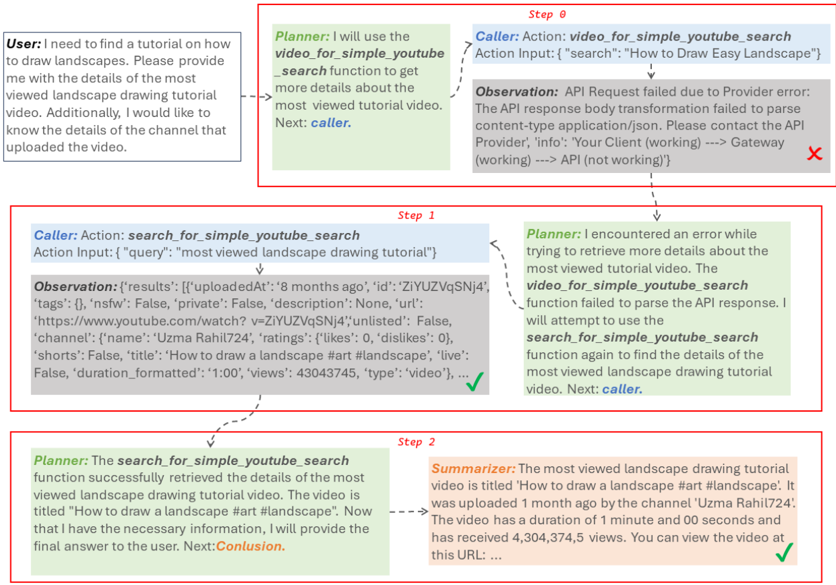
This flowchart illustrates a multi-step process for retrieving and summarizing details about the most viewed YouTube tutorial on landscape drawing. It includes error handling, API interactions, and data summarization.
### Components/Axes
- **Color-Coded Roles**:
- **Green**: Planner (strategic decision-making)
- **Blue**: Caller (executes actions)
- **Gray**: Observation (API responses/errors)
- **Arrows**: Indicate sequential flow between steps
- **Text Boxes**: Contain actions, observations, and summaries
### Detailed Analysis
#### Step 1: Initial Search
- **Planner Action**: Uses `video_for_simple_youtube_search` with query "most viewed landscape drawing tutorial"
- **Observation**: API error due to failed JSON parsing (content-type mismatch)
- **Retry**: Planner re-initiates search with same query
- **Successful Response**:
- Video: "How to draw a landscape #art #landscape"
- Uploaded: 8 months ago
- Channel: Uzma Rahil724
- Duration: 1:00
- Views: 430,437
- URL: `https://www.youtube.com/watch?v=ZiYUZVqSNj4`
#### Step 2: Summarization
- **Summarizer Output**:
- Title: "How to draw a landscape #art #landscape"
- Upload Date: 1 month ago (conflict with initial 8-month data)
- Channel: Uzma Rahil724
- Duration: 1:00
- Views: 430,374.5
- URL: Truncated link
#### Step 8: Conclusion
- Final answer provided to user with consolidated video details
### Key Observations
1. **Temporal Inconsistency**: Initial observation states video uploaded 8 months ago, but summarizer reports 1 month ago.
2. **View Count Discrepancy**: Observation shows 430,437 views vs. summarizer's 430,374.5 views.
3. **API Error Resolution**: System successfully retries after initial JSON parsing failure.
4. **Channel Consistency**: Channel name "Uzma Rahil724" appears in both successful and error responses.
### Interpretation
The flowchart demonstrates an automated system's ability to handle API errors and extract structured data from YouTube. The color-coding effectively separates roles (planner, caller, observer), while the arrows clarify decision points. The temporal and numerical inconsistencies suggest either:
1. API response timestamp drift
2. Rounding differences in view counts
3. Potential caching issues in the observation layer
The process highlights the importance of error resilience in data extraction pipelines and the need for timestamp validation in time-sensitive applications. The final summary successfully consolidates critical metadata despite initial API challenges, demonstrating robust information processing capabilities.