## Diagram: AI Agent Workflow with Iterative Reasoning
### Overview
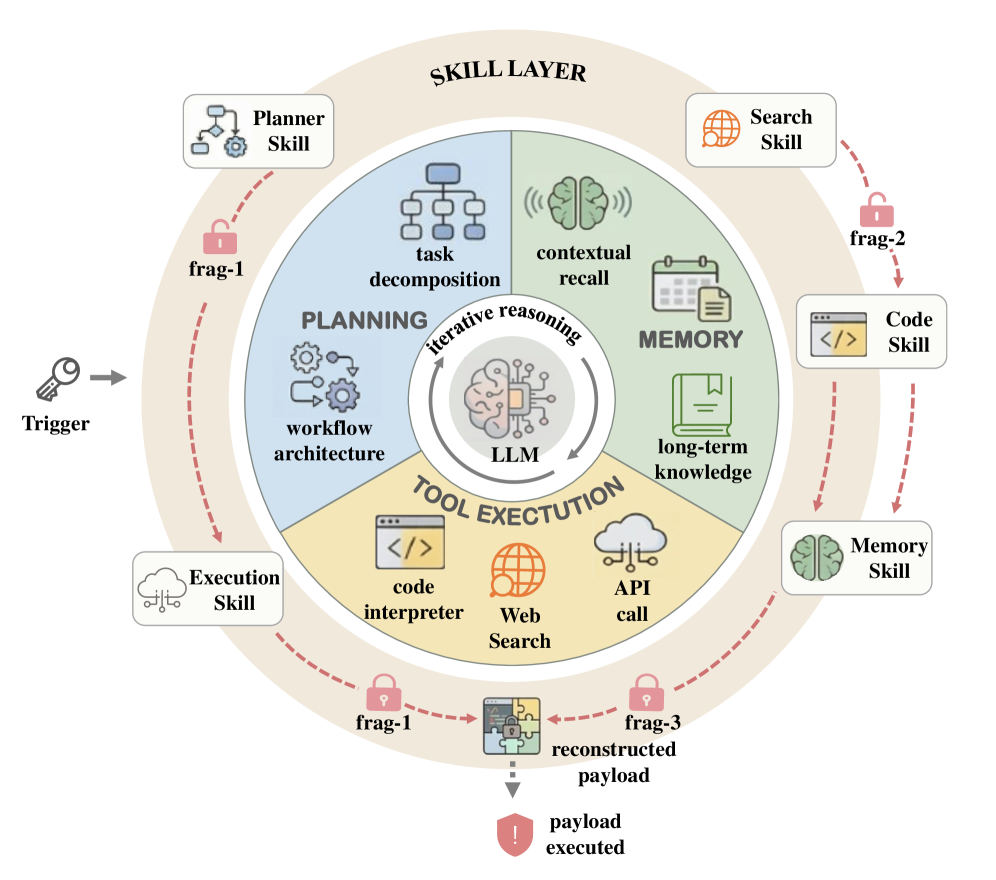
The diagram illustrates a cyclical AI agent workflow centered around an LLM (Large Language Model) with iterative reasoning. It integrates three core skill layers (Planning, Memory, Tool Execution) and an Execution Skill, connected by feedback loops and triggers. The process begins with a "Trigger" and concludes with a "payload executed" state, emphasizing dynamic interaction between components.
---
### Components/Axes
#### Labels and Sections:
1. **Skill Layer** (outermost circle):
- **Planning** (blue section):
- Task decomposition
- Workflow architecture
- **Memory** (green section):
- Contextual recall
- Long-term knowledge
- **Tool Execution** (orange section):
- Code interpreter
- Web search
- API call
- **Execution Skill** (cloud icon with raindrops).
2. **Central Component**:
- **Iterative reasoning** (gray circle with brain/neural network icon).
- **LLM** (central node).
3. **Arrows and Flow**:
- **Trigger** (left arrow) → Planner Skill → Task decomposition → Workflow architecture.
- **Frag-1** (red dashed arrow) → Iterative reasoning → Memory (contextual recall/long-term knowledge).
- **Frag-2** (red dashed arrow) → Code Skill → Memory.
- **Frag-3** (red dashed arrow) → Reconstructed payload → Payload executed (shield icon with exclamation mark).
4. **Other Elements**:
- **Search Skill** (magnifying glass icon).
- **Memory Skill** (brain icon).
---
### Detailed Analysis
#### Spatial Grounding:
- **Planning** (blue): Top-left quadrant, connected to task decomposition and workflow architecture.
- **Memory** (green): Top-right quadrant, linked to contextual recall and long-term knowledge.
- **Tool Execution** (orange): Bottom-center, housing code interpreter, web search, and API call.
- **Execution Skill**: Bottom-left, represented by a cloud icon.
- **Iterative reasoning** (LLM): Central node, surrounded by all skill layers.
- **Frag-1/Frag-2/Frag-3**: Red dashed arrows connecting components, indicating feedback loops.
#### Color Coding:
- **Blue**: Planning (task decomposition, workflow architecture).
- **Green**: Memory (contextual recall, long-term knowledge).
- **Orange**: Tool Execution (code interpreter, web search, API call).
- **Red**: Frag-1/Frag-2/Frag-3 (feedback loops).
- **Black**: Primary flow arrows (e.g., Trigger → Planner Skill).
---
### Key Observations
1. **Cyclical Process**: The workflow loops back to the LLM via Frag-1/Frag-2/Frag-3, enabling iterative refinement.
2. **Modular Skills**: Each skill layer (Planning, Memory, Tool Execution) operates independently but feeds into the central LLM.
3. **Execution Path**: The final state ("payload executed") is isolated at the bottom, suggesting a terminal output after iterative processing.
4. **Trigger Dependency**: The process initiates externally (Trigger) and relies on the Planner Skill for initial task breakdown.
---
### Interpretation
This diagram represents an AI agent architecture designed for adaptive problem-solving. The **LLM** acts as the core reasoning engine, integrating inputs from Planning (task decomposition), Memory (contextual/long-term knowledge), and Tool Execution (code/API interactions). Feedback loops (Frag-1/Frag-2/Frag-3) allow the system to refine its approach iteratively, mimicking human-like adaptability. The **Execution Skill** (cloud icon) likely represents external system integration, while the "payload executed" state signifies task completion. The use of color coding and spatial segmentation emphasizes modularity and flow, critical for debugging or optimizing such systems. The absence of numerical data suggests this is a conceptual model rather than a performance metric visualization.