## Line Chart: Volume vs. Number of Points
### Overview
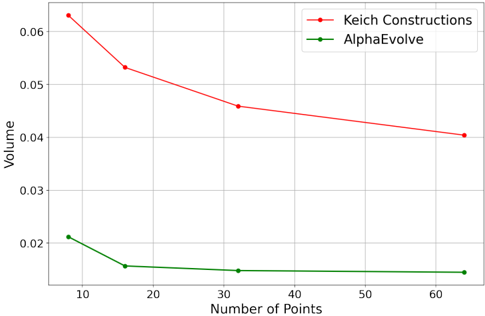
The image is a line chart comparing the volume of "Keich Constructions" and "AlphaEvolve" across different numbers of points. The x-axis represents the number of points, and the y-axis represents the volume. The chart displays how the volume changes for each method as the number of points increases.
### Components/Axes
* **Title:** There is no explicit title on the chart.
* **X-axis:** "Number of Points" with tick marks at 10, 20, 30, 40, 50, and 60.
* **Y-axis:** "Volume" with tick marks at 0.02, 0.03, 0.04, 0.05, and 0.06.
* **Legend:** Located in the top-right corner.
* Red line: "Keich Constructions"
* Green line: "AlphaEvolve"
### Detailed Analysis
* **Keich Constructions (Red Line):** The volume decreases as the number of points increases.
* At 10 points, the volume is approximately 0.063.
* At 20 points, the volume is approximately 0.053.
* At 30 points, the volume is approximately 0.046.
* At 63 points, the volume is approximately 0.040.
* **AlphaEvolve (Green Line):** The volume also decreases as the number of points increases, but the decrease is less pronounced than with Keich Constructions.
* At 10 points, the volume is approximately 0.021.
* At 20 points, the volume is approximately 0.016.
* At 30 points, the volume is approximately 0.015.
* At 63 points, the volume is approximately 0.014.
### Key Observations
* Both "Keich Constructions" and "AlphaEvolve" show a decrease in volume as the number of points increases.
* "Keich Constructions" has a higher volume than "AlphaEvolve" across all data points.
* The volume of "Keich Constructions" decreases more rapidly than "AlphaEvolve" as the number of points increases.
* The "AlphaEvolve" line flattens out significantly after 20 points, indicating that increasing the number of points beyond this value has a minimal impact on volume.
### Interpretation
The chart suggests that increasing the number of points reduces the volume for both "Keich Constructions" and "AlphaEvolve." However, "AlphaEvolve" appears to be more stable, with a smaller decrease in volume as the number of points increases. This could indicate that "AlphaEvolve" is more efficient or robust in handling a larger number of points compared to "Keich Constructions." The flattening of the "AlphaEvolve" line suggests a point of diminishing returns, where increasing the number of points provides little additional benefit in terms of volume reduction.