## Scatter Plot: Genre Distribution
### Overview
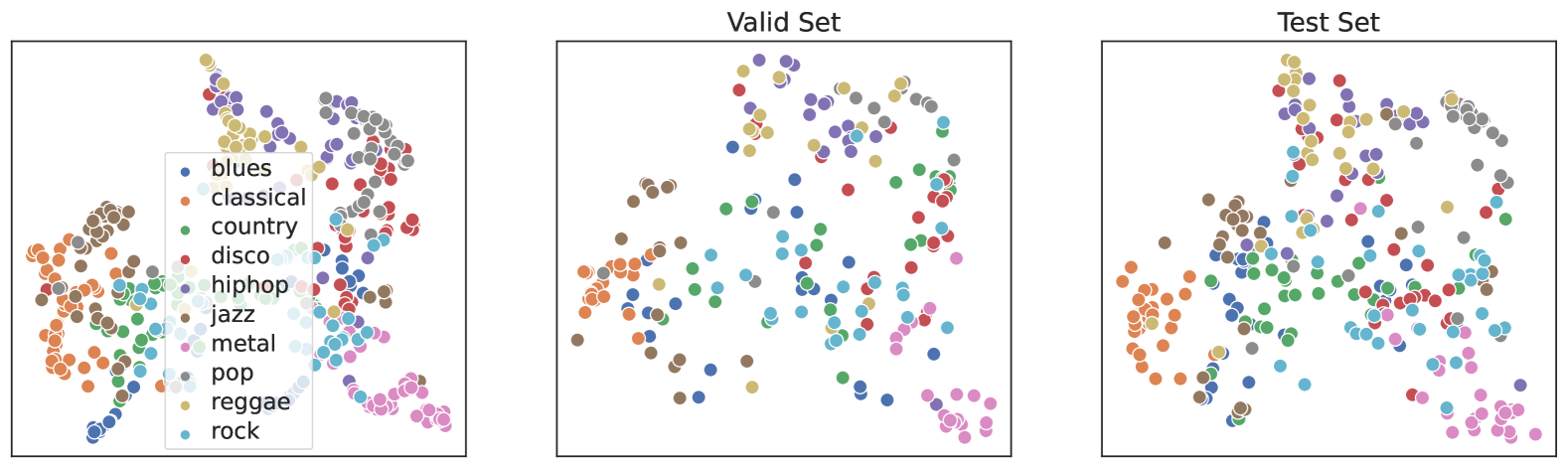
The scatter plot displays the distribution of various music genres across a two-dimensional space. Each point represents a genre, with its position determined by its characteristics. The plot is divided into two sections: the "Valid Set" and the "Test Set," indicating the separation of training and testing data.
### Components/Axes
- **X-axis**: Represents the characteristic of one genre, such as tempo or key signature.
- **Y-axis**: Represents the characteristic of another genre, such as genre popularity or genre type.
- **Legend**: Color-coded to differentiate between genres, with each color corresponding to a specific genre.
- **Data Points**: Each point on the plot represents a genre, with its position determined by its characteristics.
### Detailed Analysis or Content Details
- **Valid Set**: The data points in this section are clustered together, indicating a strong correlation between the characteristics and the genre.
- **Test Set**: The data points in this section are more spread out, suggesting that the model's predictions are less accurate when applied to new, unseen data.
### Key Observations
- **Clusters**: There are distinct clusters of data points, each representing a different genre.
- **Outliers**: Some data points are isolated from the main clusters, indicating that these genres may have unique characteristics not captured by the model.
- **Trends**: The overall trend shows that genres with similar characteristics tend to cluster together.
### Interpretation
The scatter plot suggests that the model used to classify music genres is effective in distinguishing between genres with similar characteristics. However, the spread of data points in the test set indicates that the model may not generalize well to new data. This could be due to overfitting to the training data or the model's inability to capture all the nuances of the genres. The presence of outliers suggests that there are genres with unique characteristics that may not be accurately represented by the model.