\n
## Diagram: Celestial Metaphors for Human-AI Collaboration
### Overview
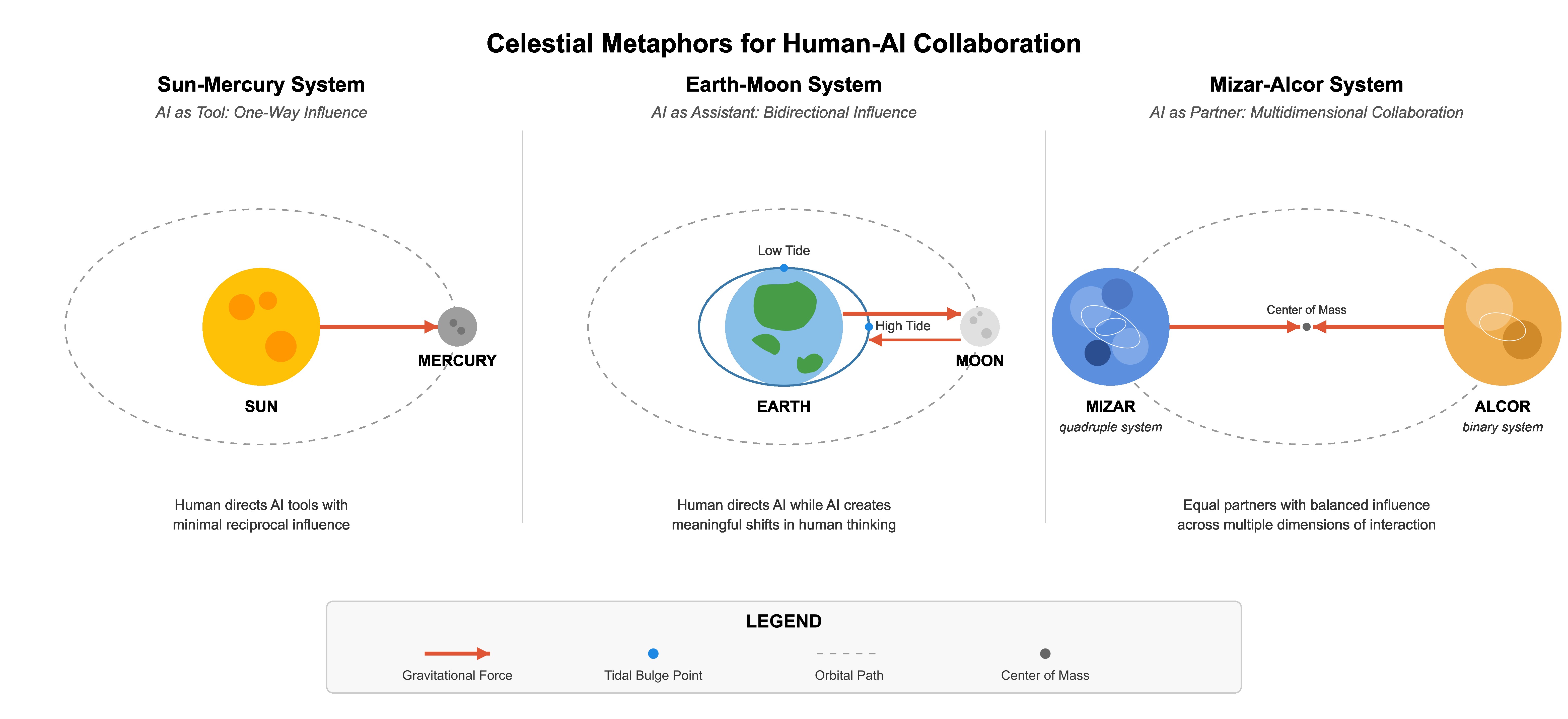
The image is a diagram illustrating three celestial systems – Sun-Mercury, Earth-Moon, and Mizar-Alcor – as metaphors for different levels of human-AI collaboration. Each system represents a distinct relationship between humans and AI, ranging from one-way influence to multidimensional collaboration. The diagram uses orbital paths, gravitational forces, and centers of mass to visually represent these relationships.
### Components/Axes
The diagram is divided into three main sections, each representing a celestial system. Each section includes:
* **Celestial Bodies:** Sun, Mercury, Earth, Moon, Mizar, Alcor.
* **Orbital Paths:** Dashed gray lines indicating the orbits of the planets/moon.
* **Gravitational Force:** Represented by red arrows.
* **Tidal Bulge Points:** Represented by blue circles.
* **Center of Mass:** Represented by black circles.
* **Descriptive Text:** Explaining the metaphor for each system.
* **Legend:** Located at the bottom, defining the symbols used.
The legend contains the following entries:
* Gravitational Force (Red)
* Tidal Bulge Point (Blue)
* Orbital Path (Gray)
* Center of Mass (Black)
### Detailed Analysis or Content Details
**1. Sun-Mercury System (AI as Tool: One-Way Influence)**
* The Sun (large yellow sphere) is positioned on the left.
* Mercury (small yellow sphere) orbits the Sun in a dashed gray orbital path.
* A red arrow representing gravitational force points from the Sun towards Mercury.
* Text: "Human directs AI tools with minimal reciprocal influence."
* Text: "AI as Tool: One-Way Influence"
**2. Earth-Moon System (AI as Assistant: Bidirectional Influence)**
* The Earth (large blue and green sphere) is positioned in the center.
* The Moon (small gray sphere) orbits the Earth in a dashed gray orbital path.
* A red arrow representing gravitational force points from the Earth towards the Moon.
* Two blue circles representing tidal bulge points are shown on the Earth, one on the side facing the Moon ("High Tide") and one on the opposite side ("Low Tide").
* Text: "Human directs AI while AI creates meaningful shifts in human thinking."
* Text: "AI as Assistant: Bidirectional Influence"
**3. Mizar-Alcor System (AI as Partner: Multidimensional Collaboration)**
* Mizar (yellow sphere) and Alcor (yellow sphere) are positioned on the right.
* A black circle representing the center of mass is located between Mizar and Alcor.
* Text: "Equal partners with balanced influence across multiple dimensions of interaction."
* Text: "AI as Partner: Multidimensional Collaboration"
* Text: "Mizar quadruple system"
* Text: "Alcor binary system"
### Key Observations
* The diagram uses increasing complexity in the celestial systems to represent increasing levels of AI collaboration.
* The Sun-Mercury system demonstrates a clear power dynamic with the Sun (human) exerting influence on Mercury (AI).
* The Earth-Moon system shows a bidirectional influence, with the Moon (AI) affecting the Earth (human) through tidal forces.
* The Mizar-Alcor system represents a balanced partnership with a shared center of mass.
* The legend clearly defines the visual elements used in the diagram.
### Interpretation
The diagram presents a compelling analogy between celestial mechanics and human-AI collaboration. It suggests that the relationship between humans and AI can evolve from a simple tool-user dynamic (Sun-Mercury) to a more complex and balanced partnership (Mizar-Alcor). The use of gravitational force and centers of mass effectively illustrates the concepts of influence and shared control. The Earth-Moon system highlights the potential for AI to not only be directed by humans but also to influence human thought processes. The diagram implies that the ideal future of human-AI interaction lies in a collaborative partnership where both parties contribute equally and benefit from the relationship. The choice of celestial bodies and their interactions is a deliberate attempt to convey these abstract concepts in a visually intuitive manner. The diagram is not presenting data, but rather a conceptual framework for understanding the evolving relationship between humans and AI.