## Diagram: Celestial Metaphors for Human-AI Collaboration
### Overview
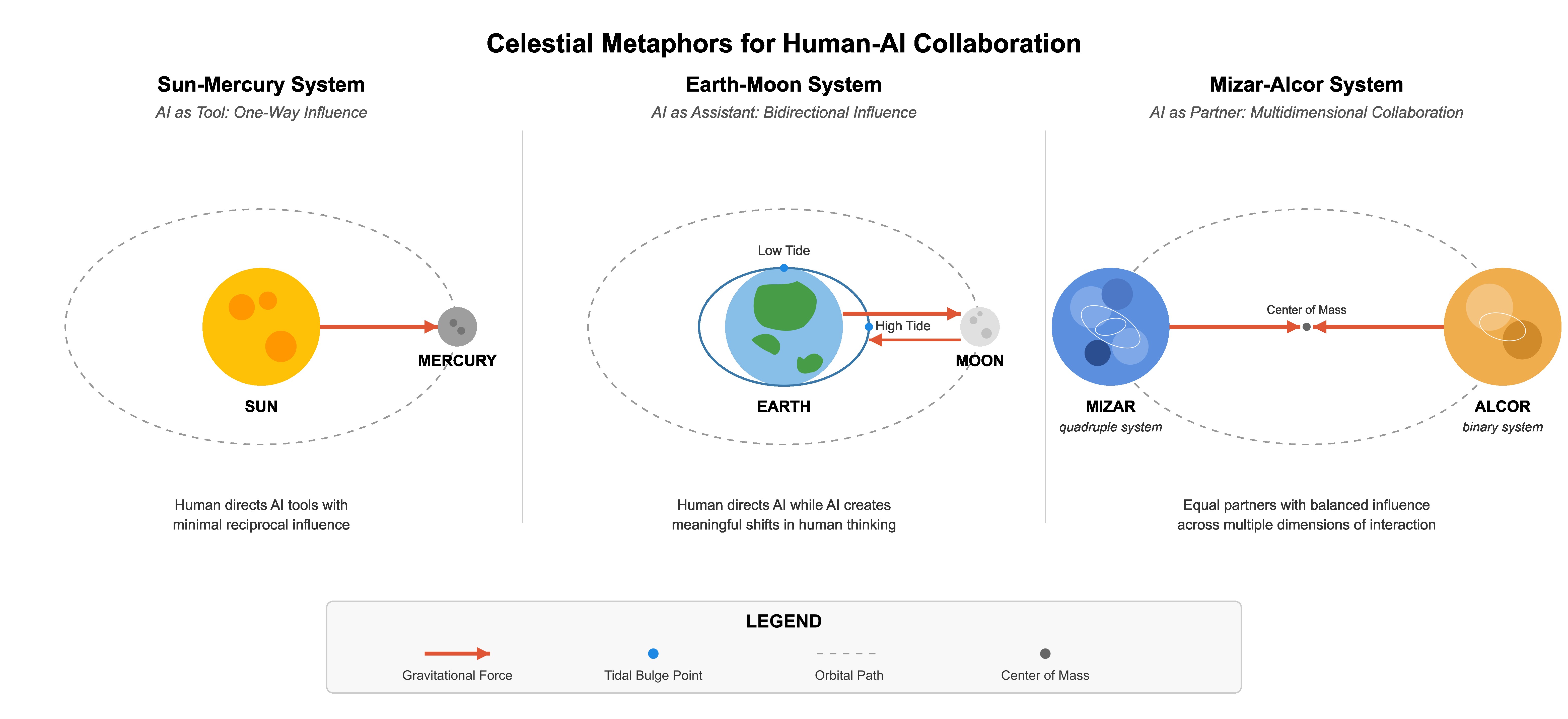
The image presents three celestial systems as metaphors for human-AI collaboration models:
1. **Sun-Mercury System** (AI as Tool: One-Way Influence)
2. **Earth-Moon System** (AI as Assistant: Bidirectional Influence)
3. **Mizar-Alcor System** (AI as Partner: Multidimensional Collaboration)
Each system includes labeled celestial bodies, directional forces, and symbolic annotations. A legend at the bottom defines visual elements (arrows, dots, lines).
---
### Components/Axes
#### Legend (Bottom Center)
- **Gravitational Force**: Red arrow (→)
- **Tidal Bulge Point**: Blue dot (•)
- **Orbital Path**: Dashed gray line (↑↓)
- **Center of Mass**: Gray dot (•)
#### System-Specific Labels
1. **Sun-Mercury System**
- **SUN**: Yellow circle with orange spots (center-left)
- **MERCURY**: Gray circle (right of SUN)
- **Text**: "Human directs AI tools with minimal reciprocal influence"
2. **Earth-Moon System**
- **EARTH**: Blue circle with green landmasses (center)
- **MOON**: Gray circle (right of EARTH)
- **Tidal Labels**:
- "Low Tide" (blue dot above EARTH)
- "High Tide" (blue dot near MOON)
- **Text**: "Human directs AI while AI creates meaningful shifts in human thinking"
3. **Mizar-Alcor System**
- **MIZAR**: Blue circle with concentric white ellipses (left)
- **ALCOR**: Orange circle with concentric brown ellipses (right)
- **Center of Mass**: Gray dot (midpoint between MIZAR and ALCOR)
- **Text**: "Equal partners with balanced influence across multiple dimensions of interaction"
---
### Detailed Analysis
#### Sun-Mercury System
- **Gravitational Force**: Red arrow points from SUN to MERCURY, emphasizing one-way dominance.
- **Orbital Path**: Dashed line encircles SUN, suggesting Mercury’s orbit.
- **Key Text**: "AI as Tool: One-Way Influence" implies AI operates under human control without reciprocal impact.
#### Earth-Moon System
- **Gravitational Force**: Red arrow points from EARTH to MOON, with tidal bulges indicating bidirectional interaction.
- **Tidal Bulge Points**: Blue dots show Earth’s tidal deformation caused by the Moon’s gravity.
- **Key Text**: "AI as Assistant: Bidirectional Influence" reflects mutual adaptation between human and AI.
#### Mizar-Alcor System
- **Center of Mass**: Gray dot lies between MIZAR and ALCOR, indicating shared gravitational equilibrium.
- **Orbital Path**: Dashed line connects MIZAR and ALCOR, forming a binary system.
- **Key Text**: "AI as Partner: Multidimensional Collaboration" suggests AI and humans co-evolve across diverse domains.
---
### Key Observations
1. **Directionality**:
- Sun-Mercury: Unidirectional influence (red arrow).
- Earth-Moon: Bidirectional influence (tidal bulges and arrows).
- Mizar-Alcor: Balanced equilibrium (center of mass).
2. **Complexity**:
- Mizar-Alcor’s "quadruple system" (MIZAR’s ellipses) vs. ALCOR’s "binary system" (ALCOR’s ellipses) implies layered collaboration models.
3. **Visual Hierarchy**:
- Larger celestial bodies (SUN, EARTH) dominate their systems, symbolizing human primacy in early AI models.
- Smaller bodies (MERCURY, MOON) represent AI’s growing autonomy.
---
### Interpretation
The metaphors illustrate evolving AI collaboration paradigms:
1. **AI as Tool**: Sun-Mercury reflects early-stage AI, where humans dictate AI’s role with minimal feedback.
2. **AI as Assistant**: Earth-Moon highlights iterative interaction, where AI influences human decisions (e.g., tidal shifts).
3. **AI as Partner**: Mizar-Alcor depicts co-evolution, with AI and humans sharing influence across multiple dimensions (e.g., scientific, ethical, creative).
The diagrams emphasize progression from hierarchical control to symbiotic collaboration, mirroring advancements in AI’s integration into human workflows. The tidal bulges and center of mass visually reinforce the shift from one-way dependency to mutual adaptation.