\n
## Diagram: Social Network/Interaction Flow
### Overview
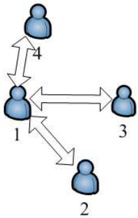
The image depicts a diagram representing a network of four individuals (labeled 1 through 4) and the interactions between them, indicated by arrows. The diagram appears to illustrate a flow of information or influence within the network.
### Components/Axes
The diagram consists of four circular nodes representing individuals, numbered 1, 2, 3, and 4. Arrows connect these nodes, indicating the direction of interaction. There are no explicit axes or scales.
### Detailed Analysis or Content Details
* **Node 1:** Connected to nodes 3 and 2 with arrows pointing *from* node 1. Also connected to node 4 with an arrow pointing *to* node 1.
* **Node 2:** Receives an arrow *from* node 1.
* **Node 3:** Receives an arrow *from* node 1 and sends an arrow *to* node 1.
* **Node 4:** Sends an arrow *to* node 1.
The arrows are not uniform in style. The arrows connecting 1 to 3 and 1 to 2 are solid lines. The arrows connecting 4 to 1 and 1 to 2 are dashed lines.
### Key Observations
Node 1 appears to be a central hub in this network, receiving input from node 4 and distributing information to nodes 2 and 3. The use of dashed lines for some connections suggests a different type or strength of relationship compared to the solid line connections.
### Interpretation
This diagram likely represents a simplified model of social interactions or information flow. Node 1 could be a key influencer or communicator, while nodes 2, 3, and 4 represent individuals who interact with this central figure. The solid and dashed lines could indicate the strength or type of relationship (e.g., strong vs. weak ties, formal vs. informal communication). The diagram suggests a non-symmetrical flow of information, with node 1 playing a disproportionately important role. Without further context, it's difficult to determine the specific nature of these interactions, but the diagram provides a visual representation of network structure and potential influence patterns.