\n
## Diagram: Reaction Mechanism - R3 Series
### Overview
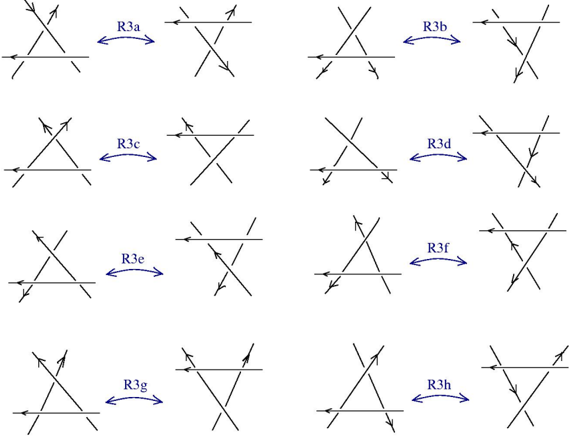
The image depicts a series of chemical reaction steps, labeled R3a through R3h. Each step shows a transformation of a molecule represented by lines and diagonal lines with arrowheads, indicating bond changes. The diagram illustrates a reaction mechanism, likely involving a cyclic transition state.
### Components/Axes
The diagram consists of eight pairs of molecular structures. Each pair is connected by a blue, bidirectional arrow labeled with "R3" followed by a letter (a-h). The structures within each pair represent the reactant and product of a single reaction step. There are no explicit axes or scales. The diagram is arranged in a 4x2 grid.
### Detailed Analysis or Content Details
Each reaction step can be described as follows:
* **R3a:** The initial structure has a horizontal line with a diagonal line crossing it from the top-left to the bottom-right, and another diagonal line crossing from the top-right to the bottom-left. Arrowheads are present on both diagonal lines pointing outwards. The product has the same horizontal line, but the diagonal lines have swapped positions and the arrowheads are now pointing inwards.
* **R3b:** The initial structure has a horizontal line with a diagonal line crossing it from the top-left to the bottom-right, and another diagonal line crossing from the top-right to the bottom-left. Arrowheads are present on both diagonal lines pointing outwards. The product has the same horizontal line, but the diagonal lines have swapped positions and the arrowheads are now pointing inwards.
* **R3c:** The initial structure has a horizontal line with a diagonal line crossing it from the top-left to the bottom-right, and another diagonal line crossing from the top-right to the bottom-left. Arrowheads are present on both diagonal lines pointing outwards. The product has the same horizontal line, but the diagonal lines have swapped positions and the arrowheads are now pointing inwards.
* **R3d:** The initial structure has a horizontal line with a diagonal line crossing it from the top-left to the bottom-right, and another diagonal line crossing from the top-right to the bottom-left. Arrowheads are present on both diagonal lines pointing outwards. The product has the same horizontal line, but the diagonal lines have swapped positions and the arrowheads are now pointing inwards.
* **R3e:** The initial structure has a horizontal line with a diagonal line crossing it from the top-left to the bottom-right, and another diagonal line crossing from the top-right to the bottom-left. Arrowheads are present on both diagonal lines pointing outwards. The product has the same horizontal line, but the diagonal lines have swapped positions and the arrowheads are now pointing inwards.
* **R3f:** The initial structure has a horizontal line with a diagonal line crossing it from the top-left to the bottom-right, and another diagonal line crossing from the top-right to the bottom-left. Arrowheads are present on both diagonal lines pointing outwards. The product has the same horizontal line, but the diagonal lines have swapped positions and the arrowheads are now pointing inwards.
* **R3g:** The initial structure has a horizontal line with a diagonal line crossing it from the top-left to the bottom-right, and another diagonal line crossing from the top-right to the bottom-left. Arrowheads are present on both diagonal lines pointing outwards. The product has the same horizontal line, but the diagonal lines have swapped positions and the arrowheads are now pointing inwards.
* **R3h:** The initial structure has a horizontal line with a diagonal line crossing it from the top-left to the bottom-right, and another diagonal line crossing from the top-right to the bottom-left. Arrowheads are present on both diagonal lines pointing outwards. The product has the same horizontal line, but the diagonal lines have swapped positions and the arrowheads are now pointing inwards.
All reactions appear to be identical in terms of structural change.
### Key Observations
The diagram shows a series of eight identical reaction steps (R3a-R3h). Each step involves a rearrangement of the diagonal lines and a reversal of the direction of the arrowheads. This suggests a reversible reaction or a series of steps within a larger cyclic process.
### Interpretation
The diagram likely represents a series of concerted, reversible steps in a chemical reaction mechanism. The consistent transformation across all R3 steps suggests a repeating motif or a series of equivalent transition states. The arrowheads indicate the direction of electron flow or bond formation/breaking. The overall process could be part of a larger catalytic cycle or a series of equilibrium reactions. Without further context, it's difficult to determine the specific chemical reaction being depicted, but the diagram clearly illustrates a mechanistic pathway involving a structural rearrangement. The repetition of the same transformation in each step suggests a highly ordered and potentially efficient process.