\n
## Textual Document: Logical Fallacy Examples
### Overview
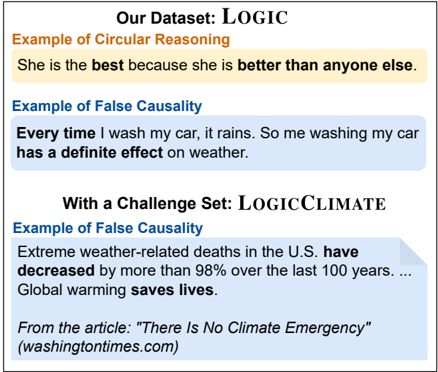
The image presents a document outlining examples of logical fallacies, categorized under the dataset "LOGIC" and a challenge set "LOGICCLIMATE". It showcases instances of circular reasoning and false causality, with a specific example related to climate change. The document appears to be a teaching or illustrative material.
### Components/Axes
The document is divided into three main sections, each highlighting a different logical fallacy. Each section has a title indicating the fallacy type, followed by an example statement. A source is cited for the final example.
### Detailed Analysis or Content Details
**Section 1: Example of Circular Reasoning**
* **Title:** "Example of Circular Reasoning" (Top-left, orange background)
* **Statement:** "She is the best because she is better than anyone else." (Black text on orange background)
**Section 2: Example of False Causality**
* **Title:** "Example of False Causality" (Center, red background)
* **Statement:** "Every time I wash my car, it rains. So me washing my car has a definite effect on weather." (Black text on red background)
**Section 3: With a Challenge Set: LOGICCLIMATE**
* **Title:** "With a Challenge Set: LOGICCLIMATE" (Bottom-left, blue background)
* **Sub-Title:** "Example of False Causality" (Blue background)
* **Statement:** "Extreme weather-related deaths in the U.S. have decreased by more than 98% over the last 100 years… Global warming saves lives." (Black text on blue background)
* **Source:** "From the article: “There Is No Climate Emergency” (washingtontimes.com)" (Small font, bottom-right, black text on blue background)
### Key Observations
The document focuses on demonstrating logical fallacies through simple, relatable examples. The inclusion of "LOGICCLIMATE" suggests a specific focus on identifying fallacies within climate change discourse. The final example is presented as a statement taken from an external source, indicating a potential critique of that source's reasoning. The statement regarding climate change is particularly noteworthy as it presents a counterintuitive claim ("Global warming saves lives") based on a statistical observation.
### Interpretation
The document serves as an educational tool to illustrate common errors in reasoning. The examples are deliberately simplistic to highlight the flawed logic. The "LOGICCLIMATE" section suggests an attempt to apply these critical thinking skills to a complex and often emotionally charged topic. The example provided in this section is a clear instance of false causality – correlating a decrease in weather-related deaths with global warming does not establish a causal relationship. It's likely the decrease in deaths is due to improvements in infrastructure, warning systems, and emergency response, rather than a direct benefit of global warming. The citation of "washingtontimes.com" implies a critical stance towards the arguments presented in that publication. The document encourages readers to identify and challenge flawed reasoning, particularly in the context of public discourse.