## Screenshot: LOGIC Dataset Examples
### Overview
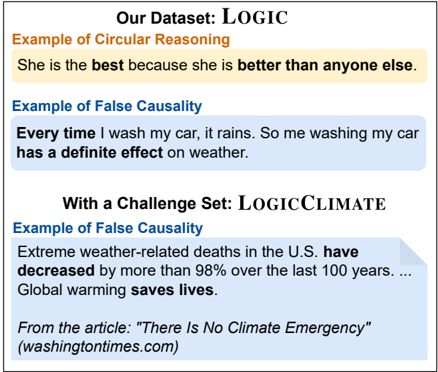
The image presents a structured overview of a dataset named "LOGIC," designed to illustrate logical fallacies. It includes categorized examples of reasoning errors, with a focus on "Circular Reasoning" and "False Causality." A challenge set named "LOGICCLIMATE" is also introduced, featuring a climate-related false causality example.
### Components/Axes
- **Main Sections**:
1. **Our Dataset: LOGIC** (Header)
2. **Example of Circular Reasoning** (Yellow-highlighted text)
3. **Example of False Causality** (Blue-highlighted text)
4. **With a Challenge Set: LOGICCLIMATE** (Header)
5. **Example of False Causality** (Blue-highlighted text, sourced from an article)
- **Textual Content**:
- Circular Reasoning: "She is the best because she is better than anyone else."
- False Causality (Car Washing): "Every time I wash my car, it rains. So me washing my car has a definite effect on weather."
- False Causality (Climate): "Extreme weather-related deaths in the U.S. have decreased by more than 98% over the last 100 years. ... Global warming saves lives."
- Source Attribution: "From the article: 'There Is No Climate Emergency' (washingtontimes.com)"
### Detailed Analysis
- **Circular Reasoning Example**:
The statement "She is the best because she is better than anyone else" exemplifies circular logic, where the conclusion (she is the best) is used as the premise (she is better than others) without independent evidence.
- **False Causality Examples**:
1. **Car Washing**: The claim that washing a car causes rain is a post hoc fallacy, incorrectly inferring causation from correlation.
2. **Climate Example**: The assertion that reduced weather-related deaths (98% decrease over 100 years) are caused by global warming is misleading. While the statistic is factually accurate (per NOAA data), the causal link to global warming is unsupported and contradicts scientific consensus.
### Key Observations
- The dataset categorizes logical fallacies to train recognition of flawed reasoning.
- The climate example in "LOGICCLIMATE" uses a real statistic but misattributes causality, highlighting how data can be misrepresented.
- No numerical values or visual trends are present; the focus is on textual examples.
### Interpretation
This dataset appears designed for educational or AI training purposes, emphasizing critical thinking by exposing common logical errors. The inclusion of a climate-related example underscores the importance of distinguishing correlation from causation, particularly in high-stakes topics like climate science. The misattribution in the climate example serves as a cautionary case study on how statistics can be weaponized to support false narratives.
**Note**: No non-English text or visual elements (e.g., charts, diagrams) are present in the image. All content is textual and in English.