## Composite Image Analysis: Pong Simulation and Neural Activity
### Overview
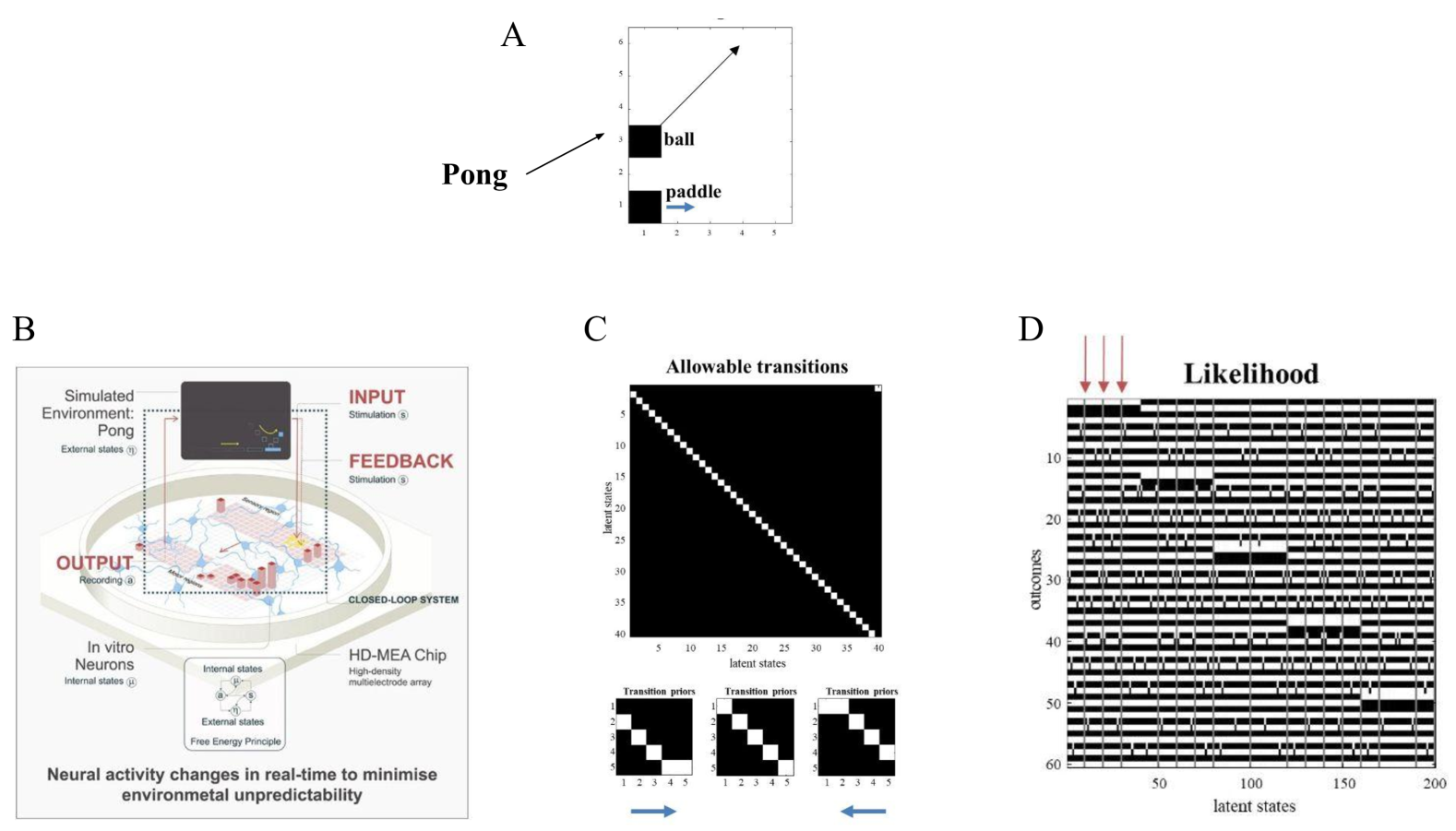
The image is a composite figure containing four sub-figures (A, B, C, and D) related to a Pong simulation and its connection to neural activity. Sub-figure A shows a simplified Pong game representation. Sub-figure B illustrates a closed-loop system involving a simulated Pong environment interacting with in-vitro neurons via an HD-MEA chip. Sub-figure C displays allowable state transitions. Sub-figure D shows a likelihood matrix.
### Components/Axes
**Sub-figure A: Pong Game Representation**
* **Labels:** "Pong", "ball", "paddle"
* **Axes:** X-axis ranges from 1 to 5, Y-axis ranges from 1 to 6.
* The "ball" is located at approximately (1, 4) and is moving towards the top-right.
* The "paddle" is located at approximately (1, 1) and is moving to the right.
**Sub-figure B: Closed-Loop System Diagram**
* **Components:**
* "Simulated Environment: Pong" with "External states"
* "INPUT" with "Stimulation (s)"
* "FEEDBACK" with "Stimulation (s)"
* "OUTPUT" with "Recording (a)"
* "In vitro Neurons" with "Internal states"
* "HD-MEA Chip" (High-density multielectrode array)
* "Internal states" and "External states" connected by "Free Energy Principle"
* "CLOSED-LOOP SYSTEM" label encompassing the entire diagram.
* **Text:** "Neural activity changes in real-time to minimise environmetal unpredictability"
**Sub-figure C: Allowable Transitions**
* **Title:** "Allowable transitions"
* **Axes:** Both X and Y axes are labeled "latent states" and range from 5 to 40 in increments of 5.
* The main plot shows a diagonal line of black squares on a white background, indicating allowed transitions between adjacent states.
* Three smaller plots labeled "Transition priors" show 5x5 matrices with a diagonal of black squares. Arrows below the plots indicate a direction.
**Sub-figure D: Likelihood Matrix**
* **Title:** "Likelihood"
* **Axes:**
* X-axis: "latent states" ranging from 50 to 200 in increments of 50.
* Y-axis: "outcomes" ranging from 10 to 60 in increments of 10.
* The plot displays a black and white matrix, where black represents high likelihood and white represents low likelihood. Three red arrows point to the top of the matrix.
### Detailed Analysis or Content Details
**Sub-figure A:**
* The Pong game is highly simplified, showing only the ball and paddle positions.
* The ball's trajectory suggests an upward and rightward movement.
* The paddle's movement is indicated by an arrow pointing to the right.
**Sub-figure B:**
* The diagram illustrates a closed-loop system where the simulated Pong environment provides input to in-vitro neurons via stimulation.
* The neural activity is recorded and used as feedback to influence the Pong simulation.
* The HD-MEA chip serves as the interface between the simulated environment and the biological neurons.
* The "Free Energy Principle" connects the internal and external states.
**Sub-figure C:**
* The diagonal line in the main plot indicates that transitions are only allowed between adjacent latent states.
* The "Transition priors" plots show the prior probabilities of transitioning between states.
**Sub-figure D:**
* The likelihood matrix shows the probability of observing different outcomes given different latent states.
* The pattern suggests that certain latent states are more likely to produce specific outcomes.
* The red arrows at the top indicate specific latent states.
### Key Observations
* The image presents a system that integrates a simulated environment (Pong) with biological neurons.
* The closed-loop architecture allows for real-time interaction between the simulation and the neural activity.
* The allowable transitions and likelihood matrix provide insights into the dynamics of the system.
### Interpretation
The image illustrates an attempt to model and understand neural activity by connecting it to a simple, controllable environment (Pong). The closed-loop system allows researchers to observe how neural activity changes in response to environmental stimuli and how these changes, in turn, affect the environment. The "Free Energy Principle" suggests a theoretical framework for understanding how the system minimizes environmental unpredictability. The allowable transitions and likelihood matrix provide a quantitative representation of the system's dynamics, allowing for further analysis and modeling. The overall goal appears to be to gain a deeper understanding of how neural systems adapt and learn in response to external stimuli.