## Diagram: Neural System for Pong Game Simulation and Outcome Prediction
### Overview
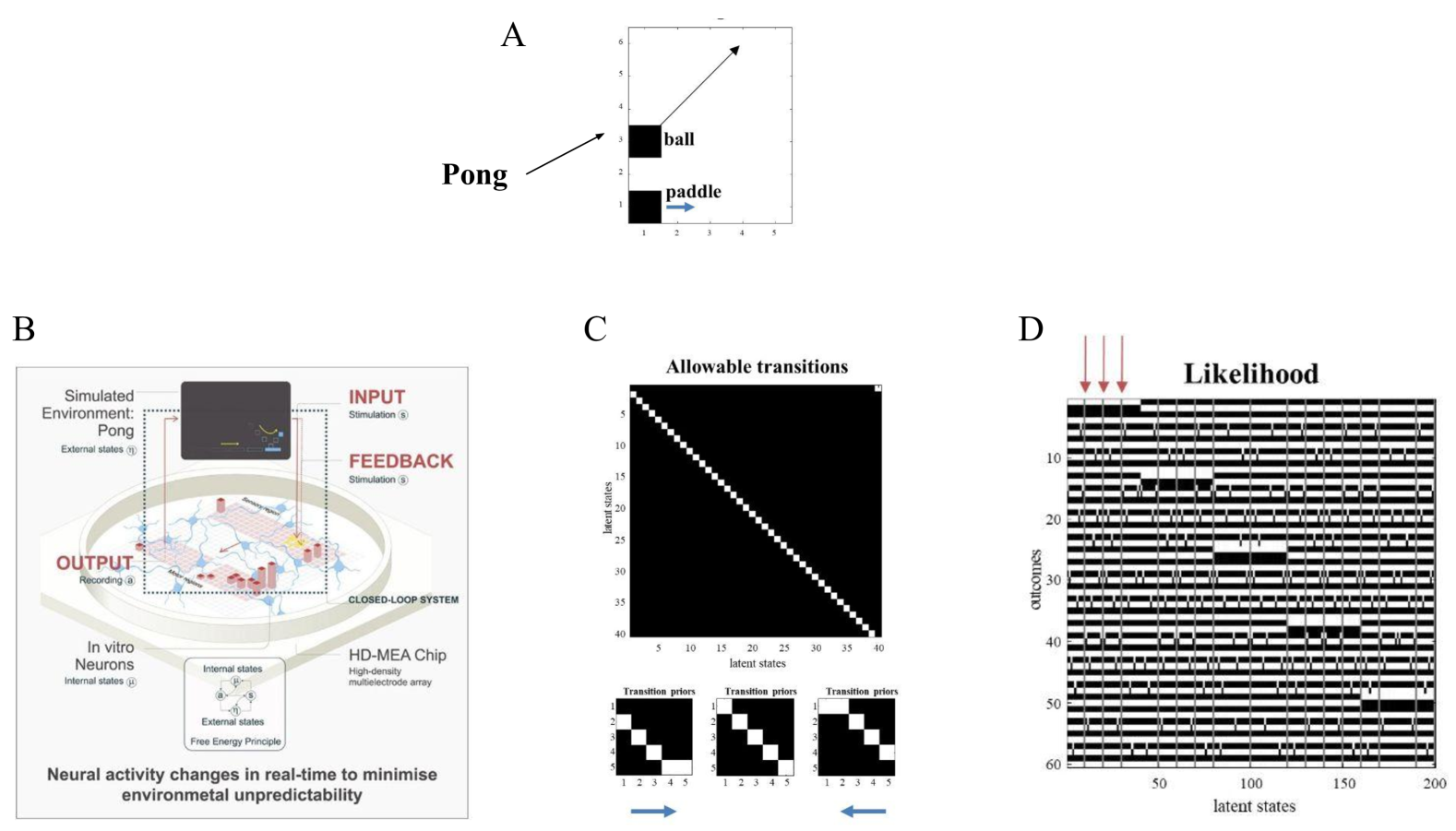
The image comprises four interconnected sections (A-D) illustrating a neural system designed to simulate a pong game and predict outcomes. Section A depicts the game environment, while B-D detail neural processing components, state transitions, and likelihood distributions.
---
### Components/Axes
#### Section A: Pong Game Environment
- **Labels**:
- "Pong" (title)
- "ball" (black square at (3,2))
- "paddle" (black square at (2,1))
- **Axes**:
- X-axis: 1–5 (horizontal)
- Y-axis: 1–6 (vertical)
- **Arrows**:
- Blue arrow from paddle (2,1) to ball (3,2), indicating movement direction.
#### Section B: Neural System Architecture
- **Labels**:
- "Simulated Environment: Pong"
- "INPUT" (red text)
- "FEEDBACK" (red text)
- "OUTPUT" (red text)
- "In vitro Neurons"
- "HD-MEA Chip" (High-density multielectrode array)
- "Closed-loop system"
- **Components**:
- Circular diagram with red/pink nodes (neurons) and blue pathways (connections).
- Feedback loop connecting HD-MEA chip to input/output.
- Text: "Neural activity changes in real-time to minimise environmental unpredictability."
#### Section C: Allowable Transitions
- **Matrix**:
- 5x5 grid labeled "Allowable transitions."
- Diagonal white squares (self-transitions) and sparse off-diagonal squares.
- **Transition Priors**:
- Three smaller matrices below the main grid, showing varying transition probabilities (e.g., diagonal dominance, sparse off-diagonal entries).
- **Arrows**:
- Blue arrows pointing left/right between matrices, suggesting directional flow.
#### Section D: Likelihood Heatmap
- **Axes**:
- X-axis: "latent states" (1–200)
- Y-axis: "outcomes" (10–60)
- **Heatmap**:
- Horizontal black/white bars indicating likelihood distributions.
- Red arrows pointing to high-likelihood regions (e.g., outcomes 30–40, latent states 50–100).
---
### Detailed Analysis
#### Section A
- Ball and paddle positions suggest a simplified 2D game state. The arrow implies the paddle's movement influences the ball's trajectory.
#### Section B
- The HD-MEA chip interfaces with neurons to process input (game state) and feedback (sensorimotor signals). The closed-loop system emphasizes real-time adaptation to minimize unpredictability.
#### Section C
- The main matrix shows strict self-transitions (diagonal), while transition priors introduce probabilistic state changes. For example:
- First prior: Diagonal + (1→2, 2→3).
- Second prior: Diagonal + (1→3, 3→4).
- Third prior: Diagonal + (1→4, 4→5).
#### Section D
- High-likelihood regions (marked by red arrows) cluster around outcomes 30–40 and latent states 50–100, suggesting predictable outcomes in this parameter range.
---
### Key Observations
1. **Section A**: Minimalist game representation; no explicit rules or scoring.
2. **Section B**: Feedback loops and high-density electrodes imply advanced neural monitoring.
3. **Section C**: Transition matrices prioritize self-states but allow limited probabilistic jumps.
4. **Section D**: Likelihood peaks in mid-outcome ranges, indicating optimal neural predictions for these states.
---
### Interpretation
The system integrates pong gameplay (A) with neural processing (B) to model state transitions (C) and predict outcomes (D). The closed-loop architecture (B) enables adaptive learning, while the transition matrices (C) constrain state changes to biologically plausible patterns. The likelihood heatmap (D) reveals that outcomes 30–40 are most predictable, likely due to stable neural activity in latent states 50–100. This suggests the system balances exploration (via sparse transitions) and exploitation (via high-likelihood regions) to optimize gameplay strategies.