\n
## Diagram: Logical Reasoning with Fox Coat Color
### Overview
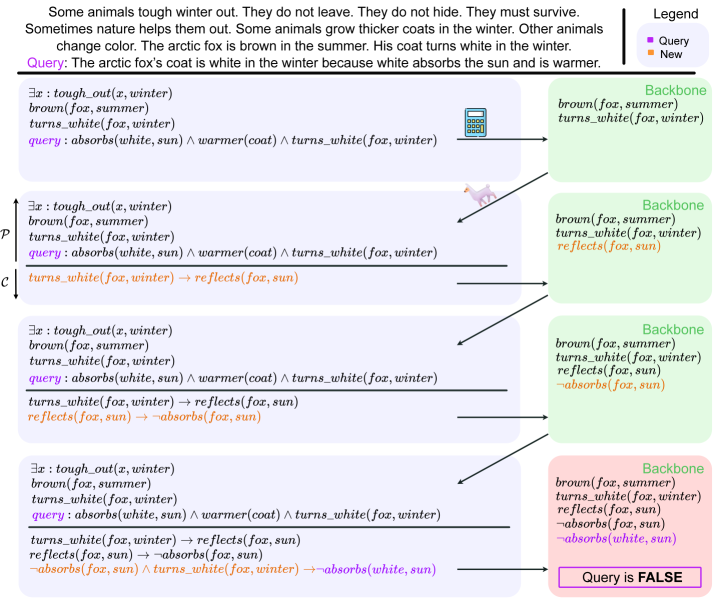
The image presents a diagram illustrating a logical reasoning process related to the color change of a fox's coat. It appears to be a visual representation of a knowledge base and a query, with a series of logical steps demonstrating whether the query is true or false. The diagram uses a combination of text, logical symbols, and arrows to represent relationships and inferences.
### Components/Axes
The diagram is structured as a series of connected blocks, representing logical steps.
* **Header:** Contains introductory text about fox coat color changes.
* **Main Diagram:** Consists of a series of blocks connected by arrows, representing the logical flow.
* **Footer:** Indicates the final result of the query (FALSE).
* **Legend:** Located in the top-right corner, defining the color coding:
* Red: Query
* Blue: New
The diagram uses logical symbols such as:
* ∃x: "There exists an x"
* ∧: "and"
* ¬: "not"
* →: "implies"
### Detailed Analysis or Content Details
The diagram can be broken down into several logical steps, starting from the top and flowing downwards.
**Step 1 (Top-most block):**
* Text: `∃x: tough_out(x, winter) brown(fox, summer) turns_white(fox, winter) query: absorbs(white, sun) ∧ warmer(coat) ∧ turns_white(fox, winter)`
* This block establishes initial facts about the fox and poses a query about its coat's properties.
**Step 2 (Second block from top):**
* Text: `∃x: tough_out(x, winter) brown(fox, summer) turns_white(fox, winter) query: absorbs(white, sun) ∧ warmer(coat) ∧ turns_white(fox, winter)`
* Arrow: `turns_white(fox, winter) → reflects(fox, sun)`
* This step infers that if the fox's coat turns white in winter, it reflects sunlight.
**Step 3 (Third block from top):**
* Text: `∃x: tough_out(x, winter) brown(fox, summer) turns_white(fox, winter) query: absorbs(white, sun) ∧ warmer(coat) ∧ turns_white(fox, winter)`
* Arrow: `reflects(fox, sun) → absorbs(fox, sun)`
* This step infers that if the fox's coat reflects sunlight, it also absorbs sunlight.
**Step 4 (Fourth block from top):**
* Text: `∃x: tough_out(x, winter) brown(fox, summer) turns_white(fox, winter) query: absorbs(white, sun) ∧ warmer(coat) ∧ turns_white(fox, winter)`
* Arrow: `absorbs(fox, sun) → absorbs(white, sun)`
* This step infers that if the fox's coat absorbs sunlight, then white absorbs sunlight.
**Step 5 (Bottom-most block):**
* Text: `∃x: tough_out(x, winter) brown(fox, summer) turns_white(fox, winter) query: absorbs(white, sun) ∧ warmer(coat) ∧ turns_white(fox, winter)`
* Text: `turns_white(fox, sun) → reflects(fox, sun)`
* Text: `reflects(fox, sun) → absorbs(fox, sun)`
* Text: `absorbs(fox, sun) → absorbs(white, sun)`
* Text: `absorbs(fox, sun) ∧ turns_white(fox, winter) → absorbs(white, sun)`
* Result: `Query is FALSE`
* This block concludes that the initial query is false based on the preceding logical steps.
**Header Text:**
"Some animals help them out. They do not leave. They do not hide. They must survive. Sometimes nature helps them out. Some animals grow thicker coats in the winter. Other animals change color. The arctic fox is brown in the summer. His coat turns white in the winter. The arctic fox's coat is white in the winter because white absorbs the sun and is warmer."
### Key Observations
* The diagram demonstrates a chain of logical inferences.
* The final conclusion is that the query is false, suggesting a contradiction in the initial assumptions.
* The diagram uses color coding to highlight the query (red) and new inferences (blue).
* The logical flow is clearly represented by the arrows connecting the blocks.
### Interpretation
The diagram illustrates a logical argument attempting to prove that white absorbs sunlight and is warmer. However, the chain of inferences ultimately leads to the conclusion that the initial query is false. This suggests that the premise that white absorbs sunlight is incorrect. The diagram effectively demonstrates how logical reasoning can be used to identify contradictions and disprove assumptions. The initial text provides context, stating that the fox's coat turns white in winter, and then incorrectly asserts that white absorbs sunlight. The diagram then systematically explores the implications of this assertion, ultimately revealing its falsity. The diagram is a visual representation of a reductio ad absurdum argument. The diagram is a demonstration of how logical reasoning can be used to evaluate the validity of a claim. The diagram is a clear and concise way to present a complex logical argument.