## Logical Reasoning Diagram: Arctic Fox Coat Color Query Evaluation
### Overview
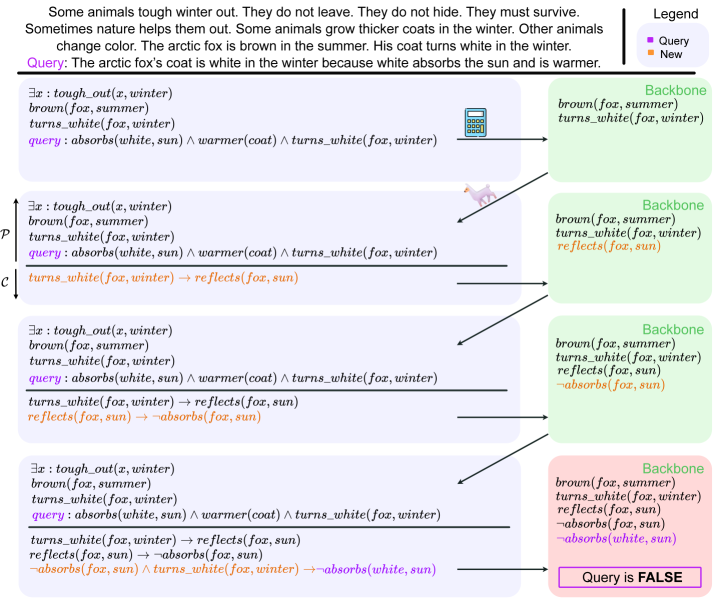
The image is a **logical reasoning diagram** illustrating the evaluation of a query about the arctic fox’s winter coat color. It combines natural language text, symbolic logic (predicates, quantifiers, implications), and a “backbone” of predicates to test the validity of the query. The diagram concludes the query is false.
### Components/Axes (Elements & Layout)
- **Legend**: Top-right corner, with two labels:
- *Query* (purple text, for the initial query statement).
- *New* (orange text, for newly introduced logical elements).
- **Natural Language Text (Top)**: Explains the arctic fox’s coat color change: *“Some animals tough winter out... The arctic fox is brown in the summer. His coat turns white in the winter. Query: The arctic fox’s coat is white in the winter because white absorbs the sun and is warmer.”*
- **Logical Steps (Left Column)**: Four sequential blocks of symbolic logic (using ∃x, →, ∧, ¬) with predicates:
- `tough_out(x, winter)`, `brown(fox, summer)`, `turns_white(fox, winter)`, `absorbs(white, sun)`, `warmer(coat)`, `reflects(fox, sun)`, `¬absorbs(fox, sun)`, `¬absorbs(white, sun)`.
- **Backbone (Right Column)**: Green boxes listing predicates (e.g., `brown(fox, summer)`, `turns_white(fox, winter)`) that evolve with each logical step.
- **Conclusion (Bottom-Right)**: Pink box: *“Query is FALSE”*.
### Detailed Analysis (Logical Flow & Predicates)
1. **Initial Query (Purple)**:
`∃x : tough_out(x, winter) brown(fox, summer) turns_white(fox, winter) query: absorbs(white, sun) ∧ warmer(coat) ∧ turns_white(fox, winter)`
(The query claims the fox’s white coat is due to white absorbing sun and being warmer.)
2. **First Logical Step**:
Adds `turns_white(fox, winter) → reflects(fox, sun)` (orange text, “New”).
Backbone updates to include `reflects(fox, sun)`.
3. **Second Logical Step**:
Adds `reflects(fox, sun) → ¬absorbs(fox, sun)` (orange text).
Backbone updates to include `¬absorbs(fox, sun)`.
4. **Third Logical Step**:
Adds `¬absorbs(fox, sun) ∧ turns_white(fox, winter) → ¬absorbs(white, sun)` (orange text).
Backbone updates to include `¬absorbs(white, sun)`.
5. **Conclusion**:
The final step negates the query’s premise (`absorbs(white, sun)`), so the query is marked *“FALSE”* (pink box).
### Key Observations
- **Logical Progression**: Each step introduces a new predicate (orange text) to the backbone, building a chain of implications.
- **Negation of Premise**: The query’s core claim (`absorbs(white, sun)`) is negated via `¬absorbs(white, sun)`, invalidating the query.
- **Spatial Layout**: The legend (top-right) distinguishes “Query” (purple) and “New” (orange) elements. The backbone (right) and logical steps (left) are connected by arrows, showing the flow of reasoning.
### Interpretation
The diagram is a **formal logical proof** demonstrating the query is false. The reasoning uses predicates about the fox’s coat color, reflection, and absorption to show:
- The arctic fox’s white coat *reflects* sun (not absorbs it), so `absorbs(white, sun)` is false.
- This negates the query’s premise, proving the initial claim (white coat = warmer due to sun absorption) is incorrect.
In practical terms, this suggests the arctic fox’s white coat may serve other purposes (e.g., camouflage) rather than sun absorption for warmth, as the logical chain invalidates the “warmer due to absorption” argument. The diagram uses symbolic logic to rigorously test the query, highlighting the importance of precise reasoning in evaluating causal claims.
(Note: All text is in English; no other languages are present.)