## Code Snippet: Theorem Definitions
### Overview
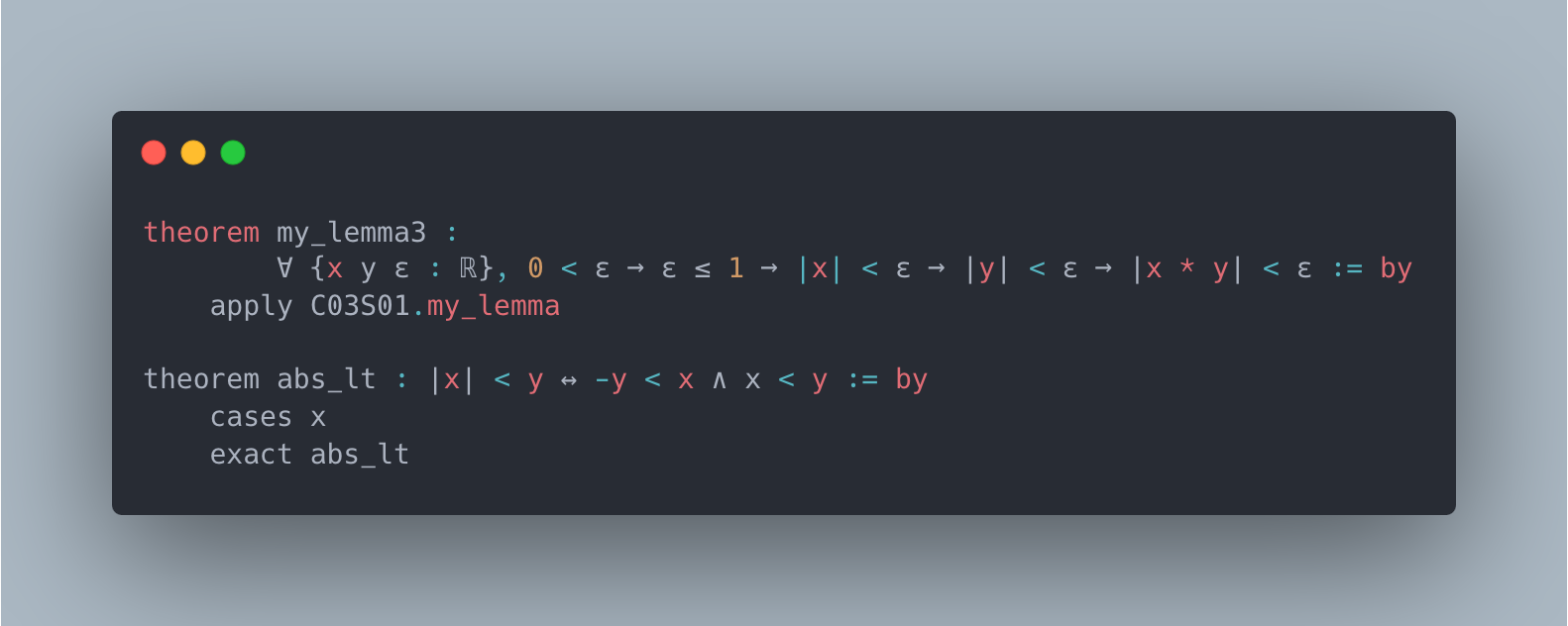
The image displays a code snippet defining two theorems, `my_lemma3` and `abs_lt`, likely within a formal verification or proof assistant environment. The code uses mathematical notation and specific commands (e.g., `apply`, `cases`, `exact`) typical of such systems.
### Components/Axes
* **Header:** The top-left of the window has three circles: red, yellow, and green.
* **Theorem Definitions:** The main content area contains the code defining the theorems.
* **Keywords:** The code uses keywords like `theorem`, `apply`, `cases`, and `exact`.
* **Mathematical Notation:** The code uses symbols like `∀` (for all), `ε` (epsilon), `R` (real numbers), `<`, `↔` (if and only if), `∧` (and), and `|x|` (absolute value of x).
### Detailed Analysis or Content Details
**Theorem `my_lemma3`:**
* **Definition:** `theorem my_lemma3 :`
* **Quantification:** `∀{x y ε : R},` (For all x, y, and epsilon, where x, y, and epsilon are real numbers)
* **Conditions:** `0 < ε → ε ≤ 1 → |x| < ε → |y| < ε → |x * y| < ε := by` (If 0 < epsilon, and epsilon <= 1, and the absolute value of x is less than epsilon, and the absolute value of y is less than epsilon, then the absolute value of x times y is less than epsilon. The `:= by` indicates the start of the proof strategy.)
* **Application:** `apply C03S01.my_lemma` (Apply the lemma `C03S01.my_lemma`)
**Theorem `abs_lt`:**
* **Definition:** `theorem abs_lt :`
* **Equivalence:** `|x| < y ↔ -y < x ∧ x < y := by` (The absolute value of x is less than y if and only if -y is less than x and x is less than y. The `:= by` indicates the start of the proof strategy.)
* **Case Analysis:** `cases x` (Perform case analysis on x)
* **Exact Proof:** `exact abs_lt` (The proof is exactly `abs_lt`)
### Key Observations
* The code defines two mathematical theorems.
* `my_lemma3` relates the absolute values of real numbers and their product to a small positive number epsilon.
* `abs_lt` defines the equivalence between the absolute value inequality and a conjunction of two inequalities.
* The code uses specific commands (`apply`, `cases`, `exact`) to construct the proofs.
### Interpretation
The code snippet demonstrates the formal definition and proof of mathematical theorems within a proof assistant. `my_lemma3` likely establishes a property related to the behavior of absolute values and inequalities, while `abs_lt` provides a fundamental equivalence for absolute value inequalities. The use of `apply`, `cases`, and `exact` suggests a step-by-step approach to constructing the proofs, leveraging existing lemmas and proof strategies. The code is written in a language designed for formal verification, where mathematical statements are rigorously defined and proven.