# Technical Document Extraction: AI Data Analysis Workflow
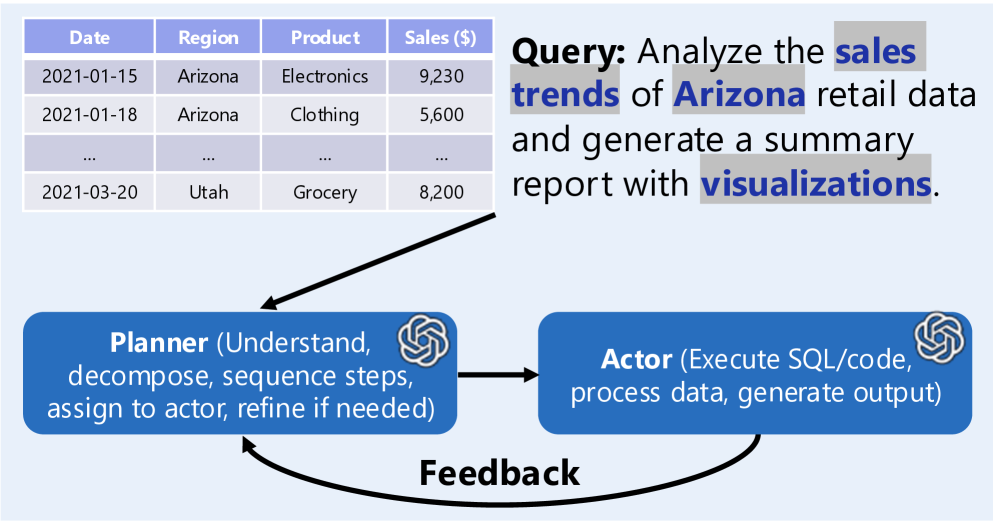
This image illustrates a conceptual workflow for an AI-driven data analysis system, utilizing a "Planner-Actor" architecture to process natural language queries against structured data.
## 1. Component Isolation
The image is divided into three primary functional regions:
* **Header (Input Layer):** Contains a sample data table and a natural language query.
* **Main Process (Logic Layer):** Two primary functional blocks ("Planner" and "Actor") connected by directional arrows.
* **Feedback Loop (Optimization Layer):** A return path from the Actor back to the Planner.
---
## 2. Data Table Extraction (Header - Left)
The image displays a structured data table representing retail transactions.
| Date | Region | Product | Sales ($) |
| :--- | :--- | :--- | :--- |
| 2021-01-15 | Arizona | Electronics | 9,230 |
| 2021-01-18 | Arizona | Clothing | 5,600 |
| ... | ... | ... | ... |
| 2021-03-20 | Utah | Grocery | 8,200 |
---
## 3. Textual Information Extraction (Header - Right)
**Query Text:**
> "**Query:** Analyze the **sales trends** of **Arizona** retail data and generate a summary report with **visualizations**."
*Note: Specific keywords ("sales trends", "Arizona", and "visualizations") are highlighted in blue bold text with grey background shading to indicate their importance as entities or instructions for the AI.*
---
## 4. Diagram Components and Flow (Main Process)
The diagram depicts a sequential and iterative process flow using two main nodes, both featuring the OpenAI logo, suggesting the use of Large Language Models (LLMs).
### Node 1: Planner
* **Location:** Bottom-left blue block.
* **Description:** Acts as the orchestrator.
* **Internal Text:** "Planner (Understand, decompose, sequence steps, assign to actor, refine if needed)"
* **Function:** Receives the input query and data schema to create a logical execution plan.
### Node 2: Actor
* **Location:** Bottom-right blue block.
* **Description:** Acts as the execution engine.
* **Internal Text:** "Actor (Execute SQL/code, process data, generate output)"
* **Function:** Performs the technical tasks (coding/querying) defined by the Planner.
### Flow Dynamics
1. **Input Path:** A black arrow points from the Header (Data/Query) down to the **Planner**.
2. **Execution Path:** A horizontal black arrow points from the **Planner** to the **Actor**, indicating the handoff of instructions.
3. **Feedback Loop:** A curved black arrow at the bottom points from the **Actor** back to the **Planner**, labeled with the text "**Feedback**". This indicates an iterative refinement process where the Actor's results or errors are sent back to the Planner for adjustment.
---
## 5. Summary of Information
The image describes an autonomous agentic workflow where a user's natural language request is first decomposed into a sequence of steps by a **Planner** module. These steps are then executed by an **Actor** module (which handles SQL or Python code). The system includes a **Feedback** mechanism, allowing the Planner to refine the strategy based on the Actor's performance or the data processed.