## Grid Point Visualizations
### Overview
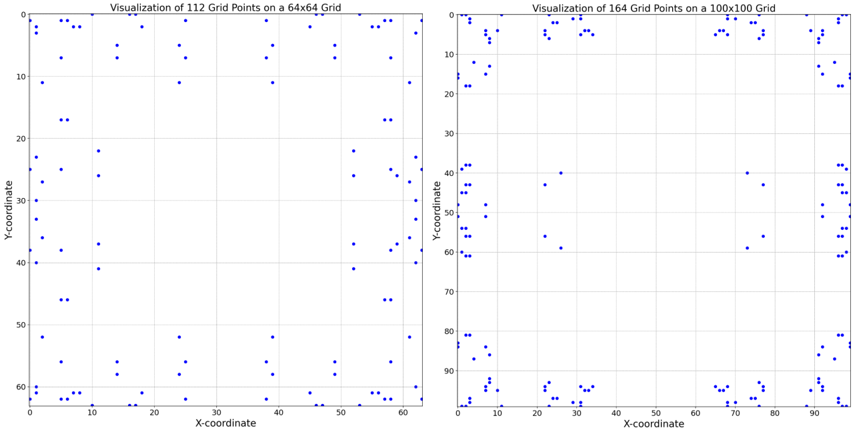
The image presents two scatter plots visualizing the distribution of grid points on different grid sizes. The left plot shows 112 grid points on a 64x64 grid, while the right plot shows 164 grid points on a 100x100 grid. The points are represented by blue dots. Both plots have X and Y axes labeled "X-coordinate" and "Y-coordinate" respectively, with grid lines for visual reference.
### Components/Axes
* **Left Plot Title:** "Visualization of 112 Grid Points on a 64x64 Grid"
* **Right Plot Title:** "Visualization of 164 Grid Points on a 100x100 Grid"
* **X-axis (both plots):** "X-coordinate"
* Left Plot: Scale from 0 to 60, with tick marks every 10 units.
* Right Plot: Scale from 0 to 90, with tick marks every 10 units.
* **Y-axis (both plots):** "Y-coordinate"
* Left Plot: Scale from 0 to 60, with tick marks every 10 units.
* Right Plot: Scale from 0 to 90, with tick marks every 10 units.
* **Data Points:** Blue dots representing the grid points.
### Detailed Analysis
**Left Plot (112 Grid Points on 64x64 Grid):**
* The points appear to be concentrated near the edges and corners of the grid.
* There are relatively fewer points in the central region of the grid.
* Specific approximate data points:
* (5, 5): A cluster of points.
* (55, 5): A cluster of points.
* (5, 55): A cluster of points.
* (55, 55): A cluster of points.
* (0, 30): A vertical line of points.
* (60, 30): A vertical line of points.
* (30, 0): A horizontal line of points.
* (30, 60): A horizontal line of points.
**Right Plot (164 Grid Points on 100x100 Grid):**
* Similar to the left plot, the points are concentrated near the edges and corners.
* The central region has fewer points.
* Specific approximate data points:
* (5, 5): A cluster of points.
* (95, 5): A cluster of points.
* (5, 95): A cluster of points.
* (95, 95): A cluster of points.
* (0, 45): A vertical line of points.
* (100, 45): A vertical line of points.
* (45, 0): A horizontal line of points.
* (45, 100): A horizontal line of points.
### Key Observations
* Both plots exhibit a similar pattern of point distribution, with higher density near the edges and corners.
* The central regions of both grids are relatively sparse.
* The 100x100 grid has a slightly more pronounced concentration of points along the edges compared to the 64x64 grid.
### Interpretation
The visualizations suggest that the grid points are not uniformly distributed across the grids. The concentration of points near the edges and corners could indicate a specific algorithm or process that favors these regions. The sparsity in the center suggests that the algorithm might be designed to avoid placing points in the middle of the grid. The similarity in the distribution pattern between the two grids, despite the different sizes, implies that the underlying principle or algorithm is consistent across different grid dimensions. The data suggests a non-random distribution, possibly designed for a specific purpose such as boundary detection or edge enhancement.