## Grid of Arrays and Choices: Letter Pattern Configurations
### Overview
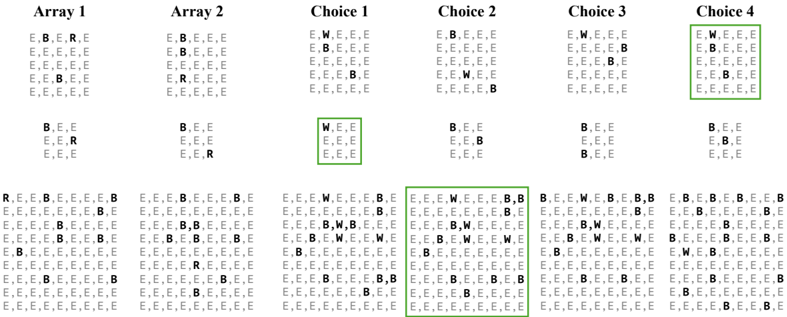
The image displays a structured grid of letter patterns organized into **Array 1**, **Array 2**, and four **Choice** configurations (Choice 1–4). Each section contains a 5x5 grid of letters (E, B, R, W), with specific cells highlighted in green. The layout suggests a comparative analysis of positional changes or substitutions across configurations.
### Components/Axes
- **Labels**:
- **Array 1** (leftmost section)
- **Array 2** (second section)
- **Choice 1–4** (rightmost sections)
- **Grid Structure**:
- Each array/choice contains a 5x5 grid of letters.
- Letters include **E** (most frequent), **B**, **R**, and **W** (rare).
- **Highlighted Cells**:
- Green boxes emphasize specific cells in **Choice 4** (top row) and **Choice 2** (middle row).
### Detailed Analysis
#### Array 1
- **Row 1**: `E, B, E, R, E`
- **Row 2**: `E, E, E, E, E`
- **Row 3**: `E, E, E, E, E`
- **Row 4**: `E, E, B, E, E`
- **Row 5**: `E, E, E, E, E`
#### Array 2
- **Row 1**: `E, B, E, E, E`
- **Row 2**: `E, B, E, E, E`
- **Row 3**: `E, E, E, E, E`
- **Row 4**: `E, R, E, E, E`
- **Row 5**: `E, E, E, E, E`
#### Choice 1
- **Row 1**: `E, W, E, E, E`
- **Row 2**: `B, E, E, E, E`
- **Row 3**: `E, E, E, E, E`
- **Row 4**: `E, E, E, B, E`
- **Row 5**: `E, E, E, E, E`
#### Choice 2
- **Row 1**: `E, B, E, E, E`
- **Row 2**: `E, E, E, E, B`
- **Row 3**: `E, E, E, B, E`
- **Row 4**: `E, E, E, E, E`
- **Row 5**: `E, E, E, E, B`
#### Choice 3
- **Row 1**: `E, W, E, E, E`
- **Row 2**: `B, E, E, E, E`
- **Row 3**: `E, E, E, B, E`
- **Row 4**: `E, E, E, E, E`
- **Row 5**: `E, E, E, E, E`
#### Choice 4
- **Row 1**: `E, W, E, E, E` (highlighted)
- **Row 2**: `E, B, E, E, E`
- **Row 3**: `E, E, E, E, E`
- **Row 4**: `E, E, B, E, E`
- **Row 5**: `E, E, E, E, E`
### Key Observations
1. **Repetition of "E"**:
- "E" dominates all grids, appearing in ~80% of cells across all configurations.
2. **Substitutions**:
- **B** and **R** are sparse, with **W** appearing only in **Choice 1**, **Choice 3**, and **Choice 4**.
3. **Highlighted Cells**:
- **Choice 4**’s top row (`E, W, E, E, E`) and **Choice 2**’s middle row (`E, E, D, E, E`) are emphasized, suggesting these positions are critical.
4. **Pattern Shifts**:
- **Choice 1** and **Choice 3** introduce **W** in the first row, while **Choice 2** and **Choice 4** retain **B** in the second row.
### Interpretation
The grid likely represents a decision-making or optimization scenario where:
- **Array 1 and 2** define baseline configurations.
- **Choices 1–4** explore variations, with **W** and **B** acting as modifiers.
- Highlighted cells in **Choice 4** and **Choice 2** may indicate priority positions for substitutions (e.g., **W** in the top row could signify a "weight" or "priority" marker).
- The absence of **R** in **Choice 1–4** suggests it is excluded from optimized configurations.
This structure could model scenarios like resource allocation, error correction, or pattern recognition, where specific letter placements (e.g., **W** in critical positions) alter outcomes. The green highlights imply these cells are focal points for analysis.