## Line Chart: Percentage of Problems Solved vs. Number of Solutions per Problem
### Overview
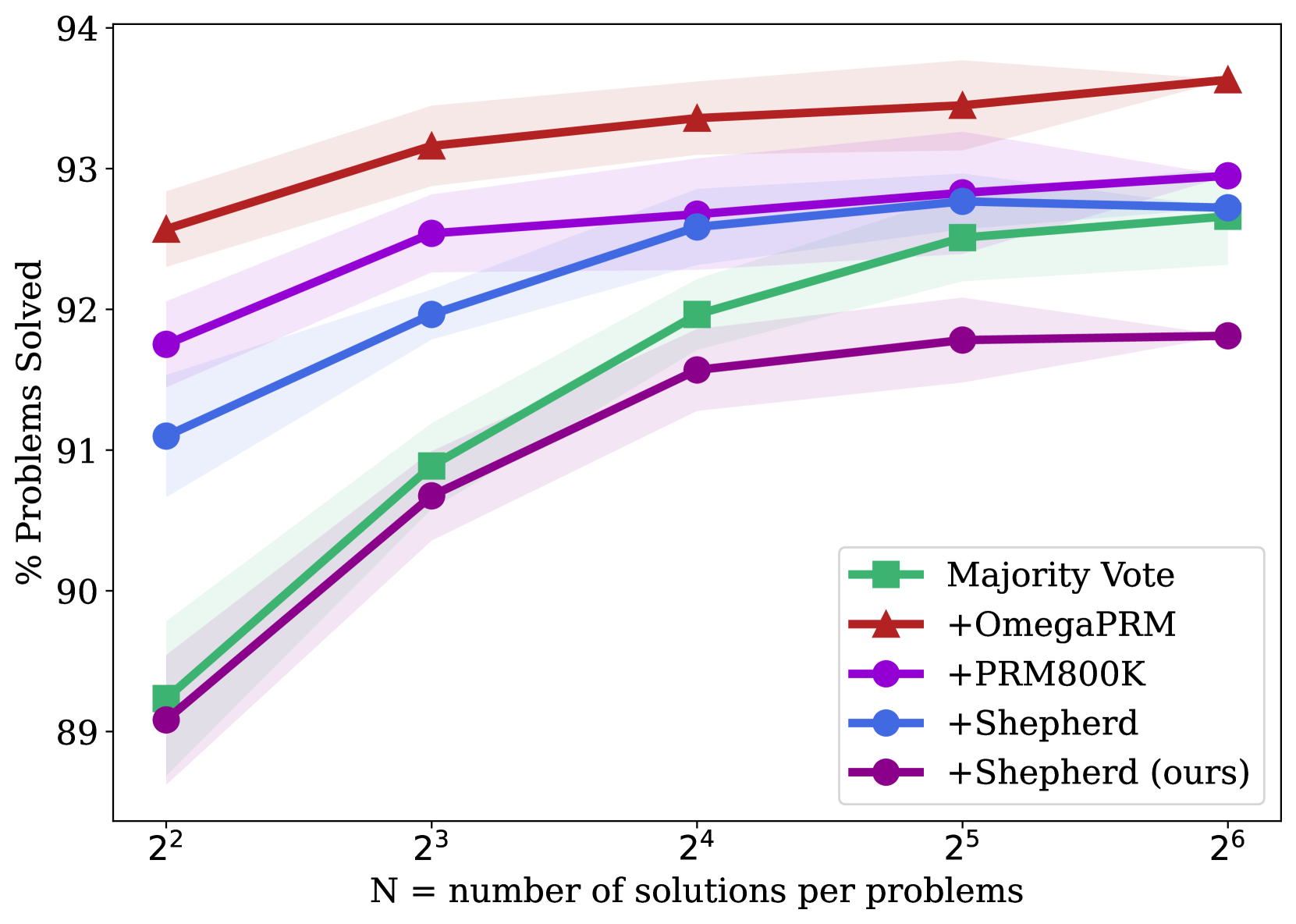
The chart illustrates the performance of five algorithms in solving problems as the number of solutions per problem (N) increases. The y-axis represents the percentage of problems solved (89%–94%), while the x-axis shows N in powers of 2 (2² to 2⁶). Each algorithm is represented by a distinct line with markers and shaded confidence intervals.
### Components/Axes
- **X-axis (N)**: Number of solutions per problem, labeled as $ N = \text{number of solutions per problems} $, with values $ 2^2, 2^3, 2^4, 2^5, 2^6 $.
- **Y-axis**: Percentage of problems solved, ranging from 89% to 94%.
- **Legend**: Located on the right, mapping colors and markers to algorithms:
- **Green +**: Majority Vote
- **Red ▲**: +OmegaPRM
- **Purple ○**: +PRM800K
- **Blue ○**: +Shepherd
- **Dark Purple ○**: +Shepherd (ours)
### Detailed Analysis
1. **Majority Vote (Green +)**:
- Starts at ~89.2% at $ 2^2 $, rising to ~92.7% at $ 2^6 $.
- Confidence interval widens at lower N values, narrowing as N increases.
2. **+OmegaPRM (Red ▲)**:
- Highest performance, starting at ~92.5% at $ 2^2 $, peaking at ~93.6% at $ 2^6 $.
- Confidence interval remains relatively narrow across all N values.
3. **+PRM800K (Purple ○)**:
- Begins at ~91.8% at $ 2^2 $, increasing to ~92.9% at $ 2^6 $.
- Confidence interval widens slightly at lower N but stabilizes.
4. **+Shepherd (Blue ○)**:
- Starts at ~91.1% at $ 2^2 $, rising to ~92.7% at $ 2^6 $.
- Confidence interval is moderate, with minimal variation.
5. **+Shepherd (ours) (Dark Purple ○)**:
- Lowest performance, starting at ~89.1% at $ 2^2 $, reaching ~91.8% at $ 2^6 $.
- Confidence interval is the widest, indicating higher uncertainty.
### Key Observations
- **+OmegaPRM** consistently outperforms all other algorithms, maintaining the highest percentage of problems solved.
- **+Shepherd (ours)** shows the lowest performance, with a significant gap compared to other methods.
- All algorithms improve as N increases, but the rate of improvement varies. +OmegaPRM and +PRM800K show steeper growth.
- Confidence intervals (shaded regions) are widest at lower N values, suggesting greater uncertainty in early results.
### Interpretation
The data demonstrates that **+OmegaPRM** is the most effective algorithm for solving problems, particularly as the number of solutions per problem increases. The shaded confidence intervals indicate that performance estimates are less reliable at lower N values, with uncertainty decreasing as N grows. The **+Shepherd (ours)** algorithm lags behind others, suggesting potential limitations in its design or implementation. The trend highlights the importance of solution quantity in problem-solving efficiency, with +OmegaPRM leveraging this advantage most effectively.