## Flowchart: Quantum Processing Workflow
### Overview
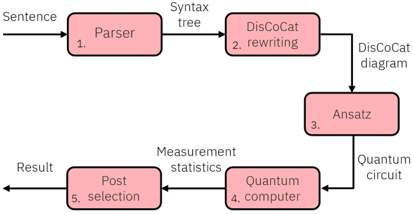
The image depicts a sequential workflow for processing a sentence through quantum computing stages. The process begins with a textual input ("Sentence") and progresses through five stages, culminating in a "Result". A feedback loop exists between "Ansatz" and "Quantum circuit".
### Components/Axes
1. **Nodes (Processes)**:
- **1. Parser**: Converts "Sentence" into a syntax tree.
- **2. DisCoCat rewriting**: Transforms the syntax tree into a DisCoCat diagram.
- **3. Ansatz**: Represents a quantum circuit setup.
- **4. Quantum computer**: Executes the quantum circuit.
- **5. Post selection**: Finalizes the result.
2. **Arrows**: Indicate directional flow between stages.
3. **Branching**: "Ansatz" connects to both "Quantum circuit" and "Quantum computer".
### Detailed Analysis
- **Input**: "Sentence" → **Parser** → Syntax tree.
- **Rewriting**: Syntax tree → **DisCoCat rewriting** → DisCoCat diagram.
- **Quantum Processing**:
- DisCoCat diagram → **Ansatz** → Quantum circuit.
- Quantum circuit → **Quantum computer** (feedback loop to Ansatz).
- **Output**: Quantum computer → **Post selection** → Result.
### Key Observations
- The workflow is linear with a single feedback loop between "Ansatz" and "Quantum circuit".
- "Post selection" acts as the final decision-making stage before outputting the result.
- "Ansatz" serves as a bridge between classical (DisCoCat) and quantum processing.
### Interpretation
This flowchart illustrates a hybrid classical-quantum workflow:
1. **Classical Preprocessing**: The sentence is parsed and rewritten using DisCoCat (a probabilistic grammar framework) to structure the problem.
2. **Quantum Execution**: The structured problem ("Ansatz") is translated into a quantum circuit, which is iteratively optimized via feedback to the quantum computer.
3. **Result Finalization**: Post-selection (a quantum measurement technique) collapses the quantum state into a classical result.
The feedback loop suggests iterative refinement of the quantum circuit design, likely to improve result accuracy or efficiency. The use of DisCoCat implies the problem involves probabilistic or context-sensitive rules, which are then mapped to quantum operations.