## Diagram: Parse Tree for a Simple Sentence
### Overview
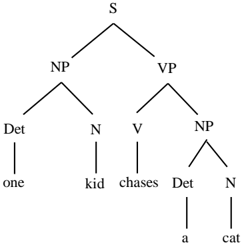
The image shows a parse tree diagram representing the syntactic structure of the sentence "one kid chases a cat." The tree illustrates how the sentence is broken down into its constituent parts, such as noun phrases (NP), verb phrases (VP), determiners (Det), nouns (N), and verbs (V).
### Components/Axes
* **Root Node:** S (Sentence)
* **Branches:**
* S branches into NP and VP.
* NP branches into Det and N.
* VP branches into V and NP.
* The second NP branches into Det and N.
* **Leaf Nodes (Terminals):**
* Det: "one"
* N: "kid"
* V: "chases"
* Det: "a"
* N: "cat"
### Detailed Analysis
The parse tree visually represents the hierarchical structure of the sentence.
* The sentence (S) is composed of a noun phrase (NP) and a verb phrase (VP).
* The first noun phrase (NP) consists of a determiner (Det) "one" and a noun (N) "kid".
* The verb phrase (VP) consists of a verb (V) "chases" and another noun phrase (NP).
* The second noun phrase (NP) consists of a determiner (Det) "a" and a noun (N) "cat".
### Key Observations
The diagram clearly shows the grammatical relationships between the words in the sentence. It demonstrates how the sentence can be broken down into smaller, meaningful units.
### Interpretation
The parse tree is a fundamental tool in linguistics and computer science for analyzing the syntax of sentences. It provides a visual representation of the grammatical structure, which can be used for various applications, such as natural language processing, machine translation, and grammar checking. The tree shows that "one kid" is the subject of the sentence, "chases" is the verb, and "a cat" is the object. The hierarchical structure reflects the way humans understand and process language.