## Syntax Tree Diagram: Sentence Structure Analysis
### Overview
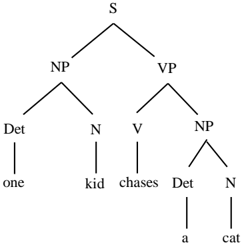
The image displays a hierarchical syntax tree diagram (also known as a parse tree or constituent structure tree) used in linguistics to represent the grammatical structure of a sentence. The tree breaks down the sentence "one kid chases a cat" into its syntactic constituents, showing how words combine into phrases and how those phrases form the complete sentence.
### Components/Axes
The diagram is a tree graph with labeled nodes and terminal nodes (words). There are no traditional axes, legends, or scales. The structure is hierarchical, flowing from the root node at the top down to the terminal words at the bottom.
**Node Labels (Non-Terminal Symbols):**
* **S**: Sentence (Root node, top-center)
* **NP**: Noun Phrase (Appears twice: as the left child of S, and as the right child of VP)
* **VP**: Verb Phrase (Right child of S)
* **Det**: Determiner (Appears twice: as the left child of each NP)
* **N**: Noun (Appears twice: as the right child of each NP)
* **V**: Verb (Left child of VP)
**Terminal Words (Leaves of the Tree):**
* **one** (under Det, left branch)
* **kid** (under N, left branch)
* **chases** (under V)
* **a** (under Det, right branch)
* **cat** (under N, right branch)
### Detailed Analysis
The tree represents the sentence **"one kid chases a cat"**. The hierarchical structure is as follows:
1. **Level 1 (Root):** The entire sentence is labeled **S**.
2. **Level 2:** The **S** node branches into two immediate constituents:
* A **Noun Phrase (NP)** on the left.
* A **Verb Phrase (VP)** on the right.
3. **Level 3 (Left Branch - NP):** The left **NP** further branches into:
* A **Determiner (Det)** on the left, which dominates the word **"one"**.
* A **Noun (N)** on the right, which dominates the word **"kid"**.
* This forms the subject noun phrase: **"one kid"**.
4. **Level 3 (Right Branch - VP):** The **VP** branches into:
* A **Verb (V)** on the left, which dominates the word **"chases"**.
* A **Noun Phrase (NP)** on the right.
5. **Level 4 (Right Branch - NP):** The second **NP** (object of the verb) branches into:
* A **Determiner (Det)** on the left, which dominates the word **"a"**.
* A **Noun (N)** on the right, which dominates the word **"cat"**.
* This forms the object noun phrase: **"a cat"**.
**Spatial Grounding:** The root **S** is centered at the top. The primary split creates a left subtree (for the subject) and a right subtree (for the predicate). Each subsequent branching occurs directly below its parent node, creating a clear, downward-flowing hierarchy.
### Key Observations
* The diagram uses standard linguistic abbreviations for syntactic categories (S, NP, VP, Det, N, V).
* The sentence follows a basic Subject-Verb-Object (SVO) word order, which is clearly mapped by the tree structure: Subject (NP: one kid) -> Verb (V: chases) -> Object (NP: a cat).
* The tree is **binary branching**, meaning each non-terminal node (except the root) splits into exactly two child nodes. This is a common convention in many syntactic theories (e.g., X-bar theory).
* The structure is **recursive**, as the category **NP** appears at two different levels in the hierarchy (as a child of S and as a child of VP).
### Interpretation
This syntax tree is a formal representation of the **constituent structure** of the sentence. It demonstrates that the sentence is not just a linear string of words but a hierarchically organized set of phrases.
* **What it demonstrates:** It shows the immediate constituency relationships. For example, "one" and "kid" are more closely related to each other (forming an NP) than "kid" is to "chases". Similarly, "chases" and "a cat" form a coherent unit (the VP), which is the predicate of the sentence.
* **How elements relate:** The tree visually encodes grammatical functions. The left NP under S is the **subject**. The V and the right NP under VP are the **head** and **complement** of the verb phrase, respectively.
* **Notable patterns:** The consistent binary branching and the clear separation of subject and predicate are the primary patterns. There are no anomalies; the tree is a standard, well-formed representation of a simple transitive sentence.
* **Underlying information:** Beyond the words themselves, the tree exposes the abstract syntactic skeleton of the sentence. This type of analysis is fundamental for understanding grammar, parsing sentences in computational linguistics, and studying language acquisition. It allows linguists to compare the structures of different sentences and languages.