## Diagram: Iterative Agent Improvement Process
### Overview
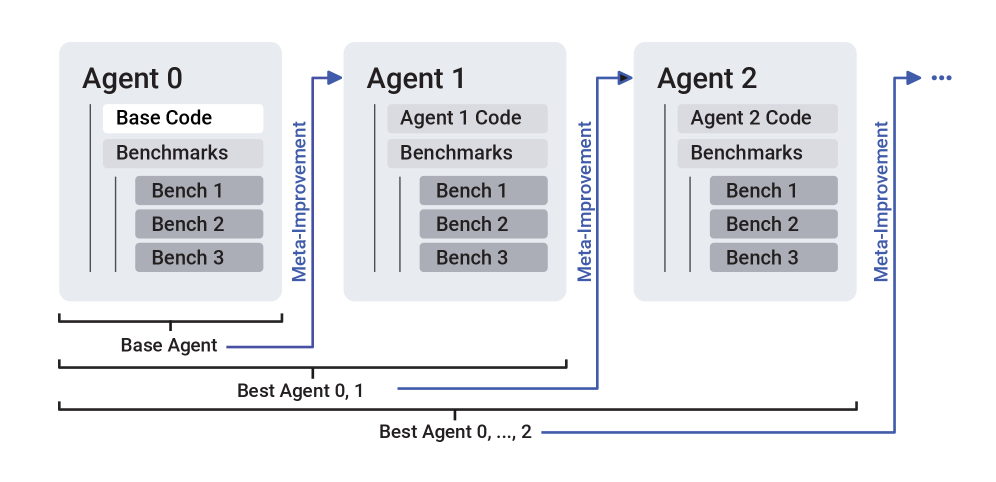
This image presents a flow diagram illustrating an iterative process for developing and improving "Agents" through a mechanism called "Meta-Improvement." It shows a sequence of agents (Agent 0, Agent 1, Agent 2, and so on) where each agent's code is evaluated against a consistent set of benchmarks, and the results inform the creation or refinement of the subsequent agent. The diagram also highlights the concept of a "Best Agent" that accumulates performance across iterations.
### Components/Axes
The diagram is structured horizontally, depicting a progression from left to right.
* **Agent Blocks (Top-Center):**
* Three primary blocks are visible: "Agent 0", "Agent 1", and "Agent 2". A "..." symbol to the right of "Agent 2" indicates the continuation of this process for further agents.
* Each agent block contains two main sub-components:
* **Code Component:** A rectangular box at the top of each agent block.
* For "Agent 0", this box is labeled "Base Code" (white background).
* For "Agent 1", this box is labeled "Agent 1 Code" (light gray background).
* For "Agent 2", this box is labeled "Agent 2 Code" (light gray background).
* **Benchmarks Component:** A rectangular box below the code component, labeled "Benchmarks" (light gray background).
* Nested within the "Benchmarks" component are three smaller, darker gray rectangular boxes, consistently labeled: "Bench 1", "Bench 2", "Bench 3". These are present for Agent 0, Agent 1, and Agent 2.
* **Meta-Improvement Arrows (Blue):**
* Horizontal blue arrows connect the output of one agent's evaluation to the input of the next agent. Each arrow is labeled "Meta-Improvement" (text oriented vertically, reading bottom-to-top).
* The first arrow originates from the right side of the "Agent 0" block and points rightwards into the "Agent 1" block.
* The second arrow originates from the right side of the "Agent 1" block and points rightwards into the "Agent 2" block.
* The third arrow originates from the right side of the "Agent 2" block and points rightwards towards the "..." symbol, indicating the process continues.
* **Best Agent Brackets (Bottom):**
* Three horizontal brackets with labels are positioned at the bottom of the diagram, indicating cumulative scope.
* **Base Agent:** A short black bracket spans horizontally directly beneath the "Agent 0" block, labeled "Base Agent".
* **Best Agent 0, 1:** A longer black bracket spans horizontally beneath both "Agent 0" and "Agent 1" blocks, labeled "Best Agent 0, 1".
* **Best Agent 0, ..., 2:** The longest black bracket spans horizontally beneath "Agent 0", "Agent 1", and "Agent 2" blocks, extending further to the right under the "..." symbol. It is labeled "Best Agent 0, ..., 2".
### Detailed Analysis
The diagram illustrates a sequential, iterative development process.
1. **Agent 0** starts with "Base Code" and is evaluated against "Benchmarks" (Bench 1, Bench 2, Bench 3).
2. The results or insights from Agent 0's performance on these benchmarks are fed into a "Meta-Improvement" process.
3. This "Meta-Improvement" process then generates or refines the code for **Agent 1** ("Agent 1 Code"). Agent 1 is subsequently evaluated against the *same* set of "Benchmarks" (Bench 1, Bench 2, Bench 3).
4. The cycle repeats: Agent 1's performance informs the "Meta-Improvement" process, which in turn leads to **Agent 2** ("Agent 2 Code"), also evaluated against the identical "Benchmarks".
5. The "..." indicates that this iterative process of "Meta-Improvement" and agent generation/evaluation continues indefinitely or for a specified number of iterations.
The horizontal brackets at the bottom indicate the scope of "best agent" selection:
* "Base Agent" refers specifically to Agent 0.
* "Best Agent 0, 1" implies a comparison or selection between Agent 0 and Agent 1, likely choosing the one with superior performance.
* "Best Agent 0, ..., 2" suggests a cumulative selection, identifying the best performing agent among Agent 0, Agent 1, Agent 2, and potentially all subsequent agents generated in the process.
### Key Observations
* **Iterative Refinement:** The core concept is an iterative loop where each new agent is an improvement or modification of the previous one, guided by performance feedback.
* **Consistent Evaluation:** All agents are evaluated using the exact same set of benchmarks, ensuring a fair and comparable assessment of improvement.
* **Meta-Learning/Optimization:** "Meta-Improvement" is the critical mechanism driving the evolution of agents, suggesting an automated or semi-automated process that learns how to improve the agents themselves.
* **Cumulative Best:** The "Best Agent" labels indicate a strategy of retaining the highest-performing agent found so far across all iterations.
### Interpretation
This diagram depicts a common paradigm in artificial intelligence, machine learning, and software engineering, particularly in areas like AutoML, evolutionary computation, or self-improving systems.
The "Base Code" for "Agent 0" represents an initial model, algorithm, or software component. Its performance is measured against a standard suite of "Benchmarks" (Bench 1, Bench 2, Bench 3). The "Meta-Improvement" step is crucial; it signifies a higher-level learning or optimization process. This process analyzes the results from the benchmarks (e.g., identifying weaknesses, strengths, or areas for optimization) and uses this meta-knowledge to generate or modify the code for the next agent. For instance, "Meta-Improvement" could be a hyperparameter optimization algorithm, an architecture search algorithm, or a system that learns to write better code based on past performance.
The continuous loop implies that the system is designed to progressively enhance the agent's capabilities. The "Best Agent 0, ..., 2" bracket suggests that the ultimate goal is not just to create a new agent, but to identify and retain the most effective agent discovered throughout the entire iterative process. This framework allows for automated discovery of better solutions without constant human intervention in the core code generation, relying instead on the "Meta-Improvement" layer to drive progress. The consistency of benchmarks is vital for objectively measuring this progress and ensuring that improvements are genuine and not merely artifacts of changing evaluation criteria.