\n
## Diagram: Iterative Agent Improvement Process
### Overview
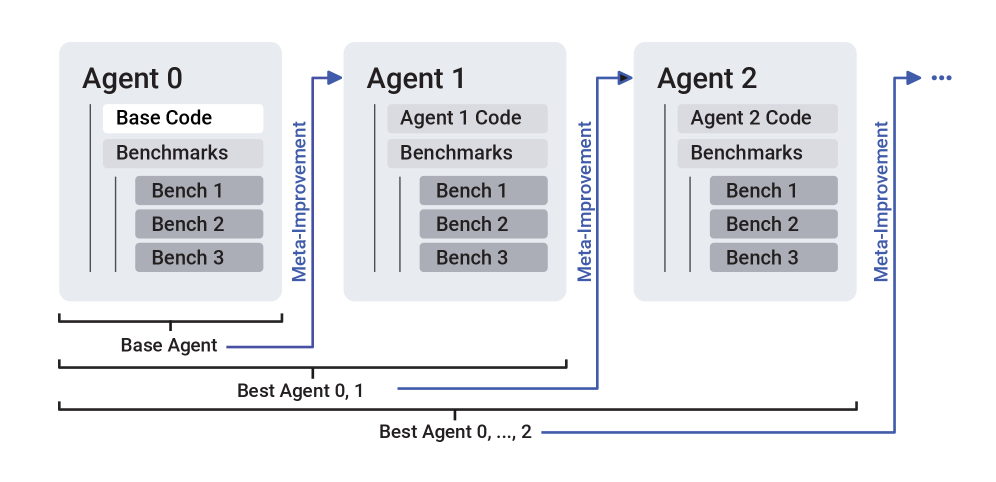
The image depicts a diagram illustrating an iterative process of agent improvement through meta-improvement. It shows a sequence of agents (Agent 0, Agent 1, Agent 2, and continuing as indicated by "..."), each building upon the code and benchmarks of the previous agent. The diagram highlights the concept of "meta-improvement" as the driving force behind the progression.
### Components/Axes
The diagram consists of several key components:
* **Agents:** Represented as rectangular blocks labeled "Agent 0", "Agent 1", "Agent 2", and "...".
* **Code & Benchmarks:** Within each agent block, there are sections labeled "Base Code", "Benchmarks", "Bench 1", "Bench 2", and "Bench 3".
* **Meta-Improvement Arrows:** Blue arrows connecting the agents, labeled "Meta-Improvement", indicating the direction of improvement.
* **Base Agent Label:** A label below Agent 0, reading "Base Agent".
* **Best Agent 0, 1 Label:** A label spanning Agent 0 and Agent 1, reading "Best Agent 0, 1".
* **Best Agent 0, ..., 2 Label:** A label spanning Agent 0, Agent 1, and Agent 2, reading "Best Agent 0, ..., 2".
There are no explicit axes in this diagram. The arrangement is primarily spatial, illustrating a sequential process.
### Detailed Analysis or Content Details
The diagram shows a progression of agents, starting with Agent 0, which contains "Base Code" and "Benchmarks" along with three specific benchmarks labeled "Bench 1", "Bench 2", and "Bench 3".
Agent 1 builds upon Agent 0, containing "Agent 1 Code" and "Benchmarks", and also includes "Bench 1", "Bench 2", and "Bench 3". The arrow labeled "Meta-Improvement" points from Agent 0 to Agent 1.
Agent 2 continues the progression, containing "Agent 2 Code" and "Benchmarks", and again includes "Bench 1", "Bench 2", and "Bench 3". Another "Meta-Improvement" arrow points from Agent 1 to Agent 2.
The ellipsis ("...") after Agent 2 indicates that this process continues indefinitely.
The labels "Best Agent 0, 1" and "Best Agent 0, ..., 2" suggest that the best performing agent at each stage is selected and used as the basis for the next iteration.
### Key Observations
* The diagram emphasizes an iterative process of improvement.
* Each agent retains the same set of benchmarks ("Bench 1", "Bench 2", "Bench 3"), suggesting these benchmarks are used to evaluate the performance of each agent.
* The "Meta-Improvement" arrows indicate that the improvement is not simply incremental code changes, but a more fundamental process of optimization.
* The diagram does not provide any quantitative data about the performance of the agents.
### Interpretation
This diagram illustrates a concept of automated agent improvement, likely within a machine learning or artificial intelligence context. The "Base Code" represents the initial starting point, and the "Benchmarks" provide a standardized way to measure performance. The "Meta-Improvement" process suggests an algorithm or mechanism that analyzes the performance of each agent and generates improved code for the next iteration.
The labels "Best Agent 0, 1" and "Best Agent 0, ..., 2" indicate a selection process where the best-performing agent at each stage is chosen to continue the improvement cycle. This is a common technique in evolutionary algorithms and reinforcement learning.
The diagram is conceptual and does not provide specific details about the implementation of the meta-improvement process. It serves as a high-level overview of the iterative agent improvement workflow. The consistent use of the same benchmarks across agents suggests a focus on consistent and comparable evaluation. The diagram implies a continuous cycle of improvement, with each agent building upon the strengths of its predecessors.