## Diagram: Iterative Agent Meta-Improvement Process
### Overview
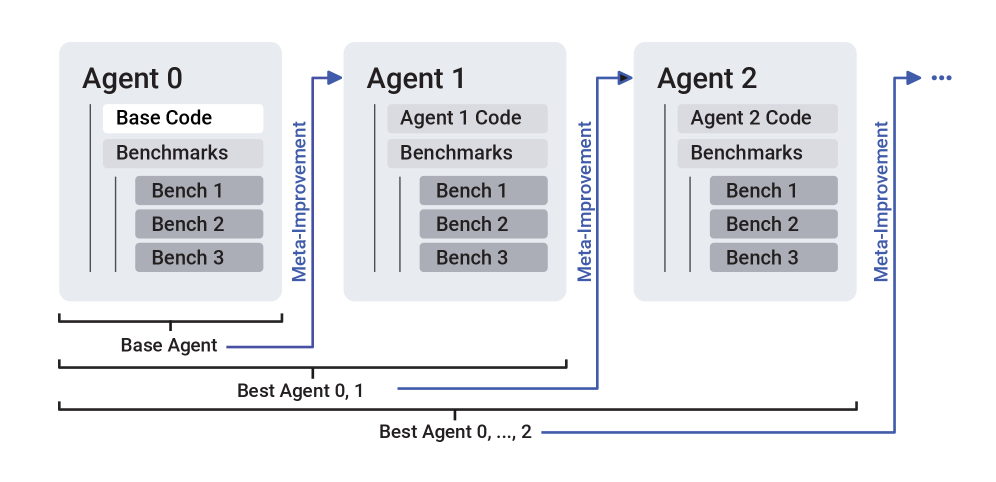
The image is a technical flowchart illustrating a sequential, iterative process for improving AI agents. It depicts a cycle where an initial "Base Agent" (Agent 0) is evaluated, and through a process labeled "Meta-Improvement," it generates a successor (Agent 1). This process repeats, with each new agent being an improved version of the previous one, based on benchmark performance. The diagram emphasizes cumulative selection, where the "best" agent from all previous iterations is used as the foundation for the next meta-improvement step.
### Components/Axes
The diagram is structured horizontally from left to right, representing progression through time or iterations.
**1. Agent Blocks (Primary Components):**
* **Agent 0 (Leftmost):** Labeled "Agent 0". Contains a vertical stack:
* "Base Code" (top, white background)
* "Benchmarks" (middle, light gray background)
* A sub-list under Benchmarks: "Bench 1", "Bench 2", "Bench 3" (each in darker gray boxes).
* **Agent 1 (Center):** Labeled "Agent 1". Contains a vertical stack:
* "Agent 1 Code" (top, light gray background)
* "Benchmarks" (middle, light gray background)
* A sub-list under Benchmarks: "Bench 1", "Bench 2", "Bench 3" (each in darker gray boxes).
* **Agent 2 (Rightmost):** Labeled "Agent 2". Contains a vertical stack:
* "Agent 2 Code" (top, light gray background)
* "Benchmarks" (middle, light gray background)
* A sub-list under Benchmarks: "Bench 1", "Bench 2", "Bench 3" (each in darker gray boxes).
* **Ellipsis (Far Right):** An arrow points from Agent 2 to an ellipsis ("..."), indicating the process continues indefinitely.
**2. Process Arrows (Meta-Improvement):**
* A blue arrow labeled "Meta-Improvement" (text written vertically) originates from the "Base Agent" bracket and points to the "Agent 1 Code" block.
* A second blue arrow labeled "Meta-Improvement" originates from the "Best Agent 0, 1" bracket and points to the "Agent 2 Code" block.
* A third blue arrow labeled "Meta-Improvement" originates from the "Best Agent 0, ..., 2" bracket and points towards the ellipsis.
**3. Selection Brackets (Bottom):**
* **"Base Agent" Bracket:** A horizontal bracket spans the width of the "Agent 0" block. A line connects its center to the first "Meta-Improvement" arrow.
* **"Best Agent 0, 1" Bracket:** A wider horizontal bracket spans the combined width of "Agent 0" and "Agent 1". A line connects its center to the second "Meta-Improvement" arrow.
* **"Best Agent 0, ..., 2" Bracket:** The widest horizontal bracket spans the combined width of "Agent 0", "Agent 1", and "Agent 2". A line connects its center to the third "Meta-Improvement" arrow.
### Detailed Analysis
* **Agent Structure:** Each agent (0, 1, 2) has an identical internal structure for evaluation: a code block ("Base Code" or "Agent N Code") and a "Benchmarks" block containing three specific benchmarks ("Bench 1", "Bench 2", "Bench 3").
* **Progression of Code:** The code block's label changes from "Base Code" (Agent 0) to "Agent 1 Code" and "Agent 2 Code", indicating the code itself is being modified or replaced in each iteration.
* **Meta-Improvement Flow:** The "Meta-Improvement" process is not applied to the immediately preceding agent alone. The brackets indicate it is applied to the **best agent identified from all previous iterations**.
* To create Agent 1: Meta-improvement is applied to the "Base Agent" (Agent 0).
* To create Agent 2: Meta-improvement is applied to the best agent chosen from the pool of Agent 0 and Agent 1 ("Best Agent 0, 1").
* To create the next agent (after Agent 2): Meta-improvement will be applied to the best agent chosen from the pool of Agent 0, Agent 1, and Agent 2 ("Best Agent 0, ..., 2").
* **Spatial Grounding:** The legend/labels ("Meta-Improvement") are placed vertically alongside the blue arrows that connect the selection brackets (bottom) to the code blocks of the *next* agent (top-right relative to the bracket).
### Key Observations
1. **Iterative and Cumulative:** The process is explicitly iterative, with each cycle producing a new agent. The selection mechanism for the meta-improvement input is cumulative, always considering the entire history of agents.
2. **Consistent Benchmarking:** The same set of three benchmarks ("Bench 1", "Bench 2", "Bench 3") is used to evaluate every agent, providing a consistent performance metric across iterations.
3. **Directional Flow:** The flow is strictly left-to-right (chronological) and bottom-to-top (from selection to application of improvement). The "Meta-Improvement" arrows always point from the selected best agent(s) to the code of the next agent.
4. **Open-Ended Process:** The ellipsis ("...") signifies that this is a potentially infinite loop of self-improvement.
### Interpretation
This diagram models a **recursive self-improvement system for AI agents**. The core idea is that an agent's code can be automatically improved ("Meta-Improvement") based on its performance against a fixed set of benchmarks. Crucially, the system does not simply improve the last agent; it maintains a population (or history) and selects the overall best performer as the starting point for the next improvement cycle. This is a safeguard against regression—if a new agent (e.g., Agent 1) performs worse than a previous one (Agent 0), the system would revert to using Agent 0 as the "Best Agent" for the next meta-improvement step.
The process suggests a research or engineering framework where the goal is to autonomously generate increasingly capable agents. The fixed benchmarks act as the objective function guiding the improvement. The "Meta-Improvement" step itself is a black box in this diagram; it represents the algorithm or process (e.g., another AI, a genetic algorithm, program synthesis) that takes an agent's code and its performance data and produces a modified, hopefully better, version of the code. The diagram's primary message is about the **selection and iteration protocol**, not the specific mechanism of improvement.