## Chart/Diagram Type: Attribute-Based Shape Categorization Diagram
### Overview
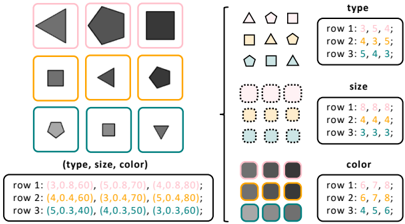
The image presents a structured visualization of shape attributes (type, size, color) organized into three rows. Each row contains three shapes, with corresponding numerical values and color codes. A legend on the right decodes the attributes, linking numerical values to visual elements.
### Components/Axes
#### Left Grid (Shapes)
- **Structure**: 3 rows × 3 columns of shapes.
- **Labels**: Each row is annotated with a tuple `(type, size, color)` in parentheses.
- **Row 1**: `(3,0.8,0.60)`, `(5,0.8,0.70)`, `(4,0.8,0.80)`
- **Row 2**: `(4,0.4,0.60)`, `(3,0.4,0.70)`, `(5,0.4,0.80)`
- **Row 3**: `(5,0.3,0.40)`, `(4,0.3,0.50)`, `(3,0.3,0.60)`
- **Shapes**:
- **Row 1**: Triangle, Pentagon, Square
- **Row 2**: Square, Triangle, Pentagon
- **Row 3**: Pentagon, Square, Triangle
#### Right Legend
- **Sections**:
1. **Type**:
- Row 1: `3, 5, 4` (Triangle, Pentagon, Square)
- Row 2: `4, 3, 5` (Square, Triangle, Pentagon)
- Row 3: `5, 4, 3` (Pentagon, Square, Triangle)
2. **Size**:
- Row 1: `8, 8, 8` (Large)
- Row 2: `4, 4, 4` (Medium)
- Row 3: `3, 3, 3` (Small)
3. **Color**:
- Row 1: `6, 7, 8` (Dark Pink, Yellow, Blue)
- Row 2: `6, 7, 8` (Dark Pink, Yellow, Blue)
- Row 3: `4, 5, 6` (Light Pink, Gray, Teal)
### Detailed Analysis
#### Left Grid (Shapes)
- **Row 1**:
- **Type**: Triangle (3), Pentagon (5), Square (4)
- **Size**: All large (8)
- **Color**: Values `(3,0.8,0.60)`, `(5,0.8,0.70)`, `(4,0.8,0.80)` (ambiguous mapping to legend colors).
- **Row 2**:
- **Type**: Square (4), Triangle (3), Pentagon (5)
- **Size**: All medium (4)
- **Color**: Values `(4,0.4,0.60)`, `(3,0.4,0.70)`, `(5,0.4,0.80)` (ambiguous mapping).
- **Row 3**:
- **Type**: Pentagon (5), Square (4), Triangle (3)
- **Size**: All small (3)
- **Color**: Values `(5,0.3,0.40)`, `(4,0.3,0.50)`, `(3,0.3,0.60)` (ambiguous mapping).
#### Right Legend
- **Type**:
- Row 1: `3, 5, 4` (Triangle, Pentagon, Square)
- Row 2: `4, 3, 5` (Square, Triangle, Pentagon)
- Row 3: `5, 4, 3` (Pentagon, Square, Triangle)
- **Size**:
- Row 1: `8, 8, 8` (Large)
- Row 2: `4, 4, 4` (Medium)
- Row 3: `3, 3, 3` (Small)
- **Color**:
- Row 1: `6, 7, 8` (Dark Pink, Yellow, Blue)
- Row 2: `6, 7, 8` (Dark Pink, Yellow, Blue)
- Row 3: `4, 5, 6` (Light Pink, Gray, Teal)
### Key Observations
1. **Consistent Size per Row**: Each row has uniform size (8, 4, or 3), but varying types and colors.
2. **Type Rotation**: Types cycle through triangle, pentagon, square in a fixed order across rows.
3. **Color Discrepancy**: The numerical color values in the left grid (e.g., `3,0.8,0.60`) do not directly match the legend’s color codes (e.g., `6,7,8`). This suggests either a different encoding system or a potential inconsistency.
4. **Spatial Layout**: The legend is positioned to the right of the grid, with clear separation between attribute categories (type, size, color).
### Interpretation
- **Purpose**: The diagram appears to categorize shapes based on three attributes (type, size, color) for comparative analysis.
- **Relationships**:
- **Type-Shape Mapping**: Numerical values (e.g., 3 = Triangle) align with the legend’s type labels.
- **Size-Size Mapping**: Numerical values (e.g., 8 = Large) match the legend’s size labels.
- **Color-Color Mapping**: Ambiguity exists between the left grid’s numerical values and the legend’s color codes. For example, `(3,0.8,0.60)` in the left grid does not correspond to `6,7,8` in the legend. This may indicate a secondary encoding (e.g., RGB values) or an error.
- **Trends**:
- **Type Rotation**: The sequence of types (3,5,4 → 4,3,5 → 5,4,3) suggests a cyclical or systematic arrangement.
- **Size Consistency**: Each row maintains a fixed size, emphasizing uniformity within categories.
- **Anomalies**: The mismatch between numerical color values and legend colors raises questions about the encoding logic.
### Conclusion
The diagram systematically organizes shapes by type, size, and color, with a legend providing a key for interpretation. However, the numerical color values in the left grid require further clarification to align with the legend’s color codes. The structure implies a focus on attribute-based categorization, potentially for educational or analytical purposes.