TECHNICAL ASSET FINGERPRINT
f13ec774c6920df0520332d2
Click to view fullscreen
Press ESC or click to close
FOUND IN PAPERS
EXPERT: healer-alpha-free VERSION 1
RUNTIME: free/openrouter/healer-alpha
INTEL_VERIFIED
## Diagram: Shape Classification System with Type, Size, and Color Attributes
### Overview
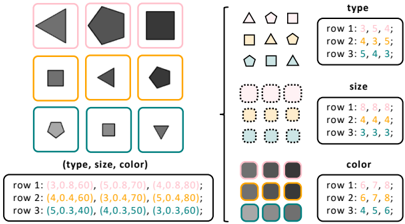
The image is a technical diagram illustrating a classification system for geometric shapes based on three attributes: **type** (shape), **size**, and **color**. It consists of three main components: a 3x3 grid of example shapes (left), a legend defining the attribute categories (right), and a data table mapping grid positions to numerical attribute values (bottom). The diagram appears to be a key for a dataset or a visual encoding scheme, possibly for machine learning, data visualization, or computer graphics.
### Components/Axes
The diagram is segmented into three distinct regions:
1. **Left Region (Example Grid):** A 3x3 grid containing nine shapes. Each shape is enclosed in a colored border (pink, orange, or teal). The shapes themselves are filled with a grayscale value (light gray to dark gray).
2. **Right Region (Legend):** A vertical legend divided into three sections:
* **type:** Defines three shape categories. Each category is represented by a row of three outline shapes.
* Row 1: Triangles (▲, △, ▽)
* Row 2: Pentagons (⬠, ⬠, ⬠) - *Note: All three appear to be the same pentagon symbol.*
* Row 3: Squares (□, □, □) - *Note: All three appear to be the same square symbol.*
* **size:** Defines three size categories using dotted outlines of a square.
* Row 1: Small dotted square
* Row 2: Medium dotted square
* Row 3: Large dotted square
* **color:** Defines three color categories using filled squares.
* Row 1: Light gray, medium gray, dark gray (solid fills)
* Row 2: Orange-bordered squares with light, medium, and dark gray fills.
* Row 3: Teal-bordered squares with light, medium, and dark gray fills.
3. **Bottom Region (Data Table):** A table with the header `(type, size, color)`. It has three rows labeled `row 1`, `row 2`, and `row 3`. Each cell contains a tuple of three numbers.
### Detailed Analysis
**1. Left Grid - Shape Analysis:**
The grid is arranged in three rows and three columns. The border color is consistent within each row.
* **Row 1 (Pink Borders):**
* Column 1: Right-pointing triangle, dark gray fill.
* Column 2: Pentagon, medium gray fill.
* Column 3: Square, dark gray fill.
* **Row 2 (Orange Borders):**
* Column 1: Square, medium gray fill.
* Column 2: Left-pointing triangle, dark gray fill.
* Column 3: Pentagon, dark gray fill.
* **Row 3 (Teal Borders):**
* Column 1: Pentagon, light gray fill.
* Column 2: Square, light gray fill.
* Column 3: Down-pointing triangle, medium gray fill.
**2. Legend - Category Definitions:**
* **Type:** The legend uses outline symbols. The first row shows three distinct triangle orientations. The second and third rows use repeated symbols, suggesting the category is "pentagon" and "square" regardless of minor visual repetition.
* **Size:** Represented by the scale of a dotted square outline. The progression from small to large is clear.
* **Color:** This section is more complex. The first row shows three solid gray fills. The second and third rows show these same gray fills but within orange and teal borders, respectively. This indicates that "color" as an attribute may refer to the *border color* (pink, orange, teal) of the shapes in the main grid, while the fill is a separate, unlisted attribute (grayscale value).
**3. Data Table - Transcription:**
The table maps grid positions (rows) to numerical attribute tuples.
| Row | Col 1 | Col 2 | Col 3 |
|-----|-------|-------|-------|
| Row 1 | (3,0.8,60) | (5,0.8,70) | (4,0.8,80) |
| Row 2 | (4,0.4,60) | (3,0.4,70) | (5,0.4,80) |
| Row 3 | (5,0.3,40) | (4,0.3,50) | (3,0.3,60) |
*Interpretation of Tuple (type, size, color):*
* **First Number (type):** Likely a categorical code. Comparing with the grid: Triangles appear as 3 and 5, Pentagons as 5, Squares as 4. The mapping is not perfectly one-to-one based on the visual alone (e.g., two different triangles have codes 3 and 5).
* **Second Number (size):** A decimal value. Values are consistent within each grid row: 0.8 for Row 1, 0.4 for Row 2, 0.3 for Row 3. This correlates with the "size" legend, where Row 1 (top) is largest and Row 3 (bottom) is smallest. **Trend:** Size value decreases from top grid row to bottom grid row.
* **Third Number (color):** An integer. Values increase across columns within a row (e.g., 60, 70, 80 in Row 1). This likely encodes the grayscale fill darkness (higher number = darker fill), which matches the visual observation (e.g., Row 1, Col 3 is the darkest square and has value 80).
### Key Observations
1. **Attribute Decoupling:** The diagram separates the visual representation (shape, border color, fill) from the underlying data model (type code, size decimal, color integer).
2. **Row-Based Encoding:** The border color (pink, orange, teal) and the `size` value are constant across each row of the main grid. This suggests the grid rows might represent different samples or instances where the `size` attribute is fixed.
3. **Column-Based Variation:** The `color` (fill darkness) value increases from left to right within each grid row, creating a clear gradient.
4. **Type Code Ambiguity:** The numerical codes for `type` (3, 4, 5) do not map cleanly to the three visual shape categories (triangle, pentagon, square) in a simple 1:1 way, as both triangles and pentagons use the code 5. This implies the `type` code may represent a more complex feature or a different classification scheme than the simple visual shape.
### Interpretation
This diagram serves as a **specification or key for a structured dataset** where each item (represented by a shape in the grid) is defined by a triplet of attributes: a categorical `type`, a continuous `size`, and a continuous `color` (likely representing grayscale intensity).
* **What it demonstrates:** It shows how abstract numerical data (the tuples) can be mapped to a visual encoding (shape, size, border color, fill). The legend bridges the gap between the visual symbols and their categorical meanings.
* **Relationships:** The primary relationship is between the data table and the visual grid. Each tuple in the table corresponds to one shape in the grid, read left-to-right, top-to-bottom. The `size` value dictates the row position (or is dictated by it), and the `color` value dictates the fill darkness within that row.
* **Notable Anomaly:** The most significant finding is the disconnect between the visual "type" (triangle, pentagon, square) and the numerical `type` code. This suggests the diagram might be illustrating a scenario where the visual representation is a simplified or projected view of a higher-dimensional data space, or that the `type` code encodes something beyond just the polygon's vertex count (e.g., orientation, as seen with the different triangles). The diagram is less about the shapes themselves and more about the **system for encoding multi-attribute data into a visual form**.
DECODING INTELLIGENCE...