## Cube 3-View Projection
### Overview
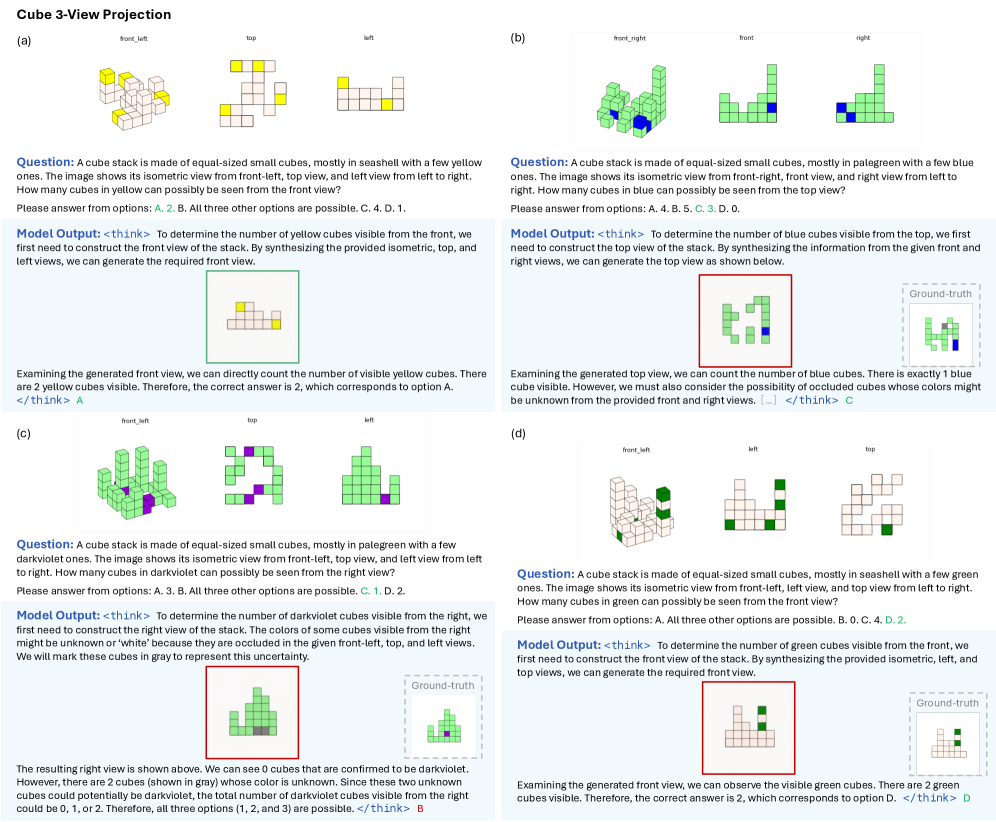
The image presents four separate cube projection problems (a, b, c, d), each involving a stack of equal-sized cubes with a primary color and a few cubes of a secondary color. For each problem, an isometric view and two orthographic views are provided. The task is to determine the maximum number of cubes of the secondary color visible from a specified view. The image includes the problem statement, possible answers, a model's reasoning process, and a "ground-truth" view for comparison.
### Components/Axes
Each sub-problem (a, b, c, d) contains the following elements:
* **Isometric View:** A 3D representation of the cube stack.
* **Orthographic Views:** Two 2D projections of the cube stack from different viewpoints (e.g., front, top, left, right).
* **Question:** A textual description of the problem, specifying the primary and secondary colors, the given views, and the target view.
* **Answer Options:** Multiple-choice options for the number of visible secondary-colored cubes.
* **Model Output:** A textual explanation of the model's reasoning process, including the generation of a specific view.
* **Generated View:** A 2D projection of the cube stack generated by the model, highlighted with a red border.
* **Ground-truth View:** A 2D projection of the cube stack representing the correct view, enclosed in a dashed border.
### Detailed Analysis
**Sub-problem (a):**
* **Colors:** Primary color is seashell, secondary color is yellow.
* **Views:** Isometric (front-left), top, and left views are given.
* **Question:** How many yellow cubes can possibly be seen from the front view?
* **Answer Options:** A. 2, B. All three other options are possible, C. 4, D. 1.
* **Model Output:** The model generates the front view.
* **Generated View:** A 2D projection showing the front view with yellow cubes.
* **Ground-truth View:** Not explicitly labeled, but implied to be the same as the generated view.
* **Model's Answer:** 2, corresponding to option A.
**Sub-problem (b):**
* **Colors:** Primary color is palegreen, secondary color is blue.
* **Views:** Isometric (front-right), front, and right views are given.
* **Question:** How many blue cubes can possibly be seen from the top view?
* **Answer Options:** A. 4, B. 5, C. 3, D. 0.
* **Model Output:** The model generates the top view.
* **Generated View:** A 2D projection showing the top view with blue cubes.
* **Ground-truth View:** A 2D projection of the top view.
* **Model's Answer:** 1, corresponding to option C.
**Sub-problem (c):**
* **Colors:** Primary color is palegreen, secondary color is darkviolet.
* **Views:** Isometric (front-left), top, and left views are given.
* **Question:** How many darkviolet cubes can possibly be seen from the right view?
* **Answer Options:** A. 3, B. All three other options are possible, C. 1, D. 2.
* **Model Output:** The model generates the right view, accounting for uncertainty in occluded cubes.
* **Generated View:** A 2D projection showing the right view with darkviolet and gray (uncertain) cubes.
* **Ground-truth View:** A 2D projection of the right view.
* **Model's Answer:** All three options (1, 2, and 3) are possible, corresponding to option B.
**Sub-problem (d):**
* **Colors:** Primary color is seashell, secondary color is green.
* **Views:** Isometric (front-left), left, and top views are given.
* **Question:** How many green cubes can possibly be seen from the front view?
* **Answer Options:** A. All three other options are possible, B. 0, C. 4, D. 2.
* **Model Output:** The model generates the front view.
* **Generated View:** A 2D projection showing the front view with green cubes.
* **Ground-truth View:** A 2D projection of the front view.
* **Model's Answer:** 2, corresponding to option D.
### Key Observations
* Each sub-problem presents a different configuration of cubes and viewpoints.
* The model attempts to reconstruct a specific view based on the given views.
* In sub-problem (c), the model acknowledges uncertainty due to occlusion.
* The "ground-truth" view serves as a reference for evaluating the model's generated view.
### Interpretation
The image demonstrates a model's ability to reason about 3D cube arrangements and project them into 2D views. The model uses the given views to infer the arrangement of cubes and generate the requested view. The inclusion of "ground-truth" views allows for a comparison of the model's performance against the correct solution. The uncertainty handling in sub-problem (c) highlights the model's awareness of potential ambiguities due to occlusion. The problems vary in difficulty, requiring the model to synthesize information from different viewpoints and handle uncertainty.