TECHNICAL ASSET FINGERPRINT
f197f7c0e50ba3725370ea1b
Click to view fullscreen
Press ESC or click to close
FOUND IN PAPERS
EXPERT: healer-alpha-free VERSION 1
RUNTIME: free/openrouter/healer-alpha
INTEL_VERIFIED
## Cube 3-View Projection: Spatial Reasoning Problems
### Overview
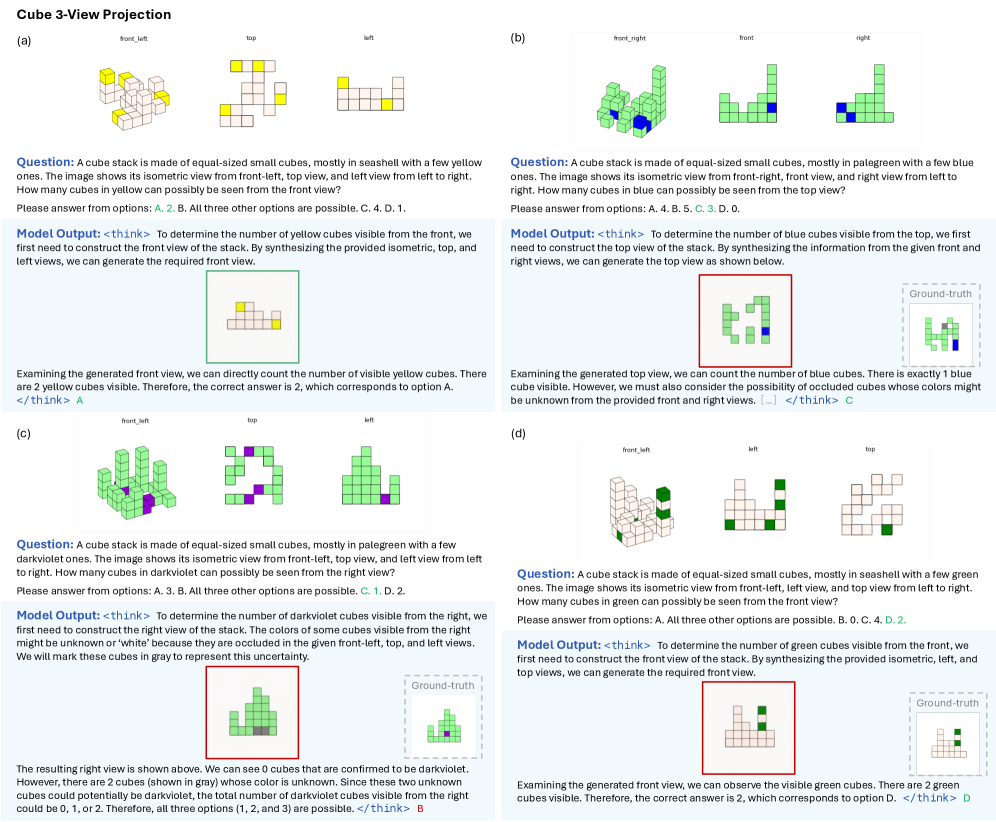
The image presents four distinct spatial reasoning problems (labeled a, b, c, d) involving stacks of colored cubes. Each problem provides three 2D orthographic projections (views) of a 3D cube stack and asks a question about the count of a specific colored cube visible from a particular viewpoint. The image includes the problem statements, multiple-choice options, and a model's step-by-step reasoning ("Model Output") to arrive at an answer. The overall title is "Cube 3-View Projection."
### Components/Axes
The image is divided into four quadrants. Each quadrant contains:
1. **View Labels:** Three labeled isometric views of a cube stack (e.g., `front_left`, `top`, `left`).
2. **Question Text:** A paragraph describing the cube stack's composition and the specific counting question.
3. **Options:** A list of multiple-choice answers (A, B, C, D).
4. **Model Output:** A section showing the model's reasoning process, often including a generated 2D view diagram and a final answer selection.
5. **Ground-truth Diagram:** A small, faint diagram in some quadrants (b, c, d) labeled "Ground-truth," showing the correct view for comparison.
### Detailed Analysis
#### Quadrant (a)
* **Views:** `front_left`, `top`, `left`.
* **Question:** "A cube stack is made of equal-sized small cubes, mostly in seashell with a few yellow ones. The image shows its isometric view from front-left, top view, and left view from left to right. How many cubes in yellow can possibly be seen from the front view?"
* **Options:** A. 2. B. All three other options are possible. C. 4. D. 1.
* **Model Output & Reasoning:** The model synthesizes the three views to construct a front view. It generates a diagram of this front view, showing a 2D grid with yellow squares. It then counts the visible yellow cubes in this generated view: "There are 2 yellow cubes visible." It concludes the answer is 2, corresponding to option **A**.
* **Colors:** Primary stack color: `seashell` (off-white). Accent color: `yellow`.
#### Quadrant (b)
* **Views:** `front_right`, `front`, `right`.
* **Question:** "A cube stack is made of equal-sized small cubes, mostly in palegreen with a few blue ones. The image shows its isometric view from front-right, front view, and right view from left to right. How many cubes in blue can possibly be seen from the top view?"
* **Options:** A. 4. B. 5. C. 3. D. 0.
* **Model Output & Reasoning:** The model constructs a top view from the given views. It generates a diagram of this top view, showing a grid with one blue square. It states: "There is exactly 1 blue cube visible." However, it then considers "the possibility of occluded cubes whose colors might be unknown from the provided front and right views." This uncertainty leads it to select option **C** (3), implying that while one is confirmed, others could be hidden.
* **Colors:** Primary stack color: `palegreen`. Accent color: `blue`.
* **Spatial Grounding:** The generated top view diagram is placed in the center of the model output section. A faint "Ground-truth" diagram is visible to its right.
#### Quadrant (c)
* **Views:** `front_left`, `top`, `left`.
* **Question:** "A cube stack is made of equal-sized small cubes, mostly in palegreen with a few darkviolet ones. The image shows its isometric view from front-left, top view, and left view from left to right. How many cubes in darkviolet can possibly be seen from the right view?"
* **Options:** A. 3. B. All three other options are possible. C. 1. D. 2.
* **Model Output & Reasoning:** The model constructs the right view. It notes that colors of some cubes might be unknown (occluded) and will be marked in gray. It generates a right view diagram showing green and gray cubes, but no darkviolet. It states: "We can see 0 cubes that are confirmed to be darkviolet." However, it identifies 2 gray (unknown) cubes that "could potentially be darkviolet." Therefore, the total could be 0, 1, or 2, making all options possible. It selects option **B**.
* **Colors:** Primary stack color: `palegreen`. Accent color: `darkviolet`. Uncertainty color: `gray`.
* **Spatial Grounding:** The generated right view diagram is centered. The "Ground-truth" diagram is to its right.
#### Quadrant (d)
* **Views:** `front_left`, `left`, `top`.
* **Question:** "A cube stack is made of equal-sized small cubes, mostly in seashell with a few green ones. The image shows its isometric view from front-left, left view, and top view from left to right. How many cubes in green can possibly be seen from the front view?"
* **Options:** A. All three other options are possible. B. 0. C. 4. D. 2.
* **Model Output & Reasoning:** The model synthesizes the views to generate a front view. The generated diagram shows a grid with two green squares. It observes: "There are 2 green cubes visible." It concludes the answer is 2, corresponding to option **D**.
* **Colors:** Primary stack color: `seashell`. Accent color: `green`.
* **Spatial Grounding:** The generated front view diagram is centered. The "Ground-truth" diagram is to its right.
### Key Observations
1. **Problem Structure:** All four problems follow an identical template: provide three 2D views, ask for a count from a fourth, unseen perspective.
2. **Model Reasoning Pattern:** The model consistently attempts to reconstruct the requested 2D view by synthesizing the given views. Its answers depend on whether the reconstruction yields a definitive count or reveals ambiguity due to occlusion.
3. **Handling Uncertainty:** Problems (b) and (c) explicitly deal with uncertainty from occluded cubes. The model's reasoning highlights this, leading to answers that account for multiple possibilities (options B and C, respectively).
4. **Visual Confirmation:** The generated view diagrams in the model output serve as visual proof for its reasoning, allowing for direct verification of the counted cubes.
5. **Ground-Truth Comparison:** The presence of faint "Ground-truth" diagrams in (b), (c), and (d) suggests this image may be from a dataset or evaluation where the model's generated view is compared to the correct one.
### Interpretation
This image is a technical demonstration of a multimodal AI model's capability in **spatial reasoning and 3D reconstruction from 2D projections**. It showcases the model's ability to:
* **Parse and Integrate Multi-View Data:** Correctly interpret three separate orthographic projections of a single 3D object.
* **Perform Mental Rotation/Synthesis:** Combine the information to construct a mental (or in this case, a drawn) model of the object from a new angle.
* **Reason Under Uncertainty:** Identify when information is missing (occluded cubes) and articulate the range of possible answers rather than forcing a single, potentially incorrect, conclusion.
* **Explain Its Process:** Provide a step-by-step, interpretable rationale for its answer, which is crucial for trust and debugging in AI systems.
The problems themselves are classic spatial intelligence tests, often used in cognitive assessments and engineering graphics education. The model's outputs demonstrate a level of proficiency in this domain, successfully navigating both straightforward counts and more complex scenarios involving hidden elements. The variation in color schemes (seashell/yellow, palegreen/blue, etc.) tests the model's ability to track specific attributes across different visual contexts.
DECODING INTELLIGENCE...