## Diagram: Sequential vs. Spatial Data Representation
### Overview
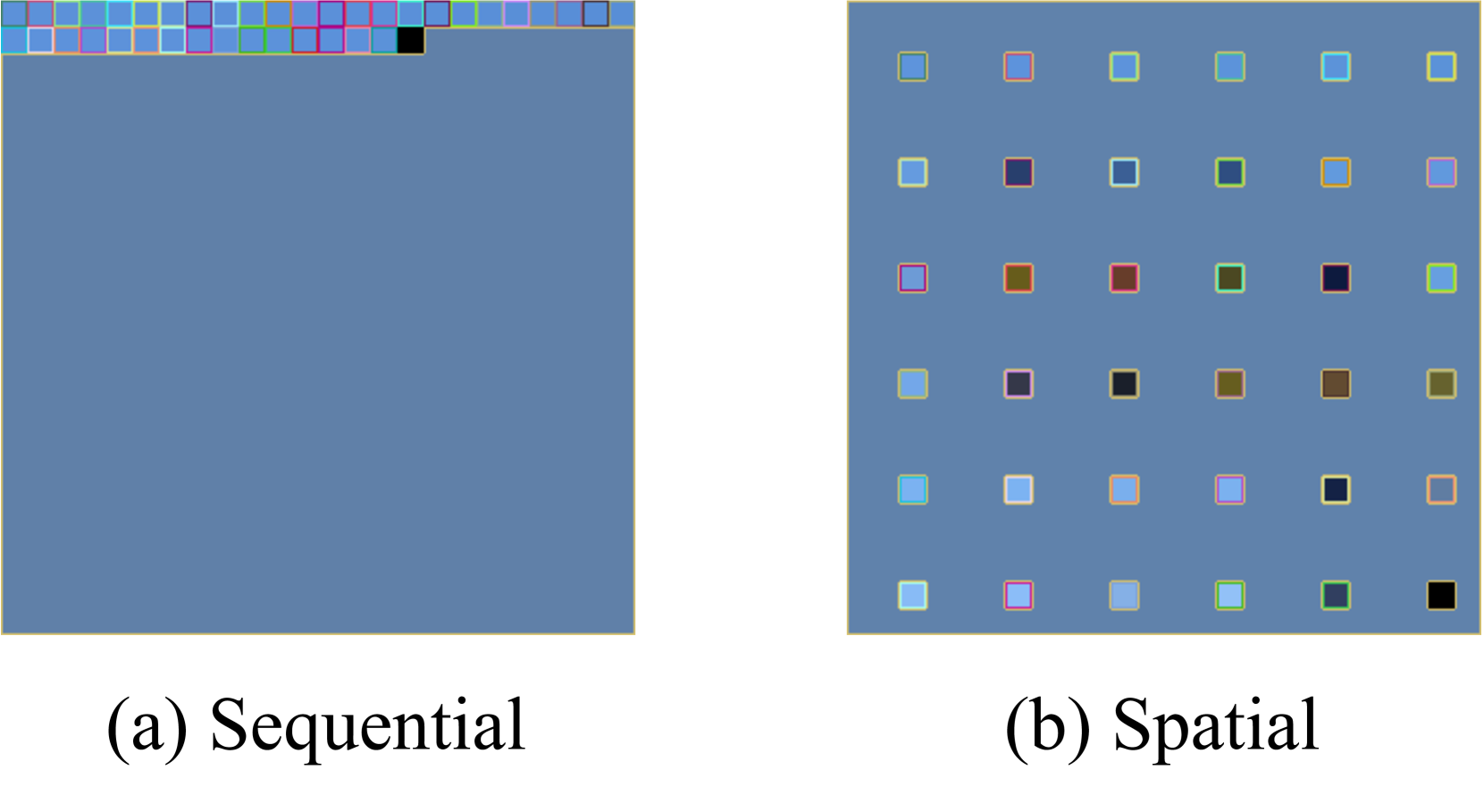
The image presents two diagrams, labeled (a) Sequential and (b) Spatial, illustrating different ways to represent data. Diagram (a) shows data arranged in a linear sequence, while diagram (b) displays the same data distributed spatially in a grid. Both diagrams use colored squares to represent data points, with each square having a distinct color.
### Components/Axes
* **Diagram (a) - Sequential:**
* Title: (a) Sequential
* Data Representation: A single row of colored squares along the top edge of a larger blue square.
* Colors: The squares are colored with a variety of colors including light blue, blue, green, yellow, orange, pink, brown, and black.
* **Diagram (b) - Spatial:**
* Title: (b) Spatial
* Data Representation: A 5x5 grid of colored squares within a larger blue square.
* Colors: The squares are colored with a variety of colors including light blue, blue, green, yellow, orange, pink, brown, and black.
### Detailed Analysis
* **Diagram (a) - Sequential:**
* The colored squares are arranged in a single row at the top of the diagram.
* The sequence of colors appears to be arbitrary.
* The remaining area of the diagram is filled with a uniform blue color.
* **Diagram (b) - Spatial:**
* The colored squares are arranged in a 5x5 grid.
* The colors are distributed seemingly randomly across the grid.
* The background of the grid is a uniform blue color.
* The colors of the squares in the grid appear to match the colors of the squares in the sequential representation.
### Key Observations
* The "Sequential" diagram presents data in a linear order, while the "Spatial" diagram distributes the same data across a two-dimensional grid.
* The color palette used in both diagrams is consistent.
* The spatial arrangement in diagram (b) does not appear to follow any obvious pattern or rule.
### Interpretation
The image illustrates two different approaches to visualizing data: sequential and spatial. The sequential representation is useful for showing data in a specific order or timeline, while the spatial representation can be used to highlight patterns or relationships between data points in a two-dimensional space. The choice of representation depends on the nature of the data and the insights that the visualization is intended to convey. The spatial representation does not seem to have any obvious pattern, suggesting that the spatial arrangement may be arbitrary or based on a specific algorithm not immediately apparent from the image.