\n
## Diagram: Paper Roadmap
### Overview
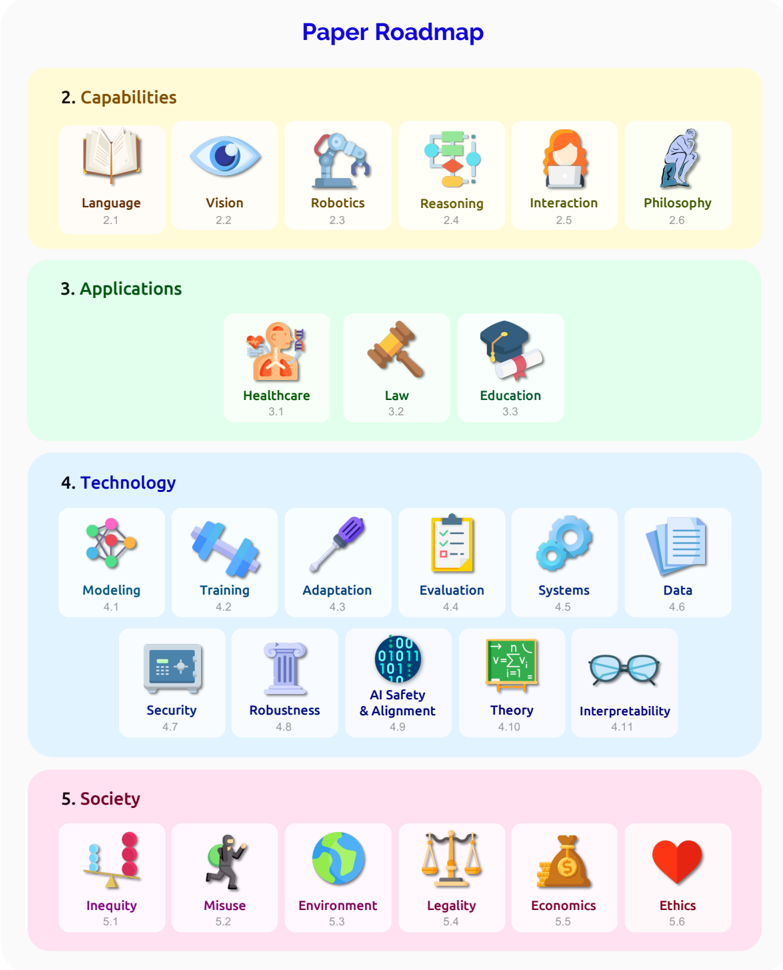
The image presents a roadmap, visually organized into four sections: Capabilities, Applications, Technology, and Society. Each section contains a series of icons representing different concepts, accompanied by labels and version numbers (e.g., 2.1, 3.2). The overall layout is a vertical progression, suggesting a sequence of development or consideration. The title "Paper Roadmap" is positioned at the top of the image.
### Components/Axes
The diagram is structured into four main sections, each with a heading and a set of icons. There are no traditional axes in the chart sense, but the sections themselves act as categories. Each icon is labeled with a descriptive term and a numerical identifier.
* **Section 2: Capabilities** - Includes Language (2.1), Vision (2.2), Robotics (2.3), Reasoning (2.4), Interaction (2.5), and Philosophy (2.6).
* **Section 3: Applications** - Includes Healthcare (3.1), Law (3.2), and Education (3.3).
* **Section 4: Technology** - Includes Modeling (4.1), Training (4.2), Adaptation (4.3), Evaluation (4.4), Systems (4.5), Data (4.6), Security (4.7), Robustness (4.8), AI Safety & Alignment (4.9), Theory (4.10), and Interpretability (4.11).
* **Section 5: Society** - Includes Inequity (5.1), Misuse (5.2), Environment (5.3), Legality (5.4), Economics (5.5), and Ethics (5.6).
### Detailed Analysis or Content Details
The diagram consists of icons arranged horizontally within each section. Each icon is paired with a label and a version number. The version numbers appear to indicate a progression or prioritization within each category.
* **Language (2.1):** Icon of a book.
* **Vision (2.2):** Icon of an eye.
* **Robotics (2.3):** Icon of a robot.
* **Reasoning (2.4):** Icon of a gear/cog.
* **Interaction (2.5):** Icon of two people.
* **Philosophy (2.6):** Icon of a head.
* **Healthcare (3.1):** Icon of a person with a cross.
* **Law (3.2):** Icon of scales of justice.
* **Education (3.3):** Icon of a graduation cap.
* **Modeling (4.1):** Icon of a geometric shape.
* **Training (4.2):** Icon of a microphone.
* **Adaptation (4.3):** Icon of a chameleon.
* **Evaluation (4.4):** Icon of a checklist.
* **Systems (4.5):** Icon of a globe with connections.
* **Data (4.6):** Icon of a document.
* **Security (4.7):** Icon of a shield with a lock.
* **Robustness (4.8):** Icon of a pillar.
* **AI Safety & Alignment (4.9):** Icon of binary code.
* **Theory (4.10):** Icon of a funnel.
* **Interpretability (4.11):** Icon of a magnifying glass.
* **Inequity (5.1):** Icon of broken pieces.
* **Misuse (5.2):** Icon of a hand with a warning sign.
* **Environment (5.3):** Icon of a tree.
* **Legality (5.4):** Icon of a gavel.
* **Economics (5.5):** Icon of a coin.
* **Ethics (5.6):** Icon of a person.
### Key Observations
The diagram presents a holistic view of considerations related to "Paper Roadmap," encompassing capabilities, applications, technology, and societal impacts. The version numbers suggest a potential order of development or importance. The visual arrangement is clean and organized, making it easy to grasp the different components.
### Interpretation
This "Paper Roadmap" appears to outline the key areas of focus for a research or development project, likely related to Artificial Intelligence (AI) given the inclusion of "AI Safety & Alignment." The roadmap progresses from foundational capabilities (Language, Vision) to practical applications (Healthcare, Law) and the underlying technology (Modeling, Training) before concluding with societal considerations (Inequity, Ethics). The version numbers could represent a phased approach to development, with lower numbers indicating earlier stages. The inclusion of societal impacts as the final section highlights the importance of responsible AI development. The roadmap is not presenting data in the traditional sense, but rather a conceptual framework for organizing thoughts and priorities. It's a high-level overview, and each category would likely require further detailed exploration.