## Diagram: Paper Roadmap
### Overview
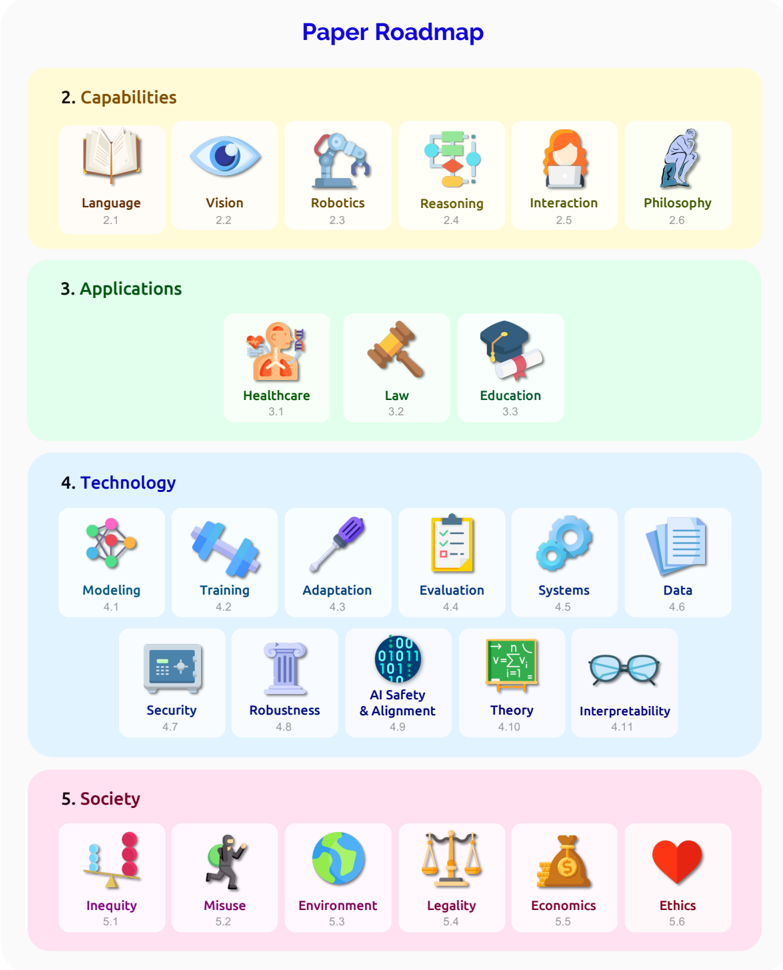
The image is a structured, hierarchical diagram titled "Paper Roadmap." It visually organizes the key topics of a research paper or field survey into four major categories, each presented as a colored horizontal band. Each category contains a series of sub-topics, represented by an icon, a label, and a numerical identifier (e.g., 2.1, 3.2). The layout is clean and uses a consistent card-based design for each sub-topic.
### Components/Axes
The diagram is segmented into four primary, vertically stacked regions, each with a distinct background color and a numbered title:
1. **Title:** "Paper Roadmap" (centered at the top, dark blue text).
2. **Section 2: Capabilities** (Light yellow background)
* Contains 6 sub-topic cards arranged horizontally.
3. **Section 3: Applications** (Light green background)
* Contains 3 sub-topic cards arranged horizontally.
4. **Section 4: Technology** (Light blue background)
* Contains 11 sub-topic cards arranged in two horizontal rows (6 in the first row, 5 in the second).
5. **Section 5: Society** (Light pink background)
* Contains 6 sub-topic cards arranged horizontally.
Each sub-topic card consists of:
* A representative icon.
* A text label (the topic name).
* A numerical identifier (e.g., 2.1) below the label.
### Detailed Analysis
**Section 2: Capabilities**
* **2.1 Language** (Icon: Open book)
* **2.2 Vision** (Icon: Eye)
* **2.3 Robotics** (Icon: Robotic arm)
* **2.4 Reasoning** (Icon: Flowchart/diagram)
* **2.5 Interaction** (Icon: Person at a computer)
* **2.6 Philosophy** (Icon: Statue of "The Thinker")
**Section 3: Applications**
* **3.1 Healthcare** (Icon: Heart with a heartbeat line and DNA helix)
* **3.2 Law** (Icon: Gavel)
* **3.3 Education** (Icon: Graduation cap and diploma)
**Section 4: Technology**
* **First Row:**
* **4.1 Modeling** (Icon: Network/graph structure)
* **4.2 Training** (Icon: Dumbbell/weights)
* **4.3 Adaptation** (Icon: Screwdriver)
* **4.4 Evaluation** (Icon: Clipboard with checklist)
* **4.5 Systems** (Icon: Gears)
* **4.6 Data** (Icon: Stack of documents)
* **Second Row:**
* **4.7 Security** (Icon: Safe/vault)
* **4.8 Robustness** (Icon: Classical pillar)
* **4.9 AI Safety & Alignment** (Icon: Binary code "01011 101" inside a shield)
* **4.10 Theory** (Icon: Chalkboard with mathematical formulas)
* **4.11 Interpretability** (Icon: Eyeglasses)
**Section 5: Society**
* **5.1 Inequity** (Icon: Unbalanced scale with people)
* **5.2 Misuse** (Icon: Person in a trench coat and hat, suggesting malicious intent)
* **5.3 Environment** (Icon: Globe/Earth)
* **5.4 Legality** (Icon: Balanced scale of justice)
* **5.5 Economics** (Icon: Money bag with a dollar sign)
* **5.6 Ethics** (Icon: Heart)
### Key Observations
* **Hierarchical Numbering:** The numbering system (2.x, 3.x, etc.) clearly indicates a parent-child relationship, suggesting this roadmap corresponds to sections or chapters in a larger document.
* **Categorical Grouping:** The diagram logically groups related concepts. Foundational "Capabilities" lead to practical "Applications," which are enabled by underlying "Technology," all of which have implications for "Society."
* **Visual Consistency:** All sub-topics are presented with equal visual weight (same card size and style), indicating they are considered parallel components within their respective categories.
* **Iconography:** Each icon is a direct, literal representation of its label, aiding quick visual recognition.
### Interpretation
This roadmap provides a comprehensive taxonomy for analyzing the field of Artificial Intelligence (AI). It moves from core competencies (Capabilities) to real-world uses (Applications), then delves into the technical mechanisms (Technology) that make them possible, and finally considers the broad societal consequences (Society).
The structure suggests a paper or survey that aims to be holistic, connecting technical details with ethical and practical considerations. The inclusion of sections like "AI Safety & Alignment" (4.9), "Inequity" (5.1), and "Ethics" (5.6) highlights a modern, responsible approach to AI research that explicitly addresses risks and societal impact alongside technical progress. The roadmap implies that advancements in capabilities and technology are not isolated but are deeply intertwined with their applications and societal outcomes.