## Line Chart: Top-rule Accuracy Across Layers for Four Emotions
### Overview
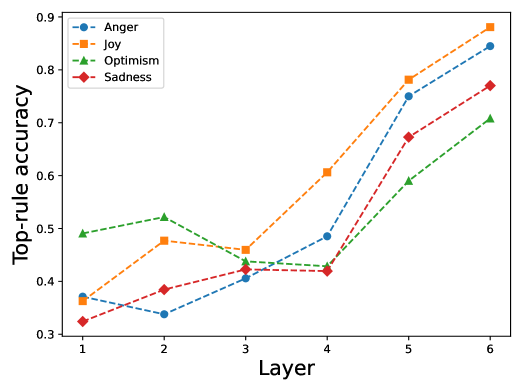
This image is a line chart displaying the "Top-rule accuracy" of four different emotions (Anger, Joy, Optimism, Sadness) across six sequential layers (1 through 6). The chart illustrates how the accuracy of a rule-based classification or detection system for these emotions changes as the model depth (layer) increases.
### Components/Axes
* **Chart Type:** Multi-line chart with markers.
* **X-Axis:** Labeled **"Layer"**. It has discrete integer markers from 1 to 6.
* **Y-Axis:** Labeled **"Top-rule accuracy"**. It is a continuous scale ranging from 0.3 to 0.9, with major tick marks at 0.1 intervals (0.3, 0.4, 0.5, 0.6, 0.7, 0.8, 0.9).
* **Legend:** Located in the **top-left corner** of the chart area. It defines four data series:
* **Anger:** Blue dashed line with circle markers (`o`).
* **Joy:** Orange dashed line with square markers (`s`).
* **Optimism:** Green dashed line with triangle-up markers (`^`).
* **Sadness:** Red dashed line with diamond markers (`D`).
### Detailed Analysis
The chart plots the approximate accuracy values for each emotion at each layer. The following table reconstructs the data points based on visual inspection. Values are approximate.
| Layer | Anger (Blue, Circle) | Joy (Orange, Square) | Optimism (Green, Triangle) | Sadness (Red, Diamond) |
| :---- | :------------------- | :-------------------- | :------------------------- | :--------------------- |
| 1 | ~0.37 | ~0.36 | ~0.49 | ~0.32 |
| 2 | ~0.34 | ~0.48 | ~0.52 | ~0.39 |
| 3 | ~0.41 | ~0.46 | ~0.44 | ~0.42 |
| 4 | ~0.49 | ~0.61 | ~0.43 | ~0.42 |
| 5 | ~0.75 | ~0.78 | ~0.59 | ~0.67 |
| 6 | ~0.85 | ~0.88 | ~0.71 | ~0.77 |
**Trend Verification per Series:**
* **Anger (Blue):** Starts at ~0.37, dips at Layer 2 (~0.34), then shows a consistent and steep upward trend from Layer 3 onward, ending at ~0.85.
* **Joy (Orange):** Starts at ~0.36, rises at Layer 2 (~0.48), dips slightly at Layer 3 (~0.46), then exhibits a strong, steady increase through Layers 4-6, achieving the highest final accuracy of ~0.88.
* **Optimism (Green):** Begins as the highest at Layer 1 (~0.49), peaks at Layer 2 (~0.52), then declines to a low at Layer 4 (~0.43) before recovering with a moderate upward trend to ~0.71.
* **Sadness (Red):** Shows the most consistent, gradual upward trend overall. It starts lowest at Layer 1 (~0.32) and increases nearly monotonically (with a plateau between Layers 3-4) to ~0.77.
### Key Observations
1. **General Upward Trend:** All four emotions show a significant increase in top-rule accuracy from the early layers (1-3) to the later layers (5-6). The most dramatic improvements occur between Layers 4 and 5.
2. **Performance Shift:** Optimism is the top-performing emotion in early layers (1-2), but is overtaken by both Joy and Anger in later layers. Joy becomes the highest-performing emotion by Layer 6.
3. **Convergence and Divergence:** The accuracy values for all emotions are relatively clustered between ~0.32 and ~0.52 in Layers 1-3. They begin to diverge significantly from Layer 4 onward, spreading across a wider range (from ~0.43 to ~0.61 at Layer 4, and from ~0.71 to ~0.88 at Layer 6).
4. **Relative Ordering Change:** The ranking of emotions by accuracy changes across layers. For example, at Layer 1: Optimism > Anger > Joy > Sadness. At Layer 6: Joy > Anger > Sadness > Optimism.
### Interpretation
This chart likely visualizes the performance of a hierarchical or deep learning model where different layers capture increasingly complex features. The data suggests:
* **Layer Specialization:** The early layers (1-3) may be extracting low-level, general features that are less discriminative for specific emotions, resulting in lower and more similar accuracy scores. The sharp rise in accuracy after Layer 4 indicates that deeper layers learn more abstract, emotion-specific representations.
* **Emotion Complexity:** The differing trajectories imply that the rules or features defining "Optimism" might be more readily accessible in shallow processing, while "Joy" and "Anger" require deeper, more complex feature integration to be accurately identified by the top-rule mechanism. "Sadness" shows steady, linear improvement, suggesting its defining features are built up consistently across layers.
* **Model Behavior:** The system's ability to apply its most confident rule ("top-rule") for classification improves dramatically with depth. This is a common pattern in deep neural networks, where higher-level layers form more semantically meaningful and separable representations. The crossover in performance (e.g., Joy surpassing Optimism) highlights that the optimal layer for extracting rules is emotion-dependent.
**Language Declaration:** All text within the chart image is in English.