## Diagram: Cognitive Functions and Computational Model
### Overview
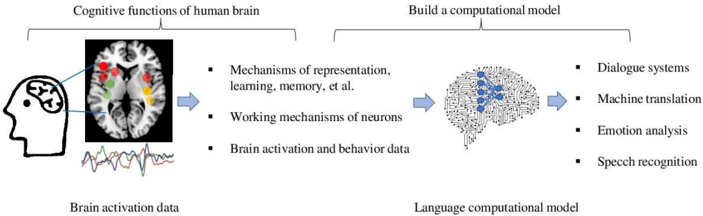
The image illustrates the process of building a computational model based on cognitive functions of the human brain. It shows the flow from brain activation data to a language computational model, highlighting key aspects like mechanisms of representation, neuron workings, and applications like dialogue systems and machine translation.
### Components/Axes
* **Header:** Contains two main titles: "Cognitive functions of human brain" and "Build a computational model".
* **Left Side:**
* A line drawing of a human head in profile.
* A brain scan image with highlighted regions in red, green, and yellow.
* A graph showing brain activation data with three lines (blue, green, and red).
* Label: "Brain activation data"
* **Middle Section:**
* Three bullet points:
* Mechanisms of representation, learning, memory, et al.
* Working mechanisms of neurons
* Brain activation and behavior data
* Two blue arrows indicating the flow of information.
* **Right Side:**
* A brain-shaped diagram composed of interconnected nodes and lines.
* Four bullet points:
* Dialogue systems
* Machine translation
* Emotion analysis
* Speech recognition
* Label: "Language computational model"
### Detailed Analysis or ### Content Details
* **Brain Scan:** The brain scan shows highlighted regions. The approximate locations are:
* Red: Frontal lobe, both hemispheres
* Green: Parietal lobe, left hemisphere
* Yellow: Temporal lobe, right hemisphere
* **Brain Activation Data:** The graph shows three lines, each with varying amplitudes and frequencies, suggesting different activation patterns.
* Blue line: Shows a relatively stable pattern with small fluctuations.
* Green line: Exhibits more frequent and larger amplitude changes.
* Red line: Shows a pattern with both high and low amplitude peaks.
* **Computational Model:** The brain-shaped diagram on the right represents a neural network or similar computational model. The nodes are interconnected, symbolizing the complex relationships within the model.
### Key Observations
* The diagram illustrates a progression from raw brain activation data to a computational model capable of language-related tasks.
* The bullet points in the middle section highlight the key areas of study and modeling.
* The applications listed on the right side (dialogue systems, machine translation, etc.) represent the potential outcomes of this research.
### Interpretation
The diagram presents a high-level overview of how cognitive functions of the human brain can be translated into computational models, specifically for language-related tasks. It suggests that understanding the mechanisms of representation, neuron workings, and brain activation patterns is crucial for developing these models. The diagram implies a research direction where brain data informs the creation of AI systems capable of complex language processing. The connection between brain activation data and specific cognitive functions is a key element, suggesting that different brain regions and activation patterns are linked to different aspects of language processing.