## Diagram: From Human Brain Cognitive Functions to Language Computational Models
### Overview
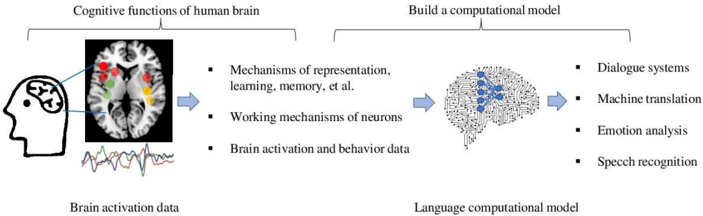
This image is a conceptual flow diagram illustrating the interdisciplinary process of deriving computational models of language from the study of the human brain. It depicts a pipeline starting with the analysis of brain activation data, moving through the understanding of cognitive and neural mechanisms, and culminating in the creation of a "Language computational model" that powers various AI applications. The diagram is divided into two primary conceptual phases: understanding the brain and building the model.
### Components/Axes
The diagram is organized into two main sections connected by a central blue arrow, indicating a directional flow of information and methodology.
**Left Section: Cognitive functions of human brain**
* **Header Label:** "Cognitive functions of human brain"
* **Visual Elements:**
1. **Brain Scan Image:** A coronal slice of a human brain MRI scan is shown. Specific regions are highlighted with colored overlays: red, yellow, and green. These likely indicate areas of activation or specific anatomical regions of interest.
2. **Waveform Graph:** Below the brain scan is a line graph labeled "Brain activation data." It shows a fluctuating waveform, representing time-series data such as an EEG or fMRI signal.
* **Textual Components (Bullet Points):**
* "Mechanisms of representation, learning, memory, et al."
* "Working mechanisms of neurons"
* "Brain activation and behavior data"
**Central Connector:**
* A large, solid blue arrow points from the left section to the right section, symbolizing the translation of biological understanding into computational frameworks.
**Right Section: Build a computational model**
* **Header Label:** "Build a computational model"
* **Visual Elements:**
1. **Neural Network Diagram:** A stylized illustration of an artificial neural network, composed of interconnected nodes (dots) and lines. A cluster of nodes in the center is highlighted in blue, possibly representing a core processing module or a specific layer.
* **Textual Components:**
* **Label below network:** "Language computational model"
* **Bullet Points (Applications):**
* "Dialogue systems"
* "Machine translation"
* "Emotion analysis"
* "Speech recognition"
### Detailed Analysis
The diagram presents a clear, linear methodology:
1. **Input Source:** The process begins with the human brain as the source of intelligence. The "Brain activation data" (waveform) and the localized activity in the brain scan (colored regions) serve as the empirical foundation.
2. **Knowledge Extraction:** The bullet points under the brain section list the types of knowledge sought from neuroscience: high-level cognitive mechanisms (representation, learning), cellular-level workings (neurons), and raw behavioral/neural data.
3. **Model Construction:** The central arrow signifies the core research endeavor: using the extracted knowledge to "Build a computational model." The neural network icon is a direct visual metaphor for this model, specifically a "Language computational model."
4. **Output Applications:** The final stage lists concrete AI applications that this language model enables. The flow suggests that a model informed by brain science can effectively handle complex language tasks like dialogue, translation, emotion detection, and speech recognition.
### Key Observations
* **Interdisciplinary Bridge:** The diagram explicitly bridges neuroscience (left) and artificial intelligence/computational linguistics (right).
* **Data-to-Application Pipeline:** It visualizes a complete pipeline from raw biological data to deployed technological applications.
* **Abstraction Level:** The left side deals with concrete, physical data (brain scans, waveforms), while the right side deals with abstract, functional systems (computational models, software applications).
* **Visual Metaphors:** The use of a biological brain scan contrasted with an artificial neural network diagram is a powerful visual metaphor for the field of neuromorphic computing or brain-inspired AI.
### Interpretation
This diagram encapsulates a research paradigm in cognitive science and AI: **reverse-engineering the brain to build better machines.** It argues that by understanding the "how" of human language processing—its neural substrates and cognitive mechanisms—we can design more robust, efficient, and perhaps more human-like artificial language models.
The inclusion of "emotion analysis" as an application is particularly noteworthy. It suggests the model aims to capture not just the syntactic and semantic aspects of language, but also its affective and pragmatic dimensions, which are deeply rooted in human brain function. The diagram implies that a model grounded in brain data is better positioned to handle such nuanced tasks.
The flow is unidirectional, from brain to model. This presents a specific viewpoint: that neuroscience primarily *informs* AI. A more complex, bidirectional relationship (where AI models also help test hypotheses about the brain) is not depicted here. The diagram is a high-level conceptual map, not a technical specification, and thus omits the immense complexity and current limitations in directly translating neural data into functional algorithms.