## Line Charts: ε vs. Time for Varying Ks
### Overview
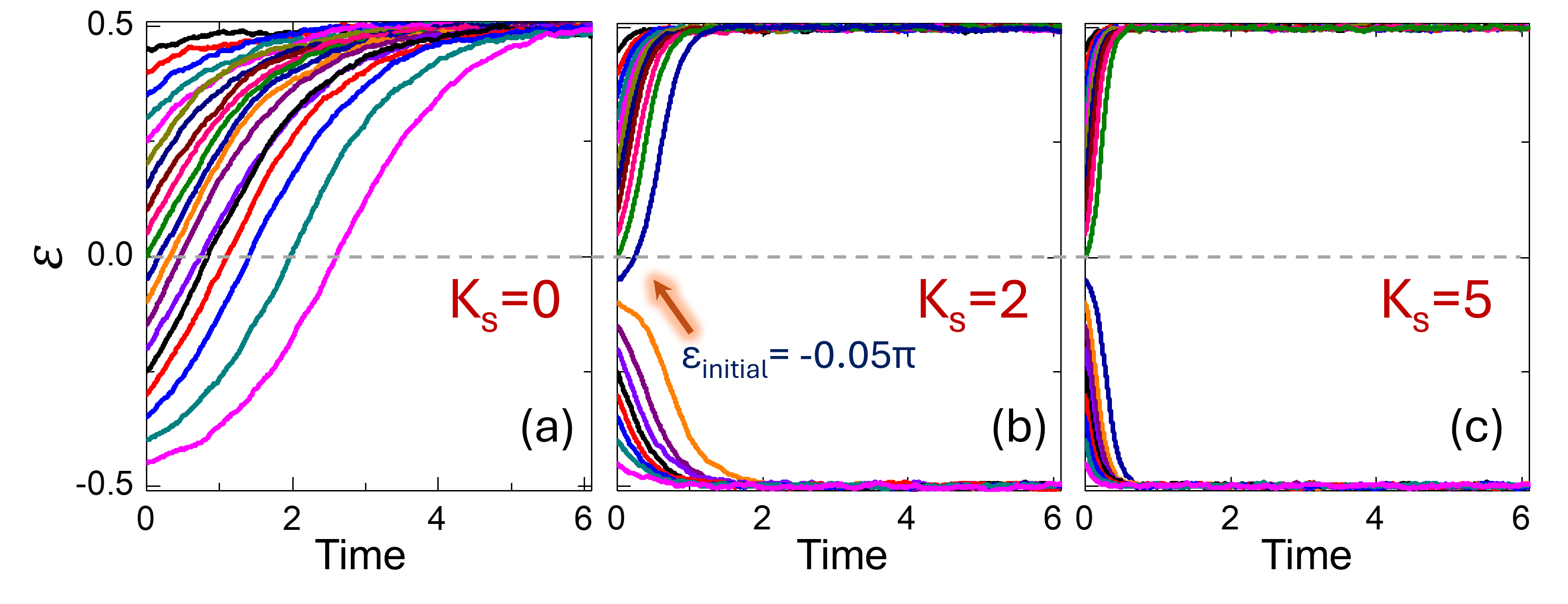
The image presents three line charts arranged horizontally, each displaying the relationship between ε (epsilon) and Time. The charts differ in their Ks values (Ks = 0, Ks = 2, and Ks = 5), which are indicated on each chart. Each chart contains multiple lines, each likely representing a different initial condition or parameter. The initial value of epsilon is indicated as εinitial = -0.05π on the second chart.
### Components/Axes
* **X-axis (Time):** All three charts share the same x-axis, labeled "Time," ranging from 0 to 6.
* **Y-axis (ε):** All three charts share the same y-axis, labeled "ε," ranging from -0.5 to 0.5. A dashed horizontal line is present at ε = 0.0.
* **Chart Titles:** Each chart is labeled with its corresponding Ks value:
* Chart (a): Ks = 0
* Chart (b): Ks = 2
* Chart (c): Ks = 5
* **Initial Condition:** Chart (b) includes the annotation "εinitial = -0.05π" with an arrow pointing to the region where the lines originate.
* **Line Colors:** The charts contain multiple lines of different colors, including magenta, teal, blue, red, black, purple, orange, brown, and green. There is no explicit legend, so the meaning of each color is not directly specified.
### Detailed Analysis
**Chart (a): Ks = 0**
* Trend: All lines start at different values below ε = 0 and increase over time, converging towards a value near ε = 0.5.
* Specific Values:
* The magenta line starts at approximately ε = -0.45 and gradually increases to approximately ε = 0.45.
* The teal line starts at approximately ε = -0.35 and increases to approximately ε = 0.45.
* The blue line starts at approximately ε = -0.25 and increases to approximately ε = 0.45.
* The red line starts at approximately ε = -0.15 and increases to approximately ε = 0.45.
* The black line starts at approximately ε = -0.05 and increases to approximately ε = 0.5.
**Chart (b): Ks = 2**
* Trend: All lines start at different values below ε = 0 and quickly converge to either a value near ε = 0.5 or a value near ε = -0.5.
* Specific Values:
* The orange line starts at approximately ε = -0.05π and decreases to approximately ε = -0.5.
* The purple line starts at approximately ε = -0.15 and decreases to approximately ε = -0.5.
* The black line starts at approximately ε = -0.05 and increases to approximately ε = 0.5.
* The blue line starts at approximately ε = -0.25 and increases to approximately ε = 0.5.
* The red line starts at approximately ε = -0.15 and increases to approximately ε = 0.5.
* The green line starts at approximately ε = -0.35 and increases to approximately ε = 0.5.
* The magenta line starts at approximately ε = -0.45 and decreases to approximately ε = -0.5.
**Chart (c): Ks = 5**
* Trend: All lines quickly converge to either a value near ε = 0.5 or a value near ε = -0.5.
* Specific Values:
* Most lines start near ε = -0.5 and remain there.
* A few lines start near ε = 0.5 and remain there.
### Key Observations
* As Ks increases, the convergence of ε to either 0.5 or -0.5 becomes more rapid.
* When Ks = 0, ε gradually increases towards 0.5.
* When Ks = 2, ε either increases to 0.5 or decreases to -0.5.
* When Ks = 5, ε remains close to its initial value of either 0.5 or -0.5.
### Interpretation
The charts illustrate the effect of the parameter Ks on the evolution of ε over time. The data suggests that Ks influences the stability and convergence of the system. When Ks is low (Ks = 0), the system gradually evolves towards a stable state. As Ks increases (Ks = 2), the system exhibits bistability, converging to one of two stable states (ε = 0.5 or ε = -0.5). When Ks is high (Ks = 5), the system becomes highly stable, remaining close to its initial state. The initial condition εinitial = -0.05π in Chart (b) highlights the starting point for some of the lines, indicating that the initial value of ε influences the final state when Ks = 2.