## Diagram: EcoCycle Conceptual Framework
### Overview
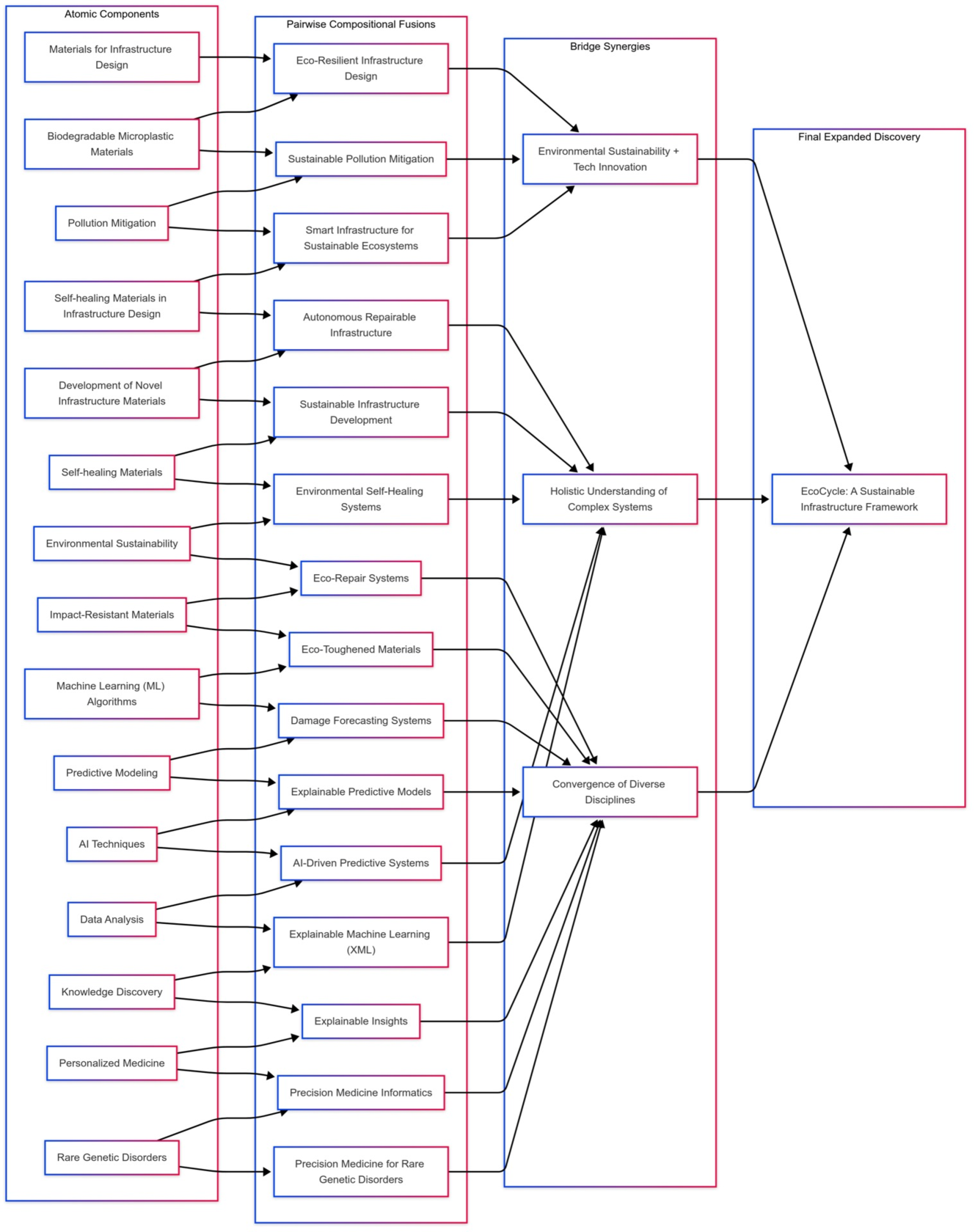
This image is a directed acyclic graph (flowchart) illustrating the synthesis of disparate scientific and engineering disciplines into a unified, high-level framework titled "EcoCycle: A Sustainable Infrastructure Framework." The diagram is organized into four vertical stages (columns) that progress from left to right, representing a progression from "Atomic Components" to "Final Expanded Discovery."
### Components/Axes
The diagram is structured into four distinct vertical regions, each containing rectangular nodes with blue-to-red gradient borders:
1. **Column 1 (Left - Atomic Components):** Contains 15 foundational concepts.
2. **Column 2 (Center-Left - Pairwise Compositional Fusions):** Contains 15 intermediate concepts formed by combining elements from Column 1.
3. **Column 3 (Center-Right - Bridge Synergies):** Contains 3 high-level synthesis concepts.
4. **Column 4 (Right - Final Expanded Discovery):** Contains the single terminal goal.
### Detailed Analysis
#### Stage 1: Atomic Components to Pairwise Compositional Fusions
The flow moves from the 15 items in the first column to the 15 items in the second column.
| Source (Column 1) | Target (Column 2) |
| :--- | :--- |
| Materials for Infrastructure Design | Eco-Resilient Infrastructure Design |
| Biodegradable Microplastic Materials | Sustainable Pollution Mitigation |
| Pollution Mitigation | Sustainable Pollution Mitigation AND Smart Infrastructure for Sustainable Ecosystems |
| Self-healing Materials in Infrastructure Design | Autonomous Repairable Infrastructure |
| Development of Novel Infrastructure Materials | Sustainable Infrastructure Development |
| Self-healing Materials | Environmental Self-Healing Systems |
| Environmental Sustainability | Environmental Self-Healing Systems |
| Impact-Resistant Materials | Eco-Repair Systems AND Eco-Toughened Materials |
| Machine Learning (ML) Algorithms | Damage Forecasting Systems AND AI-Driven Predictive Systems |
| Predictive Modeling | Damage Forecasting Systems AND Explainable Predictive Models |
| AI Techniques | AI-Driven Predictive Systems |
| Data Analysis | Explainable Machine Learning (XML) |
| Knowledge Discovery | Explainable Insights |
| Personalized Medicine | Precision Medicine Informatics |
| Rare Genetic Disorders | Precision Medicine for Rare Genetic Disorders |
#### Stage 2: Pairwise Compositional Fusions to Bridge Synergies
The 15 items in the second column converge into the 3 items in the third column.
| Bridge Synergy (Column 3) | Contributing Pairwise Fusions (Column 2) |
| :--- | :--- |
| **Environmental Sustainability + Tech Innovation** | Eco-Resilient Infrastructure Design, Sustainable Pollution Mitigation, Smart Infrastructure for Sustainable Ecosystems |
| **Holistic Understanding of Complex Systems** | Autonomous Repairable Infrastructure, Sustainable Infrastructure Development, Environmental Self-Healing Systems |
| **Convergence of Diverse Disciplines** | Eco-Repair Systems, Eco-Toughened Materials, Damage Forecasting Systems, Explainable Predictive Models, AI-Driven Predictive Systems, Explainable Machine Learning (XML), Explainable Insights, Precision Medicine Informatics, Precision Medicine for Rare Genetic Disorders |
#### Stage 3: Bridge Synergies to Final Expanded Discovery
All three items in the "Bridge Synergies" column converge into the final node:
* **Environmental Sustainability + Tech Innovation** → EcoCycle: A Sustainable Infrastructure Framework
* **Holistic Understanding of Complex Systems** → EcoCycle: A Sustainable Infrastructure Framework
* **Convergence of Diverse Disciplines** → EcoCycle: A Sustainable Infrastructure Framework
### Key Observations
* **High Convergence:** The diagram exhibits a funnel-like structure. While the first two columns maintain a 1:1 or 1:2 ratio, the third column acts as a massive aggregator, particularly the "Convergence of Diverse Disciplines" node, which absorbs 9 out of the 15 intermediate concepts.
* **Thematic Grouping:** The "Atomic Components" column is a mix of materials science, environmental science, AI/data science, and medical science. The "Pairwise" column attempts to contextualize these into applied systems (e.g., "Precision Medicine for Rare Genetic Disorders").
* **Outlier/Anomaly:** The inclusion of "Personalized Medicine" and "Rare Genetic Disorders" in the "Atomic Components" column is notable. These are biological/medical fields, whereas the rest of the diagram focuses on infrastructure and environmental engineering. Their inclusion suggests the "EcoCycle" framework is intended to be a transdisciplinary model that applies medical informatics logic to infrastructure systems.
### Interpretation
This diagram represents a roadmap for **Transdisciplinary Innovation**. It argues that complex, sustainable infrastructure cannot be solved by engineering alone. Instead, it requires a "fusion" approach where:
1. **Hard Engineering** (Materials, Infrastructure) is augmented by **Computational Intelligence** (ML, Predictive Modeling).
2. **Biological/Medical Logic** (Personalized Medicine, Rare Genetic Disorders) is abstracted and applied to infrastructure (Precision Medicine Informatics).
The "EcoCycle" framework is presented as the ultimate synthesis of these disparate fields. The diagram suggests that by treating infrastructure as a "living" or "complex" system—similar to how one treats a biological organism—we can achieve a higher level of sustainability and resilience. The "Bridge Synergies" column acts as the conceptual layer that translates technical components into actionable, holistic strategies.