TECHNICAL ASSET FINGERPRINT
f2384c819ebe2d7b7f8fe96c
Click to view fullscreen
Press ESC or click to close
FOUND IN PAPERS
EXPERT: gemini-3.1-pro-preview VERSION 1
RUNTIME: gemini/gemini-3.1-pro-preview
INTEL_VERIFIED
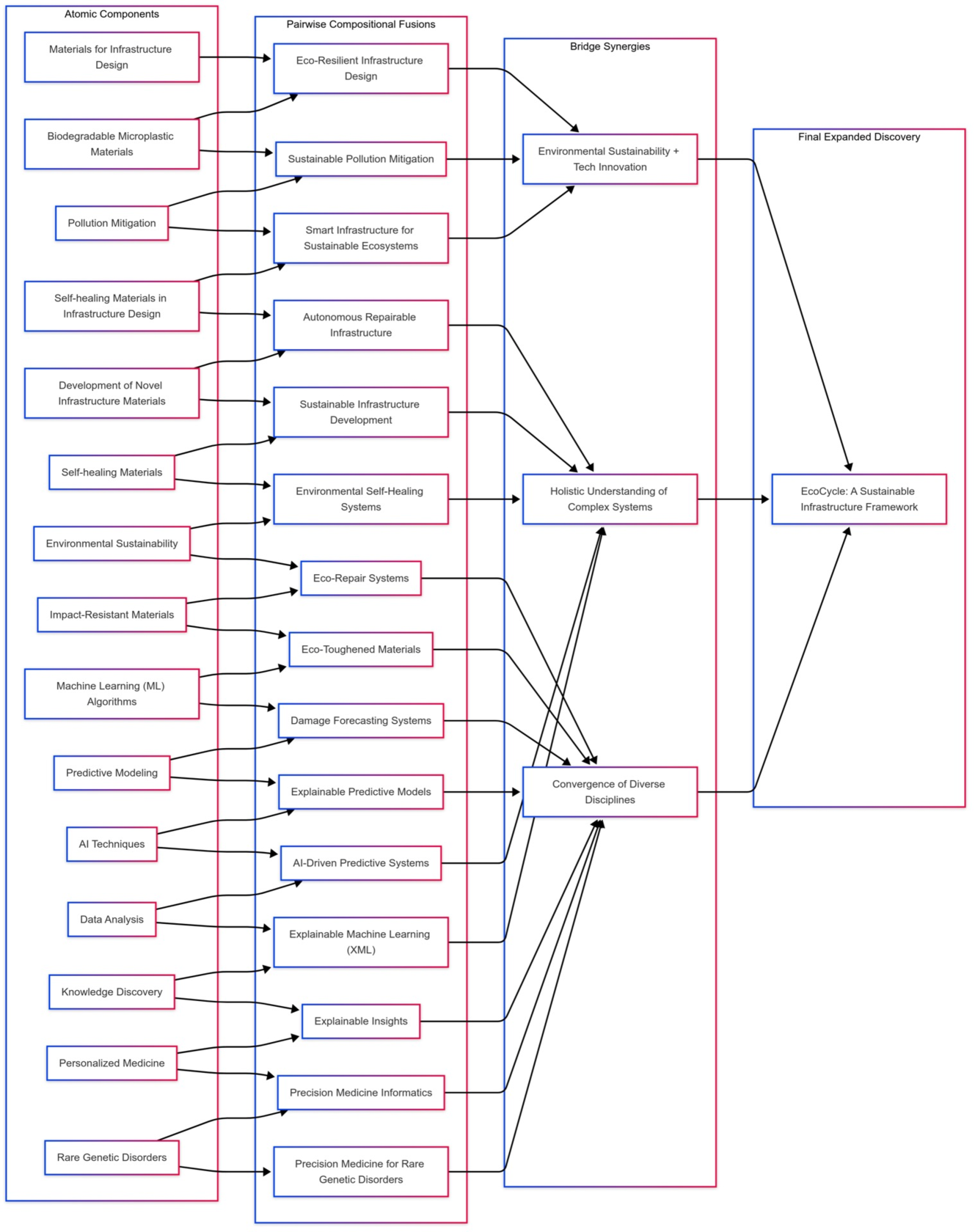
## Diagram: Concept Fusion Flowchart for EcoCycle Framework
### Overview
This image is a left-to-right process flowchart or concept map demonstrating how foundational concepts are merged and synthesized into increasingly complex frameworks, ultimately resulting in a single unified concept. The diagram is divided into four distinct vertical columns, representing stages of conceptual evolution.
### Components/Axes
The diagram contains no traditional axes, scales, or legends. Instead, it relies on spatial positioning and directional arrows to convey relationships.
* **Columns (Regions):** There are four main vertical bounding boxes, each with a header title.
1. **Atomic Components** (Far Left)
2. **Pairwise Compositional Fusions** (Center Left)
3. **Bridge Synergies** (Center Right)
4. **Final Expanded Discovery** (Far Right)
* **Nodes (Boxes):** Within each column are smaller rectangular boxes containing text.
* **Styling:** All bounding boxes and internal node boxes feature a gradient border that transitions from blue on the left/top to red on the right/bottom.
* **Flow:** Solid black lines with arrowheads connect the nodes, indicating a directional flow of information or conceptual merging from left to right.
### Content Details
Below is the precise transcription of all text and the mapping of the directional flow, isolated by column progression.
#### Stage 1 to Stage 2: Atomic Components $\rightarrow$ Pairwise Compositional Fusions
The first column contains 15 "Atomic Components." These merge, primarily in overlapping pairs, to form the 15 concepts in the second column.
1. **Materials for Infrastructure Design** + **Biodegradable Microplastic Materials** $\rightarrow$ merge into $\rightarrow$ **Eco-Resilient Infrastructure Design**
2. **Biodegradable Microplastic Materials** + **Pollution Mitigation** $\rightarrow$ merge into $\rightarrow$ **Sustainable Pollution Mitigation**
3. **Pollution Mitigation** + **Self-healing Materials in Infrastructure Design** $\rightarrow$ merge into $\rightarrow$ **Smart Infrastructure for Sustainable Ecosystems**
4. **Self-healing Materials in Infrastructure Design** + **Development of Novel Infrastructure Materials** $\rightarrow$ merge into $\rightarrow$ **Autonomous Repairable Infrastructure**
5. **Development of Novel Infrastructure Materials** + **Self-healing Materials** $\rightarrow$ merge into $\rightarrow$ **Sustainable Infrastructure Development**
6. **Self-healing Materials** + **Environmental Sustainability** $\rightarrow$ merge into $\rightarrow$ **Environmental Self-Healing Systems**
7. **Environmental Sustainability** + **Impact-Resistant Materials** $\rightarrow$ merge into $\rightarrow$ **Eco-Repair Systems**
8. **Impact-Resistant Materials** + **Machine Learning (ML) Algorithms** $\rightarrow$ merge into $\rightarrow$ **Eco-Toughened Materials**
9. **Machine Learning (ML) Algorithms** + **Predictive Modeling** $\rightarrow$ merge into $\rightarrow$ **Damage Forecasting Systems**
10. **Predictive Modeling** + **AI Techniques** $\rightarrow$ merge into $\rightarrow$ **Explainable Predictive Models**
11. **AI Techniques** + **Data Analysis** $\rightarrow$ merge into $\rightarrow$ **AI-Driven Predictive Systems**
12. **Data Analysis** + **Knowledge Discovery** $\rightarrow$ merge into $\rightarrow$ **Explainable Machine Learning (XML)**
13. **Knowledge Discovery** + **Personalized Medicine** $\rightarrow$ merge into $\rightarrow$ **Explainable Insights**
14. **Personalized Medicine** + **Rare Genetic Disorders** $\rightarrow$ merge into $\rightarrow$ **Precision Medicine Informatics**
15. **Rare Genetic Disorders** (alone) $\rightarrow$ flows into $\rightarrow$ **Precision Medicine for Rare Genetic Disorders**
#### Stage 2 to Stage 3: Pairwise Compositional Fusions $\rightarrow$ Bridge Synergies
The 15 concepts from Column 2 are grouped and funneled into 3 broader categories in Column 3.
* **Group 1 flows into "Environmental Sustainability + Tech Innovation"**
* Eco-Resilient Infrastructure Design
* Sustainable Pollution Mitigation
* Smart Infrastructure for Sustainable Ecosystems
* **Group 2 flows into "Holistic Understanding of Complex Systems"**
* Autonomous Repairable Infrastructure
* Sustainable Infrastructure Development
* Environmental Self-Healing Systems
* Eco-Repair Systems
* **Group 3 flows into "Convergence of Diverse Disciplines"**
* Eco-Toughened Materials
* Damage Forecasting Systems
* Explainable Predictive Models
* AI-Driven Predictive Systems
* Explainable Machine Learning (XML)
* Explainable Insights
* Precision Medicine Informatics
* Precision Medicine for Rare Genetic Disorders
*Note on Internal Flow:* There is an upward diagonal arrow inside Column 3 pointing from **Convergence of Diverse Disciplines** to **Holistic Understanding of Complex Systems**.
#### Stage 3 to Stage 4: Bridge Synergies $\rightarrow$ Final Expanded Discovery
All three nodes in Column 3 converge into a single final node in Column 4.
* **Environmental Sustainability + Tech Innovation** $\rightarrow$ flows into $\rightarrow$ **EcoCycle: A Sustainable Infrastructure Framework**
* **Holistic Understanding of Complex Systems** $\rightarrow$ flows into $\rightarrow$ **EcoCycle: A Sustainable Infrastructure Framework**
* **Convergence of Diverse Disciplines** $\rightarrow$ flows into $\rightarrow$ **EcoCycle: A Sustainable Infrastructure Framework**
### Key Observations
* **Overlapping Pairwise Logic:** The transition from Column 1 to Column 2 follows a strict overlapping pattern. Node 1 and 2 make Result 1; Node 2 and 3 make Result 2, etc. This visually justifies the term "Pairwise Compositional Fusions."
* **Thematic Drift:** The "Atomic Components" begin with physical engineering concepts (infrastructure, materials, microplastics), transition in the middle to computer science (Machine Learning, AI, Data Analysis), and abruptly end with medical biology (Personalized Medicine, Rare Genetic Disorders).
* **Asymmetrical Convergence:** The funneling into Column 3 is highly asymmetrical. The top node receives 3 inputs, the middle receives 4 inputs, and the bottom node receives 8 inputs (encompassing all the AI and Medical concepts).
### Interpretation
This diagram appears to map the conceptual generation of an interdisciplinary framework called "EcoCycle." It illustrates how base-level ideas are combined to create novel, cross-disciplinary solutions.
However, reading between the lines, the data suggests this may be the output of an automated semantic network traversal, a knowledge graph generation, or an AI brainstorming tool. The evidence for this is the severe thematic drift. The diagram attempts to force a relationship between "Infrastructure Design" and "Rare Genetic Disorders" by using "Machine Learning" and "Data Analysis" as a bridge.
The final output, "EcoCycle: A Sustainable Infrastructure Framework," logically aligns with the top half of the diagram (materials, pollution, self-healing). The bottom half of the diagram (precision medicine, genetics) is forced into the final framework through the highly abstracted "Convergence of Diverse Disciplines" node. This suggests the diagram is demonstrating a theoretical or algorithmic exercise in connecting disparate academic fields, rather than a practical, real-world engineering schematic.
DECODING INTELLIGENCE...