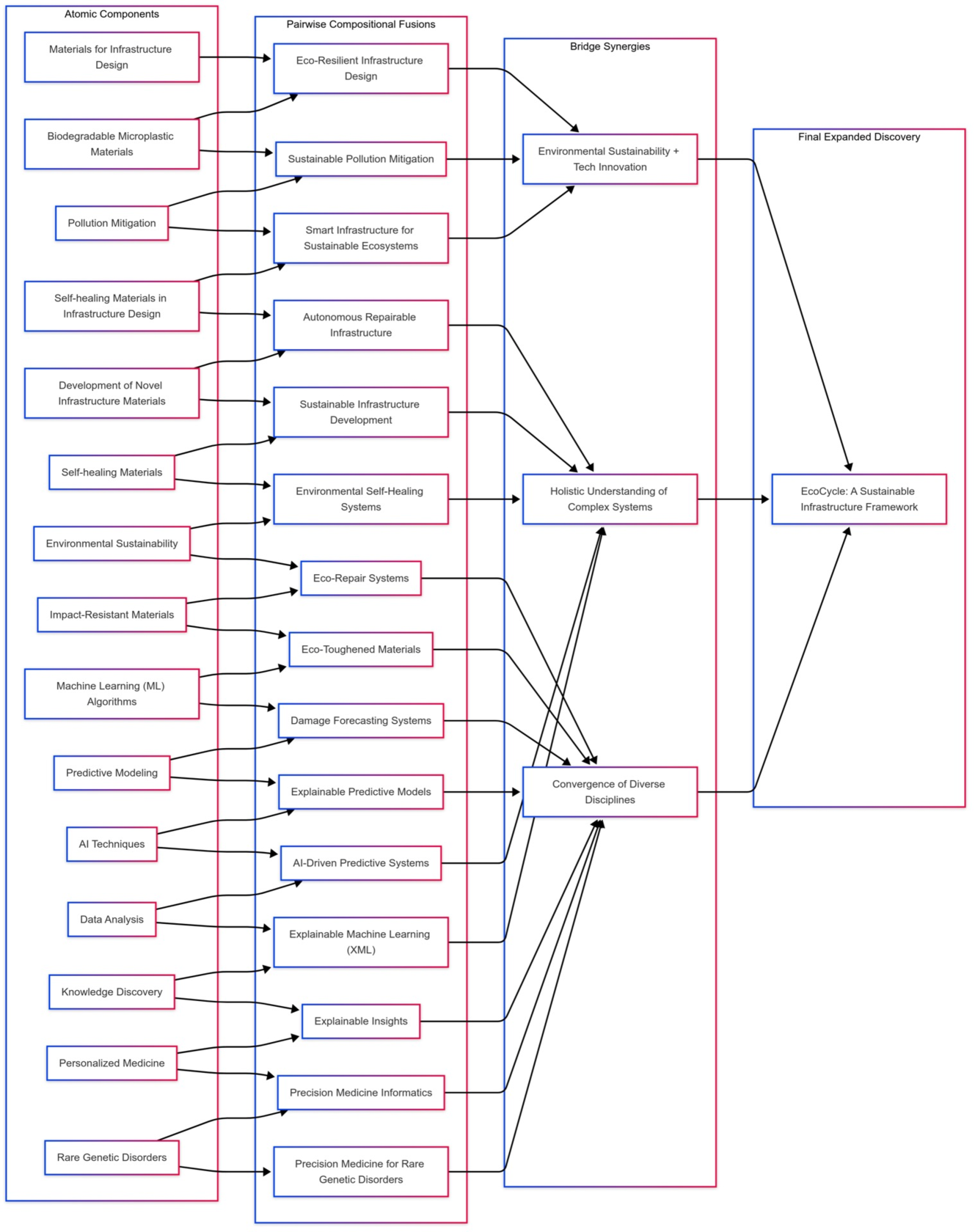
## Flowchart: Hierarchical Integration of Sustainable Infrastructure Concepts
### Overview
The flowchart illustrates a multi-stage conceptual framework for developing sustainable infrastructure systems. It progresses from foundational materials and technologies through intermediate composite solutions to a final integrated framework called "EcoCycle." The diagram uses color-coded boxes (blue for foundational elements, pink for composite solutions) connected by directional arrows showing conceptual evolution.
### Components/Axes
1. **Columns Structure**:
- **Left Column (Blue)**: "Atomic Components" (15 elements)
- **Middle Column (Blue/Pink)**: "Pairwise Compositional Fusions" (15 elements)
- **Right Column (Pink)**: "Bridge Synergies" (5 elements)
- **Final Box (Pink)**: "Final Expanded Discovery"
2. **Key Labels**:
- **Atomic Components**:
- Materials for Infrastructure Design
- Biodegradable Microplastic Materials
- Pollution Mitigation
- Self-healing Materials in Infrastructure Design
- Development of Novel Infrastructure Materials
- Self-healing Materials
- Environmental Sustainability
- Impact-Resistant Materials
- Machine Learning (ML) Algorithms
- Predictive Modeling
- AI Techniques
- Data Analysis
- Knowledge Discovery
- Personalized Medicine
- Rare Genetic Disorders
- **Pairwise Fusions**:
- Eco-Resilient Infrastructure Design
- Sustainable Pollution Mitigation
- Smart Infrastructure for Sustainable Ecosystems
- Autonomous Repairable Infrastructure
- Sustainable Infrastructure Development
- Environmental Self-Healing Systems
- Eco-Repair Systems
- Eco-Toughed Materials
- Damage Forecasting Systems
- Explainable Predictive Models
- AI-Driven Predictive Systems
- Explainable Machine Learning (XML)
- Explainable Insights
- Precision Medicine Informatics
- Precision Medicine for Rare Genetic Disorders
- **Bridge Synergies**:
- Environmental Sustainability + Tech Innovation
- Holistic Understanding of Complex Systems
- Convergence of Diverse Disciplines
- **Final Discovery**:
- EcoCycle: A Sustainable Infrastructure Framework
3. **Color Coding**:
- Blue boxes: Foundational components and initial fusions
- Pink boxes: Advanced integrations and final framework
### Detailed Analysis
1. **Conceptual Flow**:
- **Stage 1 (Atomic Components)**: Lists 15 foundational elements spanning materials science, environmental tech, and AI/ML applications.
- **Stage 2 (Pairwise Fusions)**: Combines two atomic components each to create 15 intermediate solutions (e.g., "Materials + Sustainability" → "Eco-Resilient Infrastructure").
- **Stage 3 (Bridge Synergies)**: Merges intermediate solutions into three overarching concepts, culminating in the final framework.
2. **Key Connections**:
- Environmental Sustainability (Atomic) → Eco-Repair Systems (Pairwise) → Convergence of Diverse Disciplines (Bridge)
- Machine Learning Algorithms (Atomic) → Explainable ML (Pairwise) → Convergence of Diverse Disciplines (Bridge)
3. **Color Consistency**:
- All atomic components (blue) feed into pairwise fusions (blue/pink transition)
- Bridge synergies and final framework use pink boxes, indicating higher-level integration
### Key Observations
1. **Hierarchical Progression**: Each stage builds complexity, with the final framework representing synthesis of all preceding elements.
2. **Interdisciplinary Focus**: Combines materials science, environmental tech, and AI/ML into a unified system.
3. **Self-Healing Emphasis**: Multiple components address adaptive infrastructure systems (e.g., self-healing materials, environmental self-healing systems).
4. **Predictive Capabilities**: Multiple stages incorporate predictive modeling and ML-driven systems.
### Interpretation
This flowchart demonstrates a systems-thinking approach to sustainable infrastructure development. It shows how:
1. **Foundational Innovations** (e.g., biodegradable materials, ML algorithms) enable **Composite Solutions** (e.g., self-healing infrastructure, predictive maintenance systems).
2. These solutions then converge through **Cross-Disciplinary Integration** to form a holistic framework (EcoCycle) that addresses environmental, technological, and adaptive challenges simultaneously.
3. The use of color coding visually reinforces the progression from basic components to complex systems, suggesting a methodology for incremental innovation in sustainable infrastructure design.
The framework emphasizes both technical innovation (materials science, AI) and systemic thinking (holistic understanding, convergence of disciplines), positioning EcoCycle as a comprehensive solution for future infrastructure challenges.