## Code Snippet: Python Function Definitions
### Overview
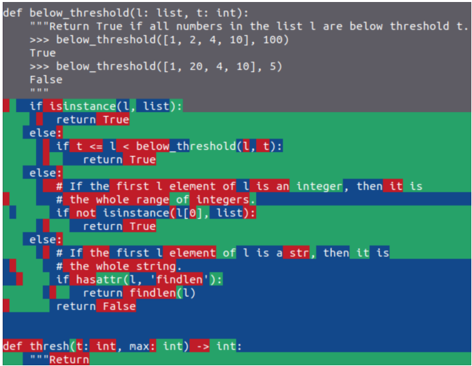
The image presents a snippet of Python code, featuring two function definitions: `below_threshold` and `thresh`. The code includes type hints, docstrings, conditional statements, and function calls. The code appears to be partially highlighted, with some words in red and others in blue.
### Components/Axes
* **Function Definitions:** `below_threshold(l: list, t: int)` and `thresh(t: int, max: int) -> int`
* **Docstrings:** Explanatory text within triple quotes (`"""..."""`) describing the function's purpose and providing example usages.
* **Conditional Statements:** `if`, `else` blocks controlling the flow of execution.
* **Type Hints:** Annotations indicating the expected data types of function arguments and return values (e.g., `l: list`, `t: int`, `-> int`).
* **Highlighting:** Red and blue highlighting on certain words, possibly indicating syntax or semantic elements.
### Detailed Analysis or ### Content Details
**1. `below_threshold(l: list, t: int)` Function:**
* **Signature:** Takes a list `l` and an integer `t` as input.
* **Docstring:**
* "Return True if all numbers in the list l are below threshold t."
* Example 1: `below_threshold([1, 2, 4, 10], 100)` returns `True`.
* Example 2: `below_threshold([1, 20, 4, 10], 5)` returns `False`.
* **Code Logic:**
* `if isinstance(l, list):`
* `return True`
* `else:`
* `if t <= l < below_threshold(l, t):`
* `return True`
* `else:`
* `# If the first l element of l is an integer, then it is`
* `# the whole range of integers.`
* `if not isinstance(l[0], list):`
* `return True`
* `else:`
* `# If the first l element of l is a str, then it is`
* `# the whole string.`
* `if hasattr(l, 'findlen'):`
* `return findlen(l)`
* `return False`
**2. `thresh(t: int, max: int) -> int` Function:**
* **Signature:** Takes two integers `t` and `max` as input and is expected to return an integer.
* **Docstring:** "Return" (incomplete).
**Highlighting:**
* The words highlighted in red and blue are interspersed throughout the code.
* The highlighting does not appear to follow a consistent pattern related to syntax or semantics.
### Key Observations
* The `below_threshold` function's logic is incomplete and contains potentially problematic recursive calls (`below_threshold(l, t)` within the `if t <= l < below_threshold(l, t):` condition).
* The docstring for `thresh` is incomplete.
* The highlighting is unexplained and may be an artifact of the code editor or a debugging tool.
### Interpretation
The code snippet presents two Python function definitions, one of which (`below_threshold`) has incomplete logic and potential recursion issues. The highlighting is unexplained. The `below_threshold` function is intended to check if all numbers in a list are below a given threshold. The `thresh` function's purpose is unclear due to the incomplete docstring. The code requires further development and clarification to be fully functional and understandable.