\n
## Code Snippet: Python Function Definitions
### Overview
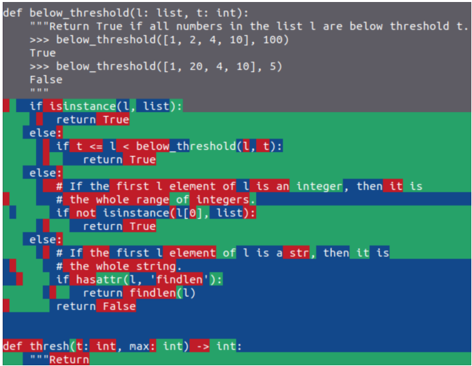
The image displays a screenshot of Python code, specifically function definitions related to checking if elements in a list are below a threshold and a function named `thresh`. The code is presented in a dark-themed text editor, with syntax highlighting to differentiate keywords, variables, and strings.
### Components/Axes
The image consists of multiple code blocks. The primary components are:
1. `below_threshold(l: list, t: int)` function definition and examples.
2. Conditional statements within an unnamed function.
3. `thresh(t: int, max: int) -> int` function definition.
The code uses syntax highlighting with the following colors:
* Green: Keywords (def, if, else, return, instance, True, False)
* Blue: Function names and variables (below\_threshold, l, t, thresh, max)
* Red: Numbers and integers (1, 2, 4, 10, 100, 20, 5)
* Dark Gray: Background
* Light Gray: Comments
### Detailed Analysis or Content Details
**1. `below_threshold(l: list, t: int)` Function:**
```python
def below_threshold(l: list, t: int):
"""Return True if all numbers in the list l are below threshold t."""
>>> below_threshold([1, 2, 4, 10], 100)
True
>>> below_threshold([1, 20, 4, 10], 5)
False
```
This function takes a list `l` and an integer `t` as input. It returns `True` if all numbers in the list `l` are below the threshold `t`, and `False` otherwise. Two example calls are provided:
* `below_threshold([1, 2, 4, 10], 100)` returns `True`.
* `below_threshold([1, 20, 4, 10], 5)` returns `False`.
**2. Conditional Statements:**
```python
if instance(l, list):
return True
else:
if t < l:
return True
else:
# If the first l element of l is an integer, then it is
# the whole range of integers.
if not instance(l[0], list):
return True
else:
# If the first l element of l is a str, then it is
# the whole string.
if hasattr(l, 'findlen'):
return findlen(l)
return False
```
This block of code contains nested conditional statements.
* The first `if` statement checks if `l` is an instance of a list. If it is, it returns `True`.
* If `l` is not a list, the `else` block is executed.
* Inside the `else` block, another `if` statement checks if `t` is less than `l`. If it is, it returns `True`.
* If `t` is not less than `l`, another `else` block is executed.
* This nested `else` block checks if the first element of `l` is not an instance of a list. If it is not, it returns `True`.
* If the first element of `l` is a list, another `else` block is executed.
* This final `else` block checks if `l` has an attribute named `'findlen'`. If it does, it returns the result of calling `findlen(l)`. Otherwise, it returns `False`.
**3. `thresh(t: int, max: int) -> int` Function:**
```python
def thresh(t: int, max: int) -> int:
"""Return"""
```
This function definition is incomplete. It takes two integer arguments, `t` and `max`, and is annotated to return an integer. The docstring is incomplete, only containing the word "Return".
### Key Observations
* The code snippet demonstrates a mix of function definitions and conditional logic.
* The `below_threshold` function provides a clear example of list processing and threshold comparison.
* The conditional statements are deeply nested and somewhat complex, potentially indicating an incomplete or evolving algorithm.
* The `thresh` function is incomplete, suggesting it is still under development.
* The use of type hints (`l: list`, `t: int`, `-> int`) indicates modern Python coding practices.
### Interpretation
The code appears to be part of a larger program that involves data analysis or validation. The `below_threshold` function is a utility for checking if values fall within a specified range. The nested conditional statements suggest a more complex decision-making process, potentially involving different data types or conditions. The incomplete `thresh` function hints at ongoing development or a missing component. The code's structure and use of type hints suggest a focus on readability and maintainability. The comments provide some insight into the intended logic, but the overall purpose of the code remains somewhat unclear without additional context. The use of `hasattr` and `findlen` suggests the code might be designed to handle different data structures or objects with varying attributes. The code is likely intended to be used in a data processing pipeline or a validation system.