\n
## Code Screenshot: Python Function Definitions
### Overview
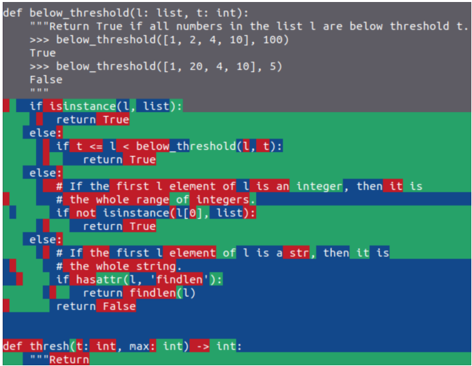
The image is a screenshot of Python code displayed in a dark-themed code editor with syntax highlighting. It contains two function definitions: `below_threshold` and `thresh`. The code includes docstrings, type hints, conditional logic, and comments. The syntax highlighting uses colors to distinguish different code elements (e.g., keywords, strings, comments).
### Components/Axes
This is not a chart or diagram with axes. The components are textual code elements:
- **Function Definitions**: `below_threshold(l: list, t: int)` and `thresh(t: int, max: int) -> int`.
- **Docstrings**: Multi-line strings (in red) describing function purpose and examples.
- **Comments**: Lines starting with `#` (in green) explaining logic.
- **Control Flow**: `if`, `elif`, `else` statements (keywords in blue).
- **Function Calls**: `isinstance()`, `findlen()`.
- **Return Statements**: `return True`, `return False`, `return findlen(l)`.
- **Type Hints**: `list`, `int`, `-> int`.
### Detailed Analysis
**Line-by-Line Transcription & Description:**
1. **Function 1: `below_threshold`**
* **Definition**: `def below_threshold(l: list, t: int):`
* **Docstring**:
```python
"""Return True if all numbers in the list l are below threshold t.
>>> below_threshold([1, 2, 4, 10], 100)
True
>>> below_threshold([1, 20, 4, 10], 5)
False
"""
```
* **Function Body**:
* `if isinstance(l, list):` -> `return True`
* `else:` -> `if t <= l < below_threshold(l, t):` -> `return True`
* `else:` -> Contains a comment block and further logic.
* Comment: `# If the first l element of l is an integer, then it is # the whole range of integers`
* `if not isinstance(l[0], list):` -> `return True`
* `else:` -> Contains another comment and logic.
* Comment: `# If the first l element of l is a str, then it is # the whole string.`
* `if hasattr(l, 'findlen'):` -> `return findlen(l)`
* `return False`
2. **Function 2: `thresh` (Partially Visible)**
* **Definition**: `def thresh(t: int, max: int) -> int:`
* **Docstring (Partial)**:
```python
"""Return
```
The docstring is cut off at the bottom of the image.
**Syntax Highlighting Colors (Approximate):**
- **Background**: Dark gray (`#3C3F41`).
- **Keywords (`def`, `if`, `else`, `return`, `not`)**: Blue.
- **Function/Method Names (`below_threshold`, `isinstance`, `findlen`)**: Light blue/cyan.
- **Strings & Docstrings**: Red/orange.
- **Comments**: Green.
- **Numbers (`100`, `5`)**: Light blue.
- **Type Hints (`list`, `int`)**: Italicized, grayish.
- **Operators & Punctuation**: White or light gray.
### Key Observations
1. **Logic Structure**: The `below_threshold` function has a complex, nested conditional structure that appears to handle different data types (lists, integers, strings) within the input `l`.
2. **Recursive Call**: The line `if t <= l < below_threshold(l, t):` contains a call to itself (`below_threshold`), which is unusual and could lead to infinite recursion if not carefully bounded, as the parameters `l` and `t` do not change in the recursive call.
3. **Type Checking**: The function uses `isinstance()` and `hasattr()` to check the type and attributes of its input, suggesting it is designed to handle heterogeneous data structures.
4. **Incomplete Code**: The second function, `thresh`, is only partially visible. Its docstring and body are cut off.
5. **Potential Typos/Ambiguity**: The comments refer to "the first l element of l", which is ambiguous. It likely means "the first element of `l`".
### Interpretation
The code defines a utility function, `below_threshold`, intended to check if all numeric elements in a (potentially nested or mixed-type) list are below a given threshold `t`. However, the implementation contains significant logical issues:
1. **Recursive Logic Flaw**: The recursive call `below_threshold(l, t)` within the condition `t <= l < below_threshold(l, t)` is problematic. It compares the threshold `t` to the list `l` itself (which would raise a `TypeError` in Python) and then to the result of a recursive call with identical arguments. This would almost certainly cause a `RecursionError` for any non-trivial input, as there is no base case that reduces the problem size in this branch.
2. **Unclear Intent**: The nested checks for `isinstance(l[0], list)` and `hasattr(l, 'findlen')` suggest the function might be trying to handle different container types (lists, strings) in a generic way, but the logic is convoluted and the comments are not fully clear. The function's actual behavior for complex inputs is difficult to predict from this code alone.
3. **Document vs. Implementation Mismatch**: The docstring provides simple examples with flat lists of integers, but the function body attempts to handle much more complex, nested, or custom objects. This indicates the implementation may be over-engineered or still in development for use cases not reflected in its documentation.
In summary, while the image provides the full text of the `below_threshold` function, the code itself appears to be a work-in-progress or contains logical errors that would prevent it from functioning as described in its docstring for general inputs. The `thresh` function is incomplete and cannot be analyzed.