## Screenshot: Python Code with Syntax Highlighting
### Overview
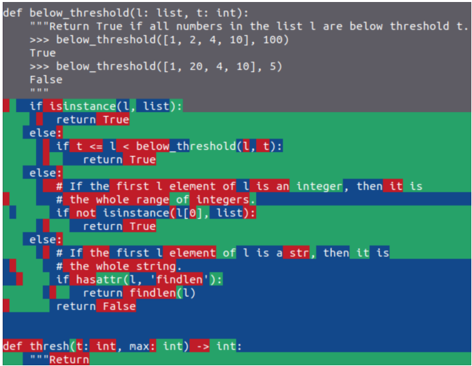
The image displays a Python code snippet with syntax highlighting. It includes two functions (`below_threshold` and `thresh`), example usages, and comments. The code is structured with indentation, and keywords, strings, and comments are color-coded (red, green, blue, gray).
### Components/Axes
- **Syntax Highlighting Colors**:
- **Red**: Keywords (`def`, `if`, `else`, `return`, `True`, `False`), function names (`below_threshold`, `thresh`), and variable names (`l`, `t`).
- **Green**: Strings (`"""`), list literals (`[1, 2, 4, 10]`, `[1, 20, 4, 10]`), and comments (`"""`).
- **Blue**: Operators (`<=`, `<`, `==`), logical operators (`and`, `or`), and function calls (`isinstance`, `hasattr`, `findlen`).
- **Gray**: Function definitions (`def`) and parameter annotations (`: int`, `: list`).
- **Code Structure**:
- **Function Definitions**:
- `below_threshold(l: list, t: int)`: Checks if all elements in `l` are below `t`.
- `thresh(t: int, max: int) -> int`: Incomplete; returns an integer but lacks implementation.
- **Example Usages**:
- `print(below_threshold([1, 2, 4, 10], 100))` → Output: `True`.
- `print(below_threshold([1, 20, 4, 10], 5))` → Output: `False`.
- **Comments**:
- Docstrings explaining function purposes.
- Inline comments (e.g., `# If the first l element of l is an integer, then it is`).
### Detailed Analysis
1. **Function `below_threshold`**:
- **Purpose**: Returns `True` if all elements in list `l` are below threshold `t`.
- **Logic**:
- If `l` is empty, returns `True`.
- If the first element of `l` is an integer and below `t`, recursively checks the rest of the list.
- If the first element is a string, checks for the substring `'findlen'` and returns `True` if found, else `False`.
- **Edge Cases**:
- Handles mixed-type lists (integers and strings).
- Uses recursion for iteration.
2. **Function `thresh`**:
- **Purpose**: Incomplete; intended to return an integer based on `t` and `max`.
- **Issue**: The `return` statement is missing a value, causing a syntax error.
3. **Example Usages**:
- Tests `below_threshold` with:
- `[1, 2, 4, 10]` and `t=100` → All elements < 100 → `True`.
- `[1, 20, 4, 10]` and `t=5` → 20 > 5 → `False`.
### Key Observations
- **Syntax Errors**: The `thresh` function is incomplete, with a `return` statement lacking a value.
- **Recursive Logic**: `below_threshold` uses recursion to iterate through the list, which may lead to stack overflow for large lists.
- **Mixed-Type Handling**: The function accommodates lists with both integers and strings, using `isinstance` and `hasattr` checks.
### Interpretation
The code demonstrates a recursive approach to validate list elements against a threshold. The `below_threshold` function is robust for mixed-type lists but could be optimized for performance. The incomplete `thresh` function suggests a work-in-progress implementation, possibly intended to find a threshold value (e.g., maximum) but lacks logic. The example usages validate the function’s correctness for simple cases.
**Note**: The code’s recursive design and mixed-type handling may introduce edge-case complexities, such as infinite recursion or unexpected behavior with non-integer/string elements.