\n
## Text Document: ASCII Art Design Exploration
### Overview
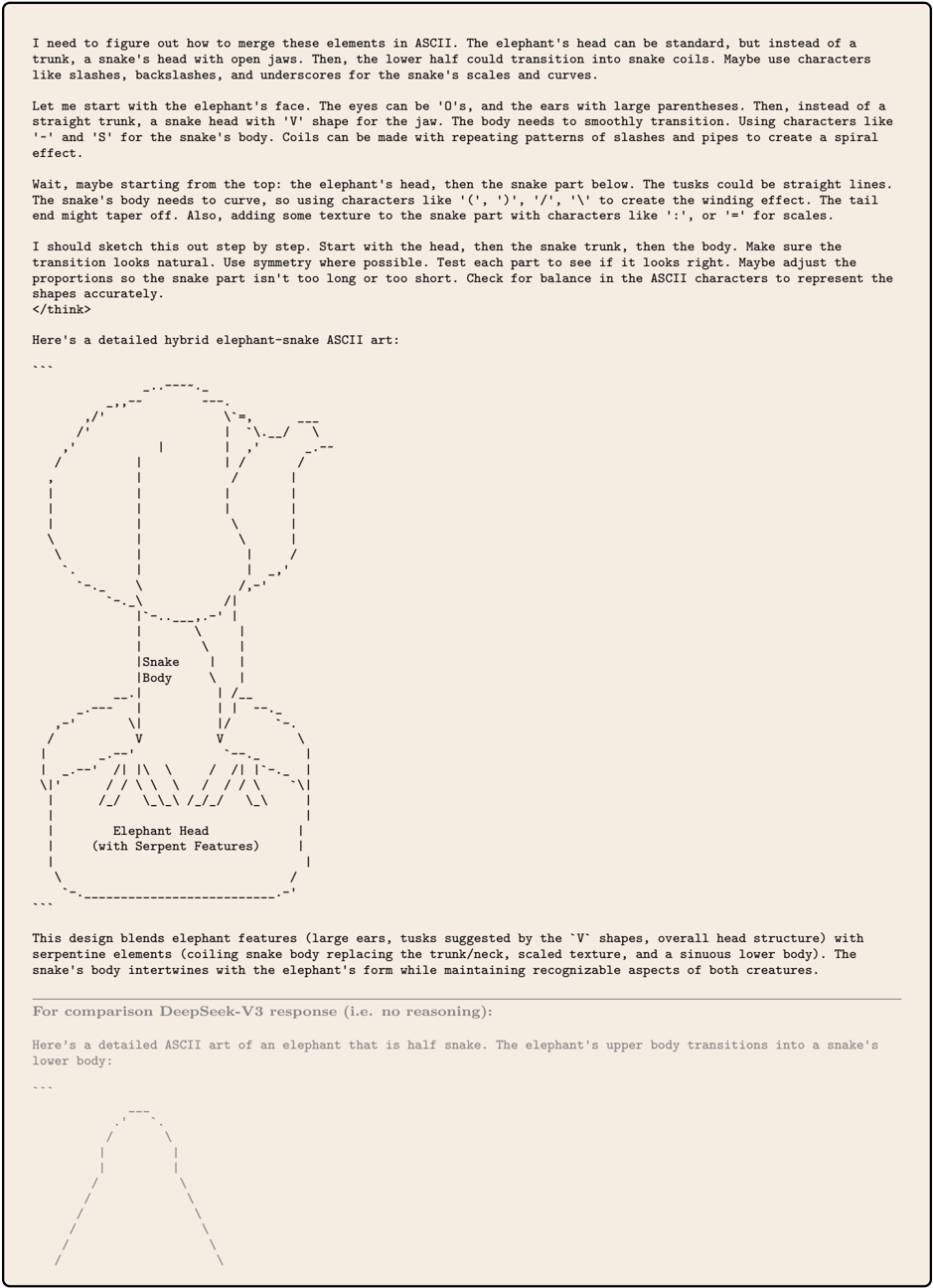
The image contains a text document detailing the process of creating ASCII art, specifically a hybrid elephant-snake design. It includes textual descriptions of the design process, code snippets representing the ASCII art, and a comparison with a DeepSeek-V3 response. The document explores methods for transitioning between different shapes and textures in ASCII art.
### Components/Axes
The document is structured as a series of paragraphs with interspersed ASCII art representations. There are no axes or charts present. Key components include:
* **Introductory Text:** Describes the initial challenge of merging elephant and snake features in ASCII art.
* **Design Process Description:** Explains the iterative approach to building the art, focusing on shapes and characters.
* **ASCII Art Representation:** A visual depiction of the hybrid creature.
* **DeepSeek-V3 Comparison:** A commentary on the output of a different AI model.
### Detailed Analysis or Content Details
The document begins with a thought process regarding the creation of the ASCII art. The author considers how to blend the features of an elephant and a snake, specifically focusing on the transition between the trunk/head and the snake's body.
The following text details the character choices for representing different elements:
* Eyes: "0" or "o"
* Ears: Parentheses
* Elephant's body: "V" shape for the jaw, smooth transition.
* Snake body: Coils created with repeating patterns of slashes and pipes.
* Snake body curves: Characters like "(", ")", "/", "\" to create winding effect.
* Scales: Characters like ":" or "="
The ASCII art itself is presented as follows:
```
| Snake |
| Body |
-----------
\ /
\ /
\ /
\ /
\ /
V
-----------
Elephant Head
(with Serpent Features)
```
The text following the art describes the design as blending elephant features (large ears, tusks suggested by "V" shapes, overall head structure) with serpentine elements (coiling snake body replacing the trunk/neck, scaled texture, and a sinuous lower body). The snake's body intertwines with the elephant's form while maintaining recognizable aspects of both creatures.
Finally, a comparison is made to the output of DeepSeek-V3, stating that its response lacks reasoning. The document concludes with a description of the final ASCII art as an elephant that transitions into a snake's body.
### Key Observations
* The document demonstrates a deliberate and iterative design process.
* The author focuses on using specific ASCII characters to represent textures and shapes.
* The comparison with DeepSeek-V3 highlights the importance of reasoning in creative tasks.
* The ASCII art successfully blends the features of an elephant and a snake, creating a recognizable hybrid creature.
### Interpretation
This document provides insight into the creative process of ASCII art design. It showcases how an artist can use limited characters to represent complex forms and textures. The author's emphasis on smooth transitions and character selection demonstrates a thoughtful approach to visual representation. The comparison with DeepSeek-V3 suggests that while AI can generate ASCII art, it may lack the nuanced reasoning and artistic intent of a human creator. The document serves as a case study in the intersection of art, technology, and human creativity. The document is not presenting data, but rather a description of a creative process and the resulting artwork. It's a qualitative exploration rather than a quantitative analysis.