## Mathematical Problem and Solution Guidance
### Overview
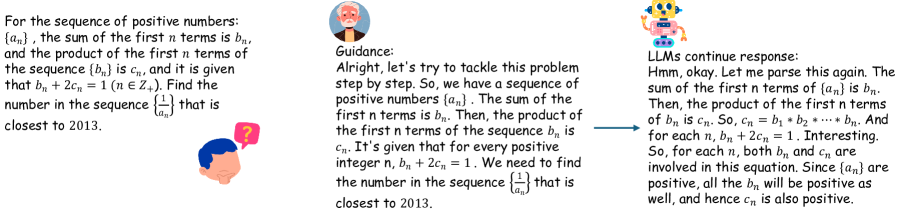
The image presents a mathematical problem involving sequences of positive numbers and their sums and products. It then shows a step-by-step guidance approach to tackle the problem, followed by a response from a Large Language Model (LLM) parsing the problem and outlining initial observations.
### Components/Axes
The image is divided into three sections:
1. **Problem Statement:** Defines the sequences and the relationship between them.
2. **Guidance:** Provides a step-by-step approach to solving the problem.
3. **LLM Response:** Shows the LLM's initial understanding and parsing of the problem.
### Detailed Analysis or ### Content Details
**1. Problem Statement (Left)**
* **Text:**
"For the sequence of positive numbers: {a\_n}, the sum of the first n terms is b\_n, and the product of the first n terms of the sequence {b\_n} is c\_n, and it is given that b\_n + 2c\_n = 1 (n ∈ Z+). Find the number in the sequence {1/a\_n} that is closest to 2013."
* **Variables:**
* {a\_n}: Sequence of positive numbers
* b\_n: Sum of the first n terms of {a\_n}
* c\_n: Product of the first n terms of {b\_n}
* **Equation:** b\_n + 2c\_n = 1, where n is a positive integer.
* **Goal:** Find the number in the sequence {1/a\_n} that is closest to 2013.
**2. Guidance (Center)**
* **Text:**
"Guidance: Alright, let's try to tackle this problem step by step. So, we have a sequence of positive numbers {a\_n}. The sum of the first n terms is b\_n. Then, the product of the first n terms of the sequence b\_n is c\_n. It's given that for every positive integer n, b\_n + 2c\_n = 1. We need to find the number in the sequence {1/a\_n} that is closest to 2013."
* **Content:** This section reiterates the problem statement and suggests a step-by-step approach.
**3. LLM Response (Right)**
* **Text:**
"LLMs continue response: Hmm, okay. Let me parse this again. The sum of the first n terms of {a\_n} is b\_n. Then, the product of the first n terms of b\_n is c\_n. So, c\_n = b\_1 \* b\_2 \* ... \* b\_n. And for each n, b\_n + 2c\_n = 1. Interesting. So, for each n, both b\_n and c\_n are involved in this equation. Since {a\_n} are positive, all the b\_n will be positive as well, and hence c\_n is also positive."
* **Content:**
* The LLM acknowledges the problem and restates the given information.
* It expresses c\_n as the product of b\_1, b\_2, ..., b\_n.
* It notes that since {a\_n} is positive, b\_n and c\_n are also positive.
### Key Observations
* The problem involves finding a specific term in a sequence derived from another sequence, given a relationship between their sums and products.
* The guidance section simply restates the problem.
* The LLM response begins to parse the problem and identify key relationships.
### Interpretation
The image presents a mathematical problem and the initial steps towards solving it. The problem involves sequences, sums, products, and a given equation. The LLM's response indicates an understanding of the problem and begins to break it down into smaller, more manageable parts. The LLM correctly identifies the relationships between the sequences and the implications of the positivity constraint. The next steps would likely involve manipulating the equation b\_n + 2c\_n = 1 and using the definitions of b\_n and c\_n to find an expression for a\_n, and then finding the term in the sequence {1/a\_n} closest to 2013.