## Diagram: Three-Round Interaction Prompt Template for Self-Refine
### Overview
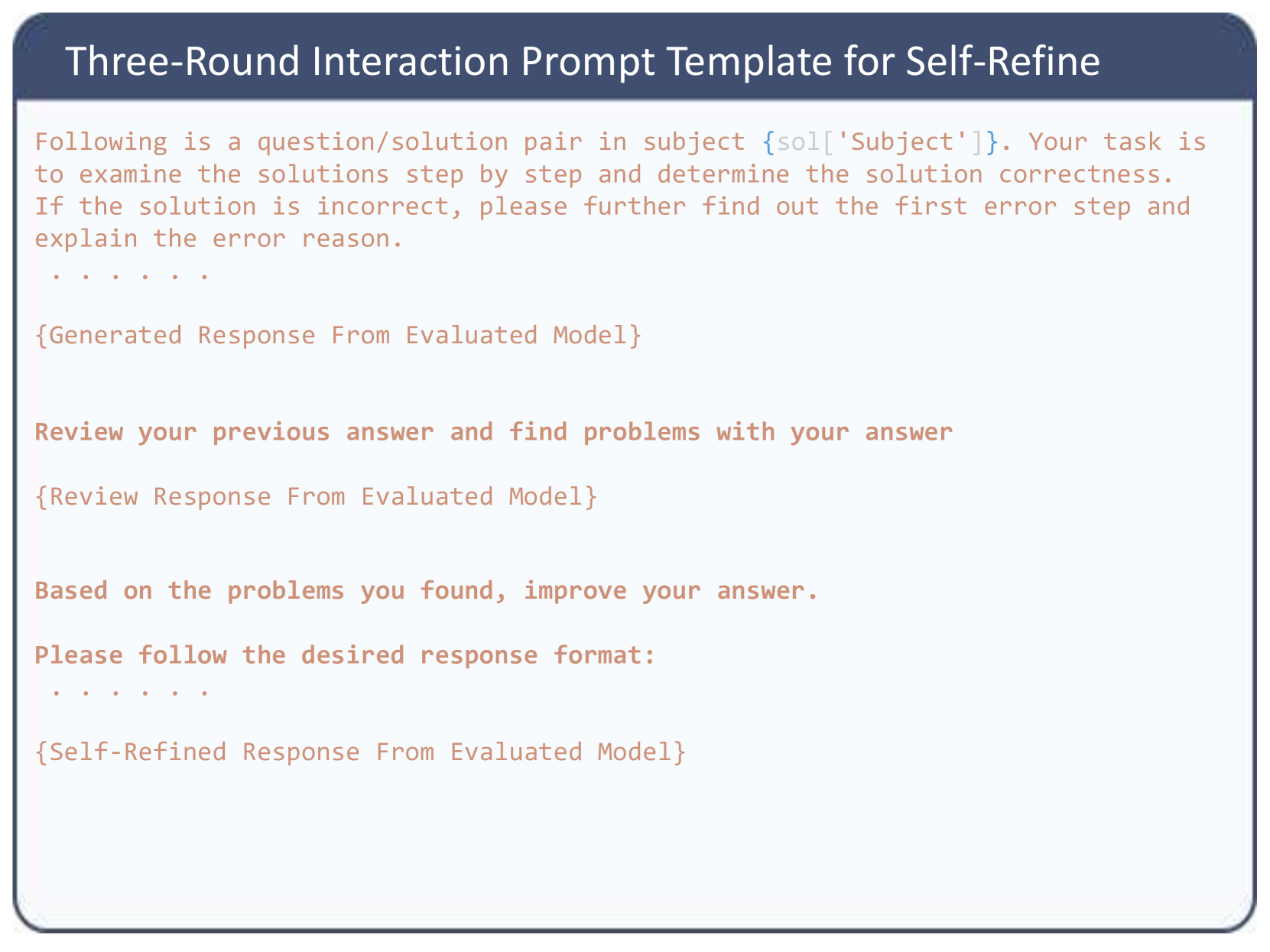
The image presents a template for a three-round interaction prompt designed for self-refinement. It outlines a process where a model generates a response, reviews it for errors, and then refines the answer based on the identified problems. The template includes placeholders for the subject of the question/solution pair and the model's responses at each stage.
### Components/Axes
The image contains the following components:
1. **Title:** "Three-Round Interaction Prompt Template for Self-Refine"
2. **Initial Prompt:**
* "Following is a question/solution pair in subject {sol['Subject']}. Your task is to examine the solutions step by step and determine the solution correctness. If the solution is incorrect, please further find out the first error step and explain the error reason."
3. **Placeholder 1:** "{Generated Response From Evaluated Model}"
4. **Review Prompt:** "Review your previous answer and find problems with your answer"
5. **Placeholder 2:** "{Review Response From Evaluated Model}"
6. **Refinement Prompt:** "Based on the problems you found, improve your answer."
7. **Instruction:** "Please follow the desired response format:"
8. **Placeholder 3:** "{Self-Refined Response From Evaluated Model}"
### Detailed Analysis
The template is structured as a sequence of prompts and response placeholders, designed to guide a model through a self-evaluation and refinement process.
* **Round 1:** The model receives an initial question/solution pair and generates a response.
* **Round 2:** The model reviews its previous answer, identifies problems, and provides a review response.
* **Round 3:** The model refines its answer based on the identified problems, generating a self-refined response.
The placeholders indicate where the model's responses should be inserted at each stage.
### Key Observations
The template emphasizes the importance of error detection and correction in the self-refinement process. It encourages the model to not only generate a solution but also to critically evaluate its own work and improve upon it.
### Interpretation
The template aims to improve the quality of model-generated responses by incorporating a self-evaluation loop. By prompting the model to identify and correct its own errors, the template encourages a more iterative and refined approach to problem-solving. The use of placeholders allows for easy integration with different models and subject areas. The template suggests a method for enhancing the accuracy and reliability of AI-generated content through self-critique and iterative refinement.