\n
## Document: Three-Round Interaction Prompt Template for Self-Refine
### Overview
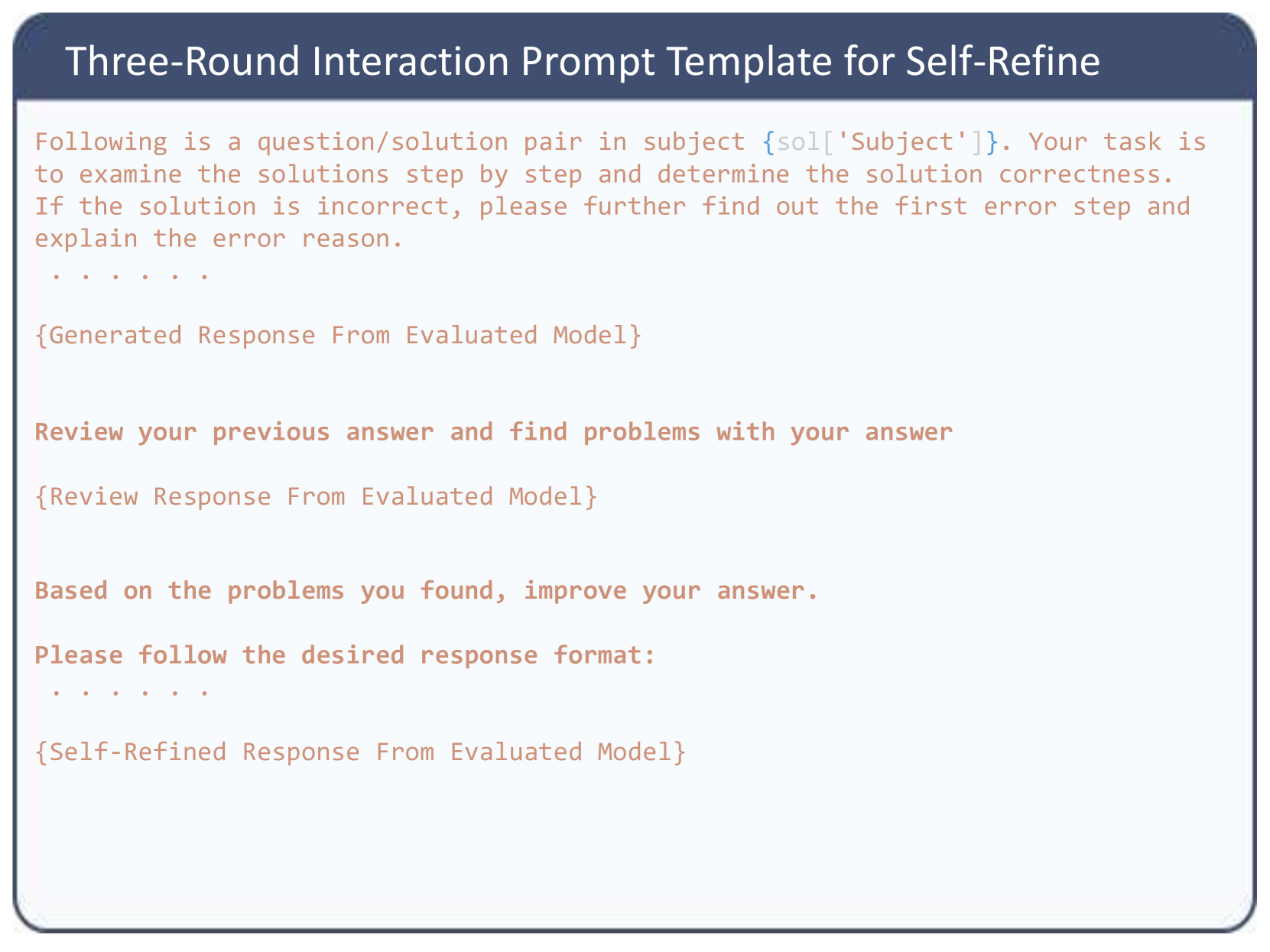
The image presents a document outlining a three-round interaction prompt template designed for self-refinement of a model's responses. It details a process for evaluating a generated solution, identifying errors, and iteratively improving the answer. The document is formatted as a series of instructions and placeholders for input/output from a model.
### Components/Axes
The document is structured into three main sections, each representing a round of interaction:
1. **Initial Prompt & Solution:** This section contains the initial question/solution pair.
* Text: "Following is a question/solution pair in subject {sol['Subject']}. Your task is to examine the solutions step by step and determine the solution correctness. If the solution is incorrect, please further find out the first error step and explain the error reason."
* Placeholder: "{sol['Subject']}"
* Placeholder: "{Generated Response From Evaluated Model}"
2. **Review & Problem Identification:** This section focuses on reviewing the previous answer and identifying problems.
* Text: "Review your previous answer and find problems with your answer"
* Placeholder: "{Review Response From Evaluated Model}"
3. **Refinement & Response:** This section details the process of improving the answer based on identified problems.
* Text: "Based on the problems you found, improve your answer. Please follow the desired response format:"
* Placeholder: "{Self-Refined Response From Evaluated Model}"
### Detailed Analysis or Content Details
The document provides a structured workflow for model self-evaluation and refinement. The core idea is to have the model critically assess its own output, pinpoint errors, and then generate a revised response. The use of placeholders suggests this is a template intended to be populated with specific questions, solutions, and review comments.
The document does not contain numerical data or charts. It is purely textual and procedural.
### Key Observations
The document emphasizes a step-by-step approach to error detection and correction. The inclusion of "error reason" in the initial prompt suggests a focus on understanding *why* a solution is incorrect, not just *that* it is incorrect. The template format implies a programmatic or automated process for self-refinement.
### Interpretation
This document outlines a methodology for improving the reliability and accuracy of language models. It moves beyond simple response generation to incorporate a critical self-assessment phase. The three-round structure allows for iterative refinement, potentially leading to more robust and correct solutions. The template format suggests this process could be integrated into a larger automated evaluation pipeline. The document is a meta-cognitive tool, designed to enable a model to think about its own thinking and improve its performance. It is a key component in building more trustworthy and reliable AI systems.