## Screenshot: Three-Round Interaction Prompt Template for Self-Refine
### Overview
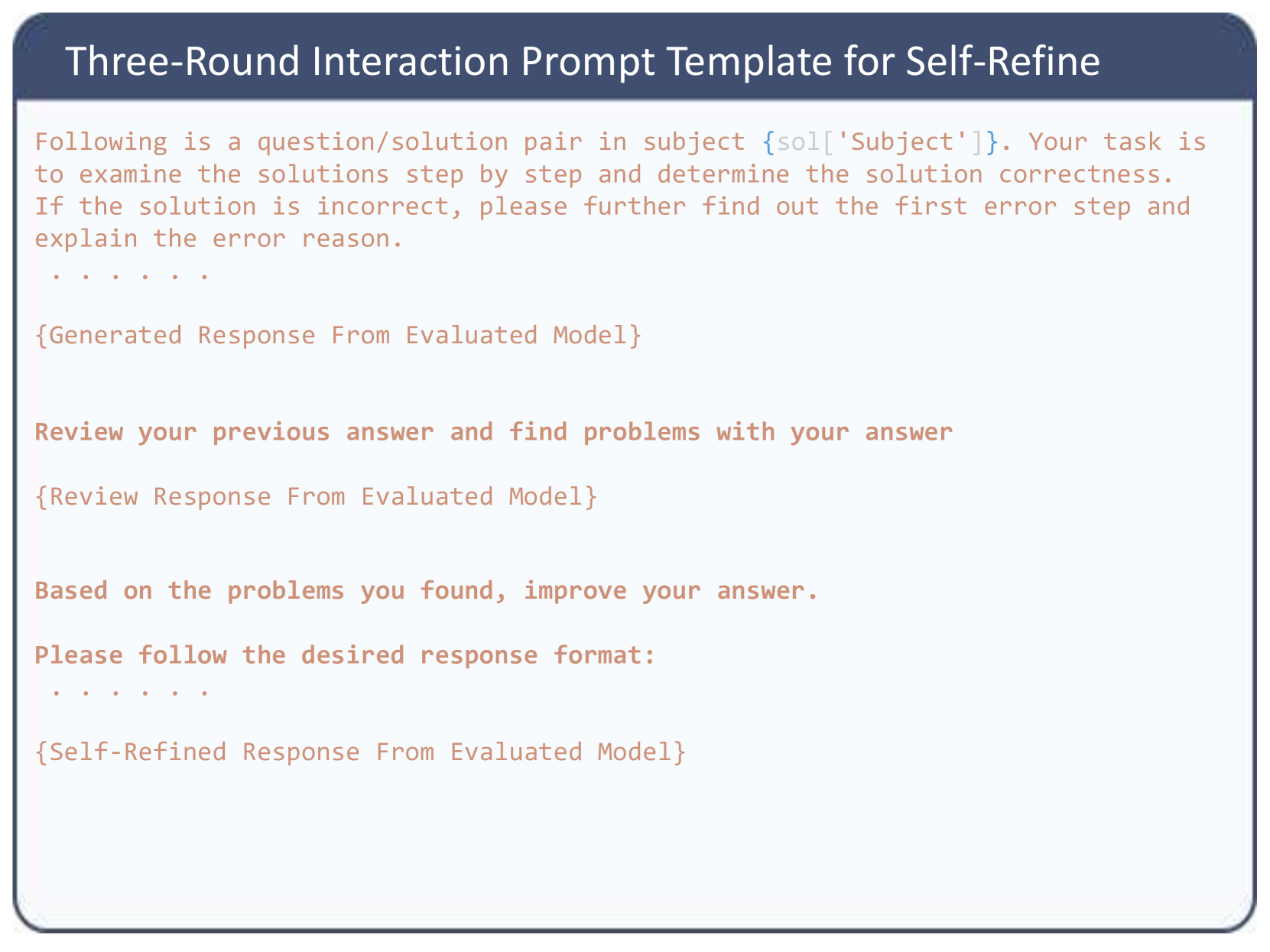
The image depicts a structured template for a three-step iterative process designed to refine responses through self-evaluation. The template uses a dark blue header, light gray background, and red text for instructions. Placeholders in curly braces ({...}) indicate where dynamic content (e.g., model responses) would be inserted.
### Components/Axes
- **Header**:
- Title: "Three-Round Interaction Prompt Template for Self-Refine" (white text on dark blue banner).
- **Main Content**:
- **Section 1**:
- Title: "Following is a question/solution pair in subject {sol['Subject']}." (red text).
- Instruction: Examine solutions step-by-step, determine correctness, and identify errors if present.
- Placeholder: `{Generated Response From Evaluated Model}` (repeated 5 times).
- **Section 2**:
- Title: "Review your previous answer and find problems with your answer" (red text).
- Placeholder: `{Review Response From Evaluated Model}` (repeated 5 times).
- **Section 3**:
- Title: "Based on the problems you found, improve your answer" (red text).
- Instruction: Follow the desired response format.
- Placeholder: `{Self-Refined Response From Evaluated Model}` (repeated 5 times).
### Detailed Analysis
- **Textual Structure**:
- The template follows a strict three-phase workflow:
1. **Initial Response Generation**: Evaluate a solution pair for correctness.
2. **Error Analysis**: Identify the first error step and explain the reason.
3. **Refinement**: Improve the answer based on identified issues.
- Placeholders are repeated 5 times in each section, likely to simulate iterative refinement cycles.
### Key Observations
- **Placeholder Repetition**: The repetition of placeholders (e.g., `{Generated Response From Evaluated Model}`) suggests a looped process for testing multiple iterations.
- **Color Coding**: Red text for instructions emphasizes critical steps, while placeholders use gray text to denote dynamic content.
- **No Numerical Data**: The template contains no charts, graphs, or numerical values—it is purely textual and procedural.
### Interpretation
This template outlines a systematic approach for self-refinement in technical or analytical tasks. By breaking the process into three rounds (evaluation → error analysis → refinement), it mimics human-like iterative reasoning. The use of placeholders allows integration with automated systems (e.g., AI models) to simulate feedback loops. The absence of numerical data indicates it is a procedural guide rather than a data-driven analysis tool.
**Note**: No additional languages or non-textual elements (e.g., icons, diagrams) are present in the image.