## Diagram: Reasoning Step Merge
### Overview
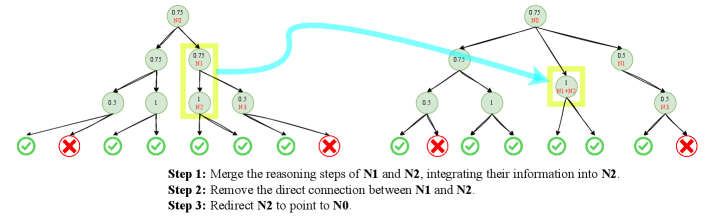
The image illustrates a process of merging reasoning steps from two nodes (N1 and N2) into another node (N2), involving the removal of a direct connection and redirection. The diagram consists of two tree-like structures, representing reasoning steps, with nodes labeled with numerical values and identifiers (N0, N1, N2, N3, NL, ND). The diagram shows the state before and after the merge.
### Components/Axes
* **Nodes:** Represented as green circles, each containing a numerical value (e.g., 0.75, 0.5, 1) and an identifier (e.g., N0, N1, N2).
* **Edges:** Represented as black lines, indicating the flow of reasoning or connections between nodes.
* **Checkmarks (Green):** Indicate a positive outcome or validation.
* **Crosses (Red):** Indicate a negative outcome or invalidation.
* **Highlight (Yellow):** Highlights the nodes N1 and N2 in the left tree and the merged node in the right tree.
* **Arrow (Light Blue):** Indicates the merging and redirection process.
* **Text Descriptions:**
* "Step 1: Merge the reasoning steps of N1 and N2, integrating their information into N2."
* "Step 2: Remove the direct connection between N1 and N2."
* "Step 3: Redirect N2 to point to N0."
### Detailed Analysis
**Left Tree (Before Merge):**
* **Root Node:** Labeled "0.75 N0" at the top.
* **Second Level:** Two nodes branching from the root: "0.75" and a highlighted node "0.75 N1".
* **Third Level (from "0.75" node):** Two nodes: "0.5" and "1".
* **Third Level (from "0.75 N1" node):** Two nodes: highlighted "1 N2" and "0.5 N3".
* **Bottom Level (from "0.5" node):** A cross (red) and a checkmark (green).
* **Bottom Level (from "1" node):** Two checkmarks (green).
* **Bottom Level (from "1 N2" node):** Two checkmarks (green).
* **Bottom Level (from "0.5 N3" node):** A checkmark (green) and a cross (red).
**Right Tree (After Merge):**
* **Root Node:** Labeled "0.75 ND" at the top.
* **Second Level:** Two nodes branching from the root: "0.75" and a highlighted node "1 (N1+N2)".
* **Third Level (from "0.75" node):** Two nodes: "0.5" and "1".
* **Third Level (from "1 (N1+N2)" node):** Two nodes: "0.5 NL" and "0.5 N3".
* **Bottom Level (from "0.5" node):** A cross (red) and a checkmark (green).
* **Bottom Level (from "1" node):** Two checkmarks (green).
* **Bottom Level (from "0.5 NL" node):** Two checkmarks (green).
* **Bottom Level (from "0.5 N3" node):** A checkmark (green) and a cross (red).
**Arrow:**
* A light blue arrow originates near the highlighted "0.75 N1" node in the left tree and points towards the highlighted "1 (N1+N2)" node in the right tree, visually representing the merging process.
### Key Observations
* The diagram illustrates a transformation where the reasoning steps associated with nodes N1 and N2 are merged and integrated into a single node, represented as "(N1+N2)".
* The merging process involves removing the direct connection between N1 and N2 (implied by the absence of a direct link in the right tree) and redirecting the merged node to point to N0 (also implied by the structure).
* The numerical values associated with the nodes change during the merge. N1 has a value of 0.75 before the merge, and the merged node (N1+N2) has a value of 1 after the merge.
* The outcomes (checkmark/cross) at the bottom level of the trees remain consistent before and after the merge for corresponding branches.
### Interpretation
The diagram depicts a process of knowledge integration or reasoning consolidation. The merging of reasoning steps from N1 and N2 into a single node suggests an attempt to combine information or evidence from multiple sources to reach a more robust conclusion. The change in numerical value (from 0.75 to 1) could represent an increase in confidence or certainty after the integration of information. The checkmarks and crosses at the bottom level indicate the validity or invalidity of certain paths of reasoning, and their consistency before and after the merge suggests that the underlying logic is preserved during the transformation. The process aims to simplify the reasoning structure by consolidating related information into a single node, potentially improving efficiency or clarity.