# Technical Document Extraction: Binary Relationship Matrix
## 1. Image Overview
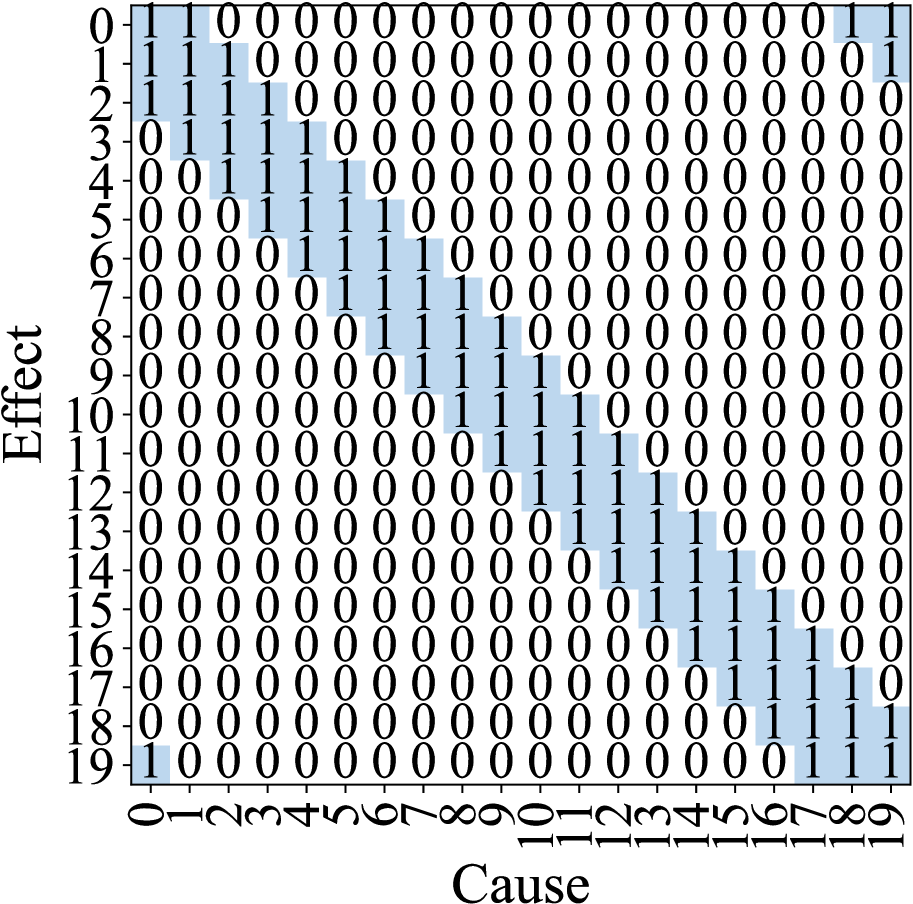
This image represents a $20 \times 20$ binary matrix (or heatmap) illustrating the relationship between "Cause" (x-axis) and "Effect" (y-axis). The matrix uses numerical values (0 and 1) and color coding (light blue for 1, white for 0) to denote the presence or absence of a relationship.
## 2. Component Isolation
### Header/Labels
- **Y-Axis Label:** "Effect" (oriented vertically on the left).
- **X-Axis Label:** "Cause" (oriented horizontally at the bottom).
### Axis Markers
- **Y-Axis (Effect):** Integers from **0 to 19**, ordered top-to-bottom.
- **X-Axis (Cause):** Integers from **0 to 19**, ordered left-to-right. Note: Labels 10 through 19 are rotated 90 degrees clockwise.
### Main Data Region
- A grid of $20 \times 20$ cells.
- **Value '1' (Light Blue Background):** Indicates an active relationship.
- **Value '0' (White Background):** Indicates no relationship.
---
## 3. Data Table Reconstruction
The following table represents the matrix. Rows correspond to **Effect** and columns correspond to **Cause**.
| Effect \ Cause | 0 | 1 | 2 | 3 | 4 | 5 | 6 | 7 | 8 | 9 | 10 | 11 | 12 | 13 | 14 | 15 | 16 | 17 | 18 | 19 |
| :--- | :---: | :---: | :---: | :---: | :---: | :---: | :---: | :---: | :---: | :---: | :---: | :---: | :---: | :---: | :---: | :---: | :---: | :---: | :---: | :---: |
| **0** | 1 | 1 | 0 | 0 | 0 | 0 | 0 | 0 | 0 | 0 | 0 | 0 | 0 | 0 | 0 | 0 | 0 | 0 | 1 | 1 |
| **1** | 1 | 1 | 1 | 0 | 0 | 0 | 0 | 0 | 0 | 0 | 0 | 0 | 0 | 0 | 0 | 0 | 0 | 0 | 0 | 1 |
| **2** | 1 | 1 | 1 | 1 | 0 | 0 | 0 | 0 | 0 | 0 | 0 | 0 | 0 | 0 | 0 | 0 | 0 | 0 | 0 | 0 |
| **3** | 0 | 1 | 1 | 1 | 1 | 0 | 0 | 0 | 0 | 0 | 0 | 0 | 0 | 0 | 0 | 0 | 0 | 0 | 0 | 0 |
| **4** | 0 | 0 | 1 | 1 | 1 | 1 | 0 | 0 | 0 | 0 | 0 | 0 | 0 | 0 | 0 | 0 | 0 | 0 | 0 | 0 |
| **5** | 0 | 0 | 0 | 1 | 1 | 1 | 1 | 0 | 0 | 0 | 0 | 0 | 0 | 0 | 0 | 0 | 0 | 0 | 0 | 0 |
| **6** | 0 | 0 | 0 | 0 | 1 | 1 | 1 | 1 | 0 | 0 | 0 | 0 | 0 | 0 | 0 | 0 | 0 | 0 | 0 | 0 |
| **7** | 0 | 0 | 0 | 0 | 0 | 1 | 1 | 1 | 1 | 0 | 0 | 0 | 0 | 0 | 0 | 0 | 0 | 0 | 0 | 0 |
| **8** | 0 | 0 | 0 | 0 | 0 | 0 | 1 | 1 | 1 | 1 | 0 | 0 | 0 | 0 | 0 | 0 | 0 | 0 | 0 | 0 |
| **9** | 0 | 0 | 0 | 0 | 0 | 0 | 0 | 1 | 1 | 1 | 1 | 0 | 0 | 0 | 0 | 0 | 0 | 0 | 0 | 0 |
| **10** | 0 | 0 | 0 | 0 | 0 | 0 | 0 | 0 | 1 | 1 | 1 | 1 | 0 | 0 | 0 | 0 | 0 | 0 | 0 | 0 |
| **11** | 0 | 0 | 0 | 0 | 0 | 0 | 0 | 0 | 0 | 1 | 1 | 1 | 1 | 0 | 0 | 0 | 0 | 0 | 0 | 0 |
| **12** | 0 | 0 | 0 | 0 | 0 | 0 | 0 | 0 | 0 | 0 | 1 | 1 | 1 | 1 | 0 | 0 | 0 | 0 | 0 | 0 |
| **13** | 0 | 0 | 0 | 0 | 0 | 0 | 0 | 0 | 0 | 0 | 0 | 1 | 1 | 1 | 1 | 0 | 0 | 0 | 0 | 0 |
| **14** | 0 | 0 | 0 | 0 | 0 | 0 | 0 | 0 | 0 | 0 | 0 | 0 | 1 | 1 | 1 | 1 | 0 | 0 | 0 | 0 |
| **15** | 0 | 0 | 0 | 0 | 0 | 0 | 0 | 0 | 0 | 0 | 0 | 0 | 0 | 1 | 1 | 1 | 1 | 0 | 0 | 0 |
| **16** | 0 | 0 | 0 | 0 | 0 | 0 | 0 | 0 | 0 | 0 | 0 | 0 | 0 | 0 | 1 | 1 | 1 | 1 | 0 | 0 |
| **17** | 0 | 0 | 0 | 0 | 0 | 0 | 0 | 0 | 0 | 0 | 0 | 0 | 0 | 0 | 0 | 1 | 1 | 1 | 1 | 0 |
| **18** | 0 | 0 | 0 | 0 | 0 | 0 | 0 | 0 | 0 | 0 | 0 | 0 | 0 | 0 | 0 | 0 | 1 | 1 | 1 | 1 |
| **19** | 1 | 0 | 0 | 0 | 0 | 0 | 0 | 0 | 0 | 0 | 0 | 0 | 0 | 0 | 0 | 0 | 0 | 1 | 1 | 1 |
---
## 4. Structural Analysis and Trends
### Banded Structure
The matrix exhibits a **circulant banded structure**. The value '1' (blue) forms a diagonal band that wraps around the edges of the matrix.
1. **Main Diagonal:** The central diagonal (where Cause = Effect) consists entirely of '1's.
2. **Band Width:** The band of '1's is 4 units wide. Specifically, for any Effect $i$, the Cause $j$ is '1' if $j \in \{i-1, i, i+1, i+2\} \pmod{20}$.
3. **Symmetry/Shift:** The pattern is a constant shift. As you move down one row (Effect), the block of four '1's shifts one column to the right (Cause).
4. **Boundary Wrapping (Cyclic Property):**
* At **Effect 0**, the '1's are at Cause 18, 19, 0, and 1.
* At **Effect 1**, the '1's are at Cause 19, 0, 1, and 2.
* At **Effect 18**, the '1's are at Cause 16, 17, 18, and 19.
* At **Effect 19**, the '1's are at Cause 17, 18, 19, and 0.
### Summary of Logic
This matrix represents a system where each "Effect" is influenced by its corresponding "Cause" index, the one preceding it, and the two following it in a modulo-20 circular array. This is characteristic of a **circulant matrix** often used in digital signal processing or periodic boundary condition simulations.